
Non-FictionInformativeEducational
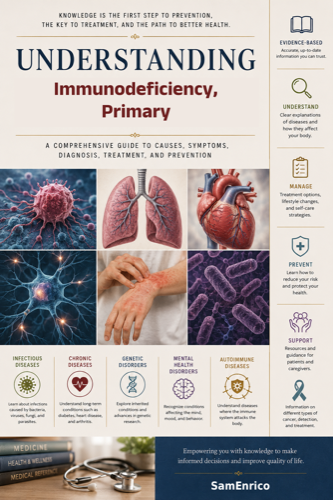
Understanding Immunodeficiency, Primary eBook
This disease publication, published by SamEnrico,
This disease publication, published by SamEnrico, covers Understanding Immunodeficiency, Primary
Formats
Free sample
Chapter 1: The Ten Warnings--–- The toddler’s mother knew something was wrong long before the doctors believed her. By the time Daniel was eighteen months old, he had already endured seven ear infections, two bouts of pneumonia, and a hospitalization for dehydration from a gastrointestinal virus that would have been mild in any other child. His pediatrician, a kind but overworked physician in a busy suburban practice, repeatedly assured her: “He’s in daycare. Kids get sick. He’ll outgrow it.” Daniel’s mother nodded, paid her copay, and drove home with a gnawing sense that “outgrow it” was not an adequate answer for a child whose weight had fallen from the 40th percentile to the 5th in eight months.She was not alone.
Across the country and around the world, thousands of parents sit in pediatric waiting rooms each year with the same unspoken question: When does normal childhood illness stop being normal? The boundary between the expected six to eight viral upper respiratory infections per year that every daycare child accumulates and the harbinger of a serious primary immunodeficiency (PID) is not marked by a flashing red light. It is subtle, often dismissed, and frequently missed until permanent damage—hearing loss, bronchiectasis, organ failure, or death—has already occurred.This chapter exists to mark that boundary. It will teach you, whether you are a medical student, a resident, a practicing clinician, or a parent fighting for answers, exactly when to stop reassuring and start investigating. You will learn the updated warning signs of PID, the concept of the “unusual infection,” and a practical screening protocol that can be completed with three blood tests and fifteen minutes of clinical reasoning.
The goal is not to turn every well-child visit into a search for rare disease. The goal is to ensure that when a child or adult with a true immunodeficiency walks through your door, you recognize them before the third pneumonia, before the sepsis, before the irreversible damage.The Spectrum of Normal To recognize the abnormal, one must first understand the boundaries of the normal. The healthy immune system is not a silent sentinel that never allows infection; it is a learning machine that requires exposure to pathogens to build memory and function. Children, particularly those in group care settings, are exposed to six to eight new viruses each year, primarily rhinovirus, respiratory syncytial virus, adenovirus, parainfluenza, and seasonal coronaviruses. These infections typically last three to seven days, resolve without antibiotics, and leave the child fully recovered between episodes.The key characteristics of normal childhood infections are threefold.
First, they are self-limited—the child gets sick, then gets better without medical intervention beyond supportive care. Second, they are separated by periods of complete wellness during which the child grows, develops, and gains weight appropriately. Third, they are caused by the common pathogens that circulate in the community, not by opportunistic organisms that take advantage of a weakened immune system.Infections in a healthy child do not lead to hospitalization, do not require intravenous antibiotics, do not cause failure to thrive, and do not leave permanent sequelae. When any of these boundaries are crossed, the clinician must step out of the “reassure and discharge” mindset and into the “investigate and refer” mindset.The Ten Warning Signs: An Updated Framework In the 1990s, the Jeffrey Modell Foundation, established by parents who lost a child to undiagnosed primary immunodeficiency, developed a list of ten warning signs to help clinicians identify patients who warranted immune evaluation. These signs have been updated multiple times as our understanding of PID has expanded.
The 2024 revision, presented here, reflects not only pediatric presentations but also the growing recognition that many PIDs present for the first time in adulthood.Warning Sign 1: Four or more new ear infections within one year.Otitis media is the most common childhood infection, but recurrent otitis media is not simply bad luck. A single ear infection is normal. Four in a twelve-month period, particularly if they are culture-proven or associated with tympanic membrane perforation, suggests an underlying defect in antibody production. The middle ear space is a protected environment; clearing bacteria from it requires functional antibodies. When antibodies are absent or deficient, the middle ear becomes a reservoir for encapsulated organisms like Streptococcus pneumoniae and Haemophilus influenzae.Warning Sign 2: Two or more serious sinus infections within one year.Sinusitis in young children is relatively uncommon because the sinuses are not fully developed.
When a preschooler presents with two or more episodes of radiographically confirmed sinusitis in a single year, or when an adult has chronic sinusitis that does not respond to appropriate antibiotic therapy, humoral immunodeficiency should be considered. The sinuses, like the middle ear, are mucosal surfaces that depend on secretory Ig A and systemic Ig G for protection.Warning Sign 3: Two or more months on antibiotics with little effect.The child who receives antibiotic after antibiotic without clearing infections is not simply unlucky or colonized with resistant organisms. In many cases, the antibiotics are working against the bacteria but the patient’s immune system cannot complete the job. The antibiotics reduce the bacterial load, but without functional antibodies or phagocytes, the infection rebounds as soon as the drug is stopped. This pattern—improvement on therapy followed by relapse off therapy—is a red flag for PID.Warning Sign 4: Two or more pneumonias within one year.Pneumonia in a healthy child is a relatively rare event.
Two pneumonias in twelve months, particularly if they are in different lobes or require hospitalization, demands immune evaluation. The lungs are the most common site of serious infection in antibody deficiencies because the lower respiratory tract depends on opsonizing antibodies to clear encapsulated bacteria. A single episode of pneumonia with a known risk factor (e.g., aspiration, asthma, anatomic abnormality) may be explained. Two episodes without such risk factors cannot be.Warning Sign 5: Failure of an infant to gain weight or grow normally.Growth is the most sensitive indicator of overall health in young children. An infant who falls off their growth curve—crossing percentiles downward—while simultaneously suffering from recurrent infections has a systemic problem that cannot be dismissed as “frequent daycare illnesses.” Failure to thrive in the setting of infections suggests a combined immunodeficiency, where the inability to clear viruses leads to chronic diarrhea, malabsorption, and protein loss.Warning Sign 6: Recurrent, deep skin or organ abscesses.Abscesses are not normal childhood events.
A superficial skin abscess from a bug bite or minor trauma in an otherwise healthy child may be a one-time occurrence. But recurrent abscesses, particularly deep abscesses of the liver, lung, or brain, or perianal abscesses that require surgical drainage, point directly to phagocyte defects. The neutrophils—the soldiers of the immune system—are responsible for walling off and killing bacteria that breach the skin or gut. When they fail, bacteria disseminate and form pockets of pus in deep tissues.Warning Sign 7: Persistent thrush or fungal infection after age one.Oral thrush is common in newborns and young infants whose immune systems are still maturing and whose oral microbiomes are still developing. It is also common after a course of antibiotics.
But thrush that persists beyond two weeks of antifungal therapy, or that appears in a child older than twelve months…
This is the end of the free sample. Get the eBook to keep going. Buy now
About this book
Details
- Author
- Keaton Stanton
- Publisher
- SamEnrico
- Language
- English
- Genre
- Non-Fiction, Informative, Educational
- Released
- 2026-06-02
- Pages (approx.)
- 149
- Available as
- eBook, Audiobook

Read better in the ZLOADR app
Your eBooks on your phone or tablet. Sign in with your SamEnrico account and start reading.
More by Keaton Stanton
 Treasure Finding Dream Symbols WorkbookKeaton Stanton$11.99
 Assertiveness Practice JournalKeaton Stanton$11.99
 OKRs for Philanthropy GoalsKeaton Stanton$11.99
 Cocaine Sleep Repair ProtocolKeaton Stanton$11.99
 Lawyers and Judges in Alcohol RecoveryKeaton Stanton$11.99
 The Visionary Streets of L’Enfant: Designing the American CapitalKeaton Stanton$11.99
 Stakeholder Silence BreakerKeaton Stanton$12.99
 Farm Revenue Optimization AIKeaton Stanton$12.99
 Universal BankerKeaton Stanton$11.99
 How to Start a Brine Production Business (Beginners Guide)Keaton Stanton$11.99
You may also like
 Hong Kong Handover 1997Dunn Johnnie$11.99
 Zumba For Postnatal Recovery CourseNeal Christian$11.99
 Zumba for BeginnersLadner Nikia$11.99
 YouTube Comment Mining GuideHumes Pandora$12.99
 Worry Box MeditationCarlin Rudy$11.99
 Workplace Stress MeditationNguyen Lynn$11.99
 Workplace Stress and Sleep RepairHawley Ivory$11.99
 Workplace Perfectionism CureDelaney Jeffry$11.99
 Workplace Injustice Anger GuideWallen Isabelle$11.99
 Work Addiction and Burnout LinkGreenwood Ester$11.99
 Women in Yoga and WellnessBeattie Galina$11.99
 Women in Stand Up ComedyChun Evangeline$11.99