
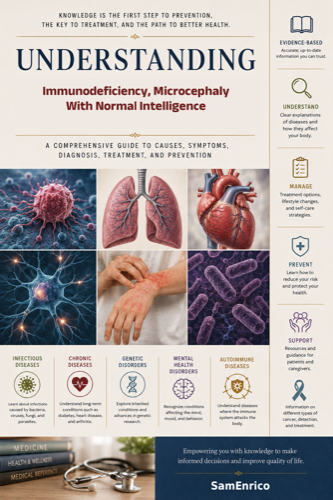
Non-FictionInformativeEducational
Understanding Immunodeficiency, Microcephaly With Normal Intelligence eBook
This disease publication, published by SamEnrico,
This disease publication, published by SamEnrico, covers Understanding Immunodeficiency, Microcephaly With Normal Intelligence
Formats
Free sample
Chapter 1: Beyond the Diagnosis...--The first time a doctor measures a newborn’s head circumference, it takes about three seconds. A plastic tape slides around the crown, just above the eyebrows and ears, and a number lands in a chart. For 97 of every 100 babies, that number fades into the background of routine well-child visits. For the other three, it becomes a verdict. Not a medical one—not yet—but a social one.
A whisper that spreads from the pediatrician’s office to the waiting room to the grandparents’ phone call: Her head is small. We need to watch it.No one ever says what they are watching for. Or rather, no one needs to. The word microcephaly carries its own gravity. In the public imagination, it is inseparable from images of severe disability, of children who never speak or walk or recognize their parents’ faces.
This association is not entirely unfair—many forms of microcephaly do involve devastating neurological impairment—but it is incomplete. And in the case of the specific condition this book describes, it is actively misleading.This book is about a small group of patients who fall into a medical blind spot: children born with both immunodeficiency (a dangerously weak immune system) and congenital microcephaly (a head circumference more than two standard deviations below average) who nevertheless develop normal intelligence. They learn to read. They tell jokes. They do math.
They make friends. They also get pneumonia three times before their second birthday, battle chronic diarrhea that no probiotic can fix, and spend more time in hospital infusion centers than on playgrounds. They are, in every sense, walking contradictions—and that contradiction is precisely why this book exists.The gap between what these children look like and what they are capable of is the central drama of their lives. A small head invites assumptions. A history of recurrent infections invites more assumptions.
A child who uses a walker or has cortical visual impairment invites even more. Put together, these three features—microcephaly, immunodeficiency, physical delays—create a gestalt that screams global disability to even the most careful clinician. And yet, again and again, parents report the same bewildering experience: their child tests in the average to above-average range on standardized cognitive assessments, reads fluently, holds complex conversations, and asks the kinds of questions that keep developmental pediatricians up at night.This chapter serves as the foundation for everything that follows. It defines the condition with precision, distinguishes it from the many other syndromes it is mistaken for, and introduces the central argument of this book: that the preservation of normal intelligence in the setting of microcephaly and immunodeficiency is not a miracle, not a fluke, and not a misdiagnosis. It is a biological phenomenon with a genetic explanation, a predictable clinical trajectory, and specific management implications.
Understanding that phenomenon requires abandoning several deeply held assumptions about the relationship between brain size and brain function—and embracing a more nuanced, hopeful, and scientifically grounded view of what the human brain can achieve.Defining the Condition: Three Pillars, One Paradox Before we can understand why this condition is so frequently misunderstood, we must define it with surgical precision. The syndrome discussed throughout this book rests on three diagnostic pillars, each of which must be present to qualify for the specific phenotype we are exploring.Pillar One: Congenital Microcephaly Microcephaly is defined clinically as an occipitofrontal circumference (head circumference) that falls more than two standard deviations below the age- and sex-matched population mean—typically below the third percentile. In severe cases, the measurement drops below three standard deviations, placing the patient in the less than first percentile. The key word here is congenital. The small head must be present at birth or emerge within the first few months of life as a static, non-progressive finding.
This distinguishes the condition from progressive microcephalies, in which a normal-sized head at birth later shrinks relative to growth curves due to neurodegeneration, metabolic disease, or acquired brain injury.In the population this book focuses on, the microcephaly is almost always congenital and stable. A child born with a head circumference at the second percentile will typically remain at the second percentile as they grow. Their head grows at a normal rate—just along a lower curve. This stability is the first clue that the underlying problem is not an active degenerative process but rather a developmental limitation: the brain was built smaller from the start, but it is not falling apart.Pillar Two: Combined Immunodeficiency The immune defect in these patients is not the complete absence of T cells seen in Severe Combined Immunodeficiency (SCID)—the so-called "bubble boy" disease—but rather a partial, variable, and often progressive impairment of both the cellular (T cell) and humoral (B cell) arms of the adaptive immune system. This pattern is called Combined Immunodeficiency (CID).
Patients typically have low but detectable T cell counts, reduced naïve T cells (cells that have not yet encountered an antigen, indicating a poorly functioning thymus), and poor specific antibody responses to vaccines and natural infections.The clinical consequences are predictable and severe. Recurrent sinopulmonary infections (otitis media, sinusitis, bronchitis, pneumonia) are nearly universal. Opportunistic infections—particularly Pneumocystis jirovecii pneumonia, which is almost never seen in immunocompetent children—occur at alarming rates. Chronic diarrhea, often from Clostridioides difficile or norovirus, leads to failure to thrive. And crucially, many of these patients also suffer from immune dysregulation: eczema that resists topical steroids, inflammatory bowel disease that mimics Crohn's, autoimmune cytopenias (low platelets, red cells, or white cells), and arthritis.
This combination of deficiency and dysregulation is a red flag that should immediately suggest a genetic syndrome rather than an acquired immune problem.Pillar Three: Normal Intelligence This is the pillar that creates the paradox. Normal in this context means an IQ score within one standard deviation of the population mean (typically 85–115) on a standardized, age-appropriate cognitive assessment. It also means age-appropriate adaptive functioning: the ability to dress oneself, hold conversations, follow instructions, and learn academic content at a typical pace.Importantly, normal intelligence does not mean typical development in all domains. Many patients in this population have significant motor delays (delayed sitting, crawling, walking), speech articulation difficulties (even when language comprehension is intact), cortical visual impairment (the eyes work but the brain struggles to process visual input), and febrile seizures triggered by their frequent infections. A child can need a walker and still read at grade level.
A child can have trouble pronouncing certain consonants and still understand calculus. The error—and it is an error made by clinicians and educators every day—is to assume that physical or motor delays inevitably signal cognitive delays.When all three pillars are present together, the diagnosis becomes specific. A child with microcephaly alone is a neurology patient. A child with immunodeficiency alone is an immunology patient. But a child with microcephaly and immunodeficiency and normal intelligence belongs to a vanishingly small intersection—one that most physicians will never see in their entire careers.
That rarity is precisely why misdiagnosis is the rule, not the exception.The Misdiagnosis Epidemic: What This Condition Is Not Before a child receives the correct diagnosis, they will almost certainly receive…
This is the end of the free sample. Get the eBook to keep going. Buy now
About this book
Details
- Author
- Schilling Lanita
- Publisher
- SamEnrico
- Language
- English
- Genre
- Non-Fiction, Informative, Educational
- Released
- 2026-05-11
- Pages (approx.)
- 160
- Available as
- eBook, Audiobook

Read better in the ZLOADR app
Your eBooks on your phone or tablet. Sign in with your SamEnrico account and start reading.
More by Schilling Lanita
 OKRs for Parent Child BondingSchilling Lanita$11.99
 Acceptance Sleep MeditationSchilling Lanita$11.99
 Deepshot Dialogue Replacement GuideSchilling Lanita$11.99
 ADHD Partner Self Esteem GuideSchilling Lanita$11.99
 The Recovery Gift A Gratitude PracticeSchilling Lanita$11.99
 The Silk Road's Forgotten Envoys: Spies, Merchants, and the Birth of Global DiplomacySchilling Lanita$11.99
 Aquaponics Systems GuideSchilling Lanita$12.99
 CEO Apology That WorksSchilling Lanita$12.99
 Unique Train TripsSchilling Lanita$11.99
 How to Start a Bridges Made In Dental Labs Business (Beginners Guide)Schilling Lanita$11.99
You may also like
 Hong Kong Handover 1997Dunn Johnnie$11.99
 Zumba For Postnatal Recovery CourseNeal Christian$11.99
 Zumba for BeginnersLadner Nikia$11.99
 YouTube Comment Mining GuideHumes Pandora$12.99
 Worry Box MeditationCarlin Rudy$11.99
 Workplace Stress MeditationNguyen Lynn$11.99
 Workplace Stress and Sleep RepairHawley Ivory$11.99
 Workplace Perfectionism CureDelaney Jeffry$11.99
 Workplace Injustice Anger GuideWallen Isabelle$11.99
 Work Addiction and Burnout LinkGreenwood Ester$11.99
 Women in Yoga and WellnessBeattie Galina$11.99
 Women in Stand Up ComedyChun Evangeline$11.99