
Non-FictionInformativeEducational
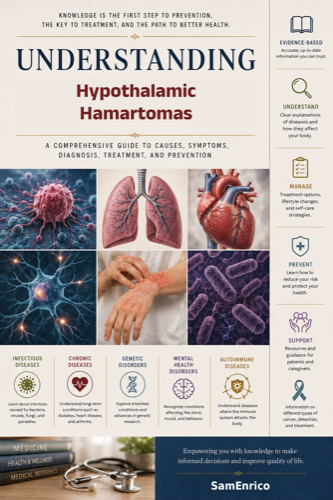
Understanding Hypothalamic Hamartomas eBook
This disease publication, published by SamEnrico,
by Roper Cleta
This disease publication, published by SamEnrico, covers Understanding Hypothalamic Hamartomas
Formats
Free sample
Chapter 1: Beyond the Tumor--The phone call comes on a Tuesday. You are at work, or making dinner, or sitting in a sterile hospital hallway on a chair that was designed for discomfort. The neurologist’s voice is careful, measured—the kind of careful that tells you something has shifted in the universe. She says the words: hypothalamic hamartoma. You hear tumor.
You stop breathing.Let us stop right there. Before you spiral into the abyss of chemotherapy, radiation, prognosis, and end-of-life planning, take a breath. You have just been given a diagnosis that sounds terrifying but means something entirely different from what your brain is screaming. A hypothalamic hamartoma is not cancer. It will never be cancer.
It does not grow, it does not invade, it does not spread to other parts of the brain or body. It is not malignant. It will never become malignant. The word you just heard—tumor—conjures images of uncontrolled cellular division, of masses that consume healthy tissue, of ticking clocks. That is not what lives inside your child’s brain.What lives there is a congenital malformation.
A collection of normal neurons and normal glial cells that formed in the wrong location during the earliest weeks of fetal development. Think of it as a tiny cluster of perfectly good brain cells that took a wrong turn during construction. They are not abnormal cells. They are normal cells in an abnormal place. And because they are normal, they do not multiply out of control.
They do not mutate. They simply sit there, embedded in or attached to the hypothalamus, causing trouble not because they are aggressive but because they are disruptive. Like a single misplaced book on a tightly packed shelf—it does not destroy the shelf, but it prevents every other book from sitting correctly.This chapter exists to do one thing: rescue you from the terror of the word tumor and replace it with an accurate, actionable understanding of what hypothalamic hamartomas actually are. By the time you finish reading, you will know the epidemiology, the history of how medicine came to understand this condition, the paradigm shift from hopelessness to curative treatment, and—most importantly—why a diagnosis that once meant a lifetime of suffering now comes with genuine hope.The Thing That Is Not Cancer Let us be absolutely precise about the pathology. A hypothalamic hamartoma is a benign, non-progressive, congenital lesion composed of neurons and glial cells that are histologically normal.
That last word is the most important: normal. Under a microscope, these cells look exactly like healthy hypothalamic neurons. They have the same shape, the same staining properties, the same intracellular machinery. The only thing wrong with them is their address.The term hamartoma comes from the Greek word hamartia, meaning “error” or “fault.” In medical usage, a hamartoma is a benign, tumor-like malformation made up of tissues normally found in the organ where it occurs. Other hamartomas exist throughout the body—lung hamartomas, liver hamartomas, breast hamartomas.
None of them are cancerous. None of them become cancerous. The hypothalamic hamartoma is simply the neurological version of this same phenomenon.This matters more than any other fact in this book because the word tumor has been weaponized by popular culture. We have been trained by movies, television, and heartbreaking fundraising campaigns to associate tumor with suffering, with chemoport catheters and hair loss, with the race against metastasis. That emotional cascade is entirely inappropriate for hypothalamic hamartomas.
When a radiologist sees an HH on an MRI, they do not call oncology. They do not order a biopsy. They do not discuss staging or grading. They call neurology or epilepsy surgery. The treatment pathway is not chemotherapy or radiation.
It is—when indicated—surgical disconnection or ablation, not because the HH is dangerous in the way cancer is dangerous, but because it is causing seizures that damage the developing brain.One parent who read an early draft of this book wrote in the margins: “Why didn’t anyone tell me this on the day of diagnosis? I spent three weeks planning my child’s funeral before I found a Facebook group that explained it.” That is not an exaggeration. That is the standard experience. And it is why this chapter exists.How Rare Is Rare? The Epidemiology of HHYou will hear the word rare so often that it begins to feel like a cage.
Rare means doctors do not know about it. Rare means you cannot find local expertise. Rare means you will spend years explaining the condition to specialists who should already understand it. But rare also means something else: it means the medical establishment has historically underfunded research, which means you must become your own expert.The true incidence of hypothalamic hamartomas is unknown. The best estimates come from combined data from epilepsy surgery centers, pediatric neurology registries, and autopsy studies.
The number most frequently cited is approximately 1 in 200,000 to 1 in 1 million live births. But that range is suspiciously wide, and for good reason. Many HHs cause no symptoms at all. An asymptomatic HH—one that does not produce seizures, does not cause precocious puberty, and does not create behavioral disturbances—may never be discovered. It simply exists quietly in the brain, found decades later if the person happens to have an MRI for an unrelated reason.
How many such people are walking around right now? No one knows.What we do know is the number of symptomatic HHs diagnosed each year is far smaller than the number that exist. One international registry study estimated that for every diagnosed child with gelastic seizures from an HH, there are likely three to five undiagnosed children whose laughing spells have been dismissed as behavioral or gastrointestinal. The average delay from first seizure to correct diagnosis is six to eight years. During those years, the HH continues to generate seizures, and those seizures continue to damage the developing brain.
The rarity of diagnosis is not the same as the rarity of the condition. It is a failure of medical recognition.There is no known genetic or familial pattern for the vast majority of HHs. They are sporadic. They are not inherited. If you have one child with an HH, the chance of a second child having an HH is no higher than the background population risk.
There are rare genetic syndromes—Pallister-Hall syndrome, for example—in which HHs appear as part of a broader constellation of midline brain malformations. But in those cases, the HH is one feature among many, and the syndromic diagnosis is usually apparent from other physical findings. For the vast majority of families reading this book, the HH appeared for no identifiable reason. There is nothing you did or did not do during pregnancy. There is nothing you could have prevented.
It is a developmental error, not a punishment.A Brief History of Misunderstanding To understand where we are now, you must understand where we have been. The history of hypothalamic hamartomas is a history of medical blindness—decades of seeing but not seeing, of dismissing symptoms as behavioral, of telling parents that nothing could be done.The Autopsy Era (1950s–1970s): In the mid-twentieth century, hypothalamic hamartomas were curiosities found…
This is the end of the free sample. Get the eBook to keep going. Buy now
About this book
Details
- Author
- Roper Cleta
- Publisher
- SamEnrico
- Language
- English
- Genre
- Non-Fiction, Informative, Educational
- Released
- 2026-05-25
- Pages (approx.)
- 150
- Available as
- eBook, Audiobook

Read better in the ZLOADR app
Your eBooks on your phone or tablet. Sign in with your SamEnrico account and start reading.
More by Roper Cleta
 Portuguese Golden Visa Green RouteRoper Cleta$11.99
 LinkedIn Endorsement EnvyRoper Cleta$11.99LinkedIn Endorsement EnvyRoper Cleta$11.99
 Survey Email AutomationRoper Cleta$11.99
 People Pleasing In Love GuideRoper Cleta$11.99
 The Boy Who Tamed the Sky: The Untold Story of the First Black Aviator to Cross the AtlanticRoper Cleta$11.99
 Gawain’s Shadow: The Knight Who Walked with the Green ManRoper Cleta$11.99
 Gifts OutfitterRoper Cleta$11.99
 Landlord Tenant Mediation HandbookRoper Cleta$12.99
 Speech Recognition Language LearningRoper Cleta$12.99
 How to Start a Hobby in Musical composition and MIDI compositionRoper Cleta$11.99
You may also like
 Hong Kong Handover 1997Dunn Johnnie$11.99
 Zumba For Postnatal Recovery CourseNeal Christian$11.99
 Zumba for BeginnersLadner Nikia$11.99
 YouTube Comment Mining GuideHumes Pandora$12.99
 Worry Box MeditationCarlin Rudy$11.99
 Workplace Stress MeditationNguyen Lynn$11.99
 Workplace Stress and Sleep RepairHawley Ivory$11.99
 Workplace Perfectionism CureDelaney Jeffry$11.99
 Workplace Injustice Anger GuideWallen Isabelle$11.99
 Work Addiction and Burnout LinkGreenwood Ester$11.99
 Women in Yoga and WellnessBeattie Galina$11.99
 Women in Stand Up ComedyChun Evangeline$11.99