
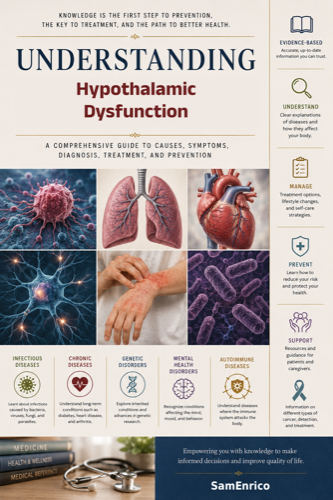
Understanding Hypothalamic Dysfunction eBook
This disease publication, published by SamEnrico,
This disease publication, published by SamEnrico, covers Understanding Hypothalamic Dysfunction
Formats
Free sample
Chapter 1: The Silent Conductor--–- Deep within the human brain, no larger than an almond and weighing less than a sugar cube, resides a structure that orchestrates every waking and sleeping moment of your life. It governs when you feel hungry and when you feel full. It decides when you fall asleep and when you wake. It sets your body’s internal thermostat, regulates your thirst, and dictates the release of hormones that control growth, stress response, reproduction, and even bonding between parent and child. This structure is the hypothalamus, and despite its profound influence over human physiology and behavior, it remains one of the least understood and most overlooked organs in modern medicine.
The average physician can name a dozen drugs that lower blood pressure but cannot name the four major nuclei of the hypothalamus. The average patient has heard of the thyroid, the pituitary, and the adrenal glands, yet has never encountered the tiny region of brain that commands them all.This book exists to change that. Understanding Hypothalamic Dysfunction is the first comprehensive, clinician-focused yet patient-accessible guide to the disorders that arise when this silent conductor loses its baton. Whether you are a physician encountering a patient with unexplained obesity, rapid temperature swings, and hormone deficiencies that do not fit classical patterns; a resident preparing for board examinations; a medical student discovering neuroendocrinology for the first time; or a patient or family member struggling to make sense of a diagnosis that seems to touch every system of the body—this book is for you.The hypothalamus has been called many things in the medical literature: the master regulator, the homeostatic thermostat, the brain’s control center. But perhaps the most accurate description is also the simplest: the hypothalamus is the conductor of the human orchestra.
It does not play every instrument itself. It does not produce every hormone, contract every muscle, or generate every thought. Instead, it stands at the front of the ensemble, baton raised, ensuring that the thyroid plays at the right tempo, the adrenal glands enter at the correct moment, the reproductive system rests when appropriate, the autonomic nervous system responds to danger, and the sleep-wake cycle maintains its rhythmic precision. When the conductor is skilled and healthy, the orchestra produces beautiful music—homeostasis. When the conductor falls ill, becomes injured, or is silenced, the result is not silence but chaos.
Instruments play out of turn. Hormones are released inappropriately. Temperature fluctuates wildly. Weight spirals upward despite starvation diets. Sleep fragments into a thousand restless hours.This chapter introduces the hypothalamus as that silent conductor.
We will explore its evolutionary history, its fundamental role in homeostasis, its position at the crossroads of endocrinology, neurology, and psychiatry, and the macroscopic divisions that organize its diverse functions. By the end of this chapter, you will understand why damage to this tiny almond of brain tissue produces some of the most challenging, multisystem, and devastating disorders known to medicine—and why a multidisciplinary approach is not optional but essential for patient care.A Brief History of a Forgotten Master The story of hypothalamic discovery is a story of medical blind spots. For centuries, physicians and anatomists focused their attention on structures they could see and measure: the heart, the lungs, the liver, the kidneys. The brain, when studied at all, was examined through the lens of phrenology or crude dissection. The hypothalamus, buried deep beneath the cerebral hemispheres and hidden behind the optic chiasm, remained largely invisible.The first written descriptions of the region now known as the hypothalamus appeared in the 18th century, when Swiss anatomist Johann Christian Reil identified a gray matter structure ventral to the thalamus.
He called it simply "the substance below the thalamus"—a descriptive name that stuck. For the next century, the hypothalamus was treated as anatomical wallpaper, a region of no particular importance connecting more interesting structures.That changed in the early 20th century, when physiologists began conducting lesion studies in animals. In the 1920s and 1930s, Swiss researcher Walter Rudolf Hess inserted fine electrodes into the brains of cats and discovered that stimulating different hypothalamic regions produced predictable behavioral and autonomic responses. Stimulation of the lateral hypothalamus caused hunger and feeding, even in recently fed animals. Stimulation of the ventromedial region caused cessation of feeding and signs of satiety.
Stimulation of the posterior hypothalamus produced alarm responses—pupil dilation, increased heart rate, piloerection. Stimulation of the anterior hypothalamus caused parasympathetic responses: slowed heart rate, pupil constriction, and gastrointestinal activity. Hess received the Nobel Prize in Physiology or Medicine in 1949 for mapping what he called the "visceral brain"—the hypothalamic control of internal organs.Simultaneously, neuroendocrinologist Geoffrey Harris at Oxford University was revolutionizing our understanding of how the brain controls the pituitary gland. Harris proposed the radical hypothesis that the hypothalamus secretes chemical factors into a specialized blood vessel system—the hypophyseal portal system—to regulate the anterior pituitary. At the time, most scientists believed that the pituitary was autonomous or controlled by nerves.
Harris was ridiculed for years before his hypothesis was proven correct. The discovery of hypothalamic releasing hormones (TRH, CRH, Gn RH, GHRH) and inhibiting hormones (dopamine, somatostatin) in the 1960s and 1970s, led by Roger Guillemin and Andrew Schally, earned another Nobel Prize and established the field of neuroendocrinology.Today, we understand that the hypothalamus is not merely a regulator but the regulator. It integrates signals from virtually every system of the body—circulating hormones, blood glucose, temperature, osmolarity, inflammatory cytokines, and psychological stress—and generates coordinated outputs that maintain internal stability. This chapter begins the journey of understanding how it does so, and what happens when it fails.The Concept of Homeostasis: The Hypothalamus Central Mission To understand the hypothalamus, one must first understand the concept of homeostasis. Coined by Walter Cannon in 1926, homeostasis refers to the maintenance of a stable internal environment despite external fluctuations.
The human body must maintain blood glucose within a narrow range, core temperature near 37°C (98.6°F), blood p H between 7.35 and 7.45, fluid balance precise to the milliliter, and countless other variables within tight tolerances. The hypothalamus is the master coordinator of this process.Consider a simple example: body temperature. When you step outside on a cold winter day, thermoreceptors in your skin send signals to the posterior hypothalamus. The hypothalamus responds by activating heat-conservation mechanisms: vasoconstriction of peripheral blood vessels (reducing heat loss), piloerection (trapping a layer of warm air against the skin—goosebumps in humans), and shivering (generating heat through muscle activity). When you develop a fever from an infection, the hypothalamus raises its set point in response to pyrogens (fever-inducing molecules) such as interleukin-1 and tumor necrosis factor.
Now your body perceives 37°C as cold, triggering shivering and heat-seeking behavior even though your temperature is elevated. When the infection resolves, the set point normalizes, and the hypothalamus activates heat-loss mechanisms: vasodilation and sweating.The same principle applies to thirst, hunger, sleep, stress responses, and reproduction. The hypothalamus receives continuous input from sensors throughout the body, compares that input to genetically programmed set points, and generates outputs that push physiological variables back toward those set points. This is not a simple reflex arc. The hypothalamus integrates multiple, often competing…
This is the end of the free sample. Get the eBook to keep going. Buy now
About this book
Details
- Author
- Polanco Ofelia
- Publisher
- SamEnrico
- Language
- English
- Genre
- Non-Fiction, Informative, Educational
- Released
- 2026-06-02
- Pages (approx.)
- 157
- Available as
- eBook, Audiobook

Read better in the ZLOADR app
Your eBooks on your phone or tablet. Sign in with your SamEnrico account and start reading.
More by Polanco Ofelia
 Flying Dream Interpretation CoursePolanco Ofelia$11.99
 Austrian Klimaaktiv ProgramPolanco Ofelia$11.99
 Post Purchase Email FlowsPolanco Ofelia$11.99
 Self Esteem After InfidelityPolanco Ofelia$11.99
 The Timbuktu Manuscripts: Africa's Hidden Treasure of KnowledgePolanco Ofelia$11.99
 The Last Whisper: How Ancient Sheep Herders Predicted Climate CollapsePolanco Ofelia$11.99
 Ultimate Handbook Guide to Tyumen : (Russia) Travel GuidePolanco Ofelia$11.99
 AI Tutor Chatbots GuidePolanco Ofelia$12.99
 Sublease And Assignment PrimerPolanco Ofelia$12.99
 Ghost HunterPolanco Ofelia$11.99