
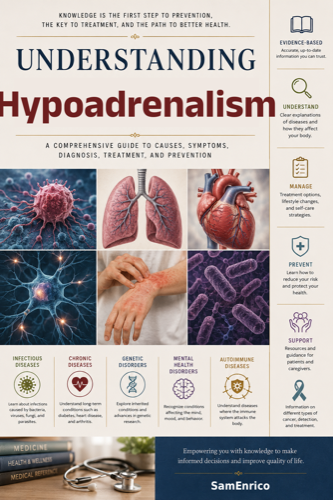
Understanding Hypoadrenalism
This disease publication, published by SamEnrico,
This disease publication, published by SamEnrico, covers Understanding Hypoadrenalism
Formats
About this book
Free sample
Chapter 1: The Great Imitator...--The email arrived at 11:47 on a Tuesday. Sarah, a 34-year-old graphic designer, had written to her doctor’s office for the fourth time. Her message read: “I know you said my labs are normal. But I can’t stay awake past 2 PM. I’m dizzy every time I stand up.
And I’ve started eating pickles straight from the jar at 10 AM. Please. Something is wrong.”She had been told it was stress. Then postpartum depression (her youngest was three). Then “probably fibromyalgia.” Then “just busy life with two kids.” One physician kindly suggested she try yoga.
Another recommended an antidepressant, which made her dizziness worse. A third, frustrated by her persistence, told her she had “health anxiety.”Sarah did not have health anxiety. She had hypoadrenalism. Specifically, she had autoimmune Addison’s disease, a form of primary adrenal insufficiency that had been quietly destroying her adrenal glands for nearly seven years before anyone thought to run an ACTH stimulation test.Her story is not rare. It is, in fact, the rule.The Epidemic That Isn’t Rare but Is Rarely Recognized Hypoadrenalism—the medical term for adrenal insufficiency—affects approximately 1 in 10,000 to 1 in 20,000 people in its primary form (Addison’s disease).
Secondary and tertiary forms add perhaps another 2 to 3 per 10,000. By the numbers, this seems like a rare disease. The National Institutes of Health classifies it as such.But rarity is not the same as obscurity. The problem with hypoadrenalism is not that it doesn’t exist. The problem is that it is the great imitator—a condition whose symptoms overlap so completely with far more common diagnoses that most physicians never consider it until a patient is literally in crisis.Consider the symptom list of untreated adrenal insufficiency:Fatigue (nearly universal)Weakness Dizziness upon standing (orthostatic hypotension)Nausea, sometimes with vomiting Abdominal pain Diarrhea or constipation Unintentional weight loss Muscle and joint pain Irritability and depression Difficulty concentrating (“brain fog”)Salt cravings Low blood pressure In some cases, hyperpigmentation (darkening of the skin)Every single one of these symptoms can be explained by something else.…
This is the end of the free sample. Get the eBook to keep going. Buy now
Contents
- Chapter 1
- Chapter 2
- Chapter 3
- Chapter 4
- Chapter 5
- Chapter 6
- Chapter 7
- Chapter 8
- Chapter 9
- Chapter 10
- Chapter 11
- Chapter 12
Details
- Author
- Bernstein Jenette
- Publisher
- SamEnrico
- Language
- English
- Genre
- Non-Fiction, Informative, Educational
- Released
- 2026-05-11
- Pages (approx.)
- 145
- Available as
- eBook, Audiobook

Read better in the ZLOADR app
Your eBooks on your phone or tablet. Sign in with your SamEnrico account and start reading.
More by Bernstein Jenette
 Wise Old Man Dream Encounters WorkbookBernstein Jenette$11.99
 Chest Opener Stretching GuideBernstein Jenette$11.99
 Weekly Review JournalBernstein Jenette$11.99
 Compound Lifts Strength FoundationBernstein Jenette$11.99
 The Great Spruce Moose Mystery: A Lumberjack’s Quest for the Legendary BeastBernstein Jenette$11.99
 The Ballad of the Singing Nun: Sister Luc Gabriel’s Forbidden HitsBernstein Jenette$11.99
 Office 365 AdministratorBernstein Jenette$11.99
 Focused Ultrasound Therapy GuideBernstein Jenette$12.99
 Procurement And Sourcing PrimerBernstein Jenette$12.99
 How to Become a DipperBernstein Jenette$11.99