
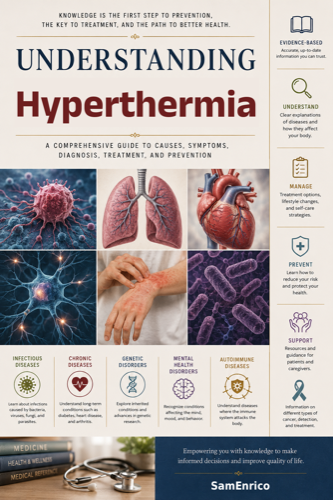
Non-FictionInformativeEducational
Understanding Hyperthermia eBook
This disease publication, published by SamEnrico,
This disease publication, published by SamEnrico, covers Understanding Hyperthermia
Formats
Free sample
Chapter 1: The Fahrenheit Fallacy...--The paramedics found him on the third-floor landing of a walk-up apartment in Brooklyn, slumped against a radiator that had not been turned on in six months. It was July 18th. The heat index had reached 112 degrees Fahrenheit. His name was Raymond Taggart, he was seventy-one years old, and his apartment had a broken air conditioner that he could not afford to fix. His daughter had called 911 when he stopped answering his phone.
By the time the paramedics arrived, Raymond's core temperature was 41.7°C (107.1°F). He was unconscious, his skin was hot and dry—not because he had stopped sweating, but because his sweat glands had simply run out of capacity hours ago. One paramedic reached for acetaminophen. The other, more experienced, pushed her hand away. "Not for this," she said.
"This isn't a fever."That distinction—between fever and hyperthermia—is the single most important concept in this book. And yet, it is routinely misunderstood by medical students, emergency physicians, athletic trainers, and even intensive care specialists. The misconception is simple but deadly: if the body is hot, give something to bring the temperature down. Acetaminophen. Ibuprofen.
Aspirin. These are the reflexive tools of a culture trained to treat fever at the first sign of a warm forehead. But in true hyperthermia, these drugs do absolutely nothing to lower core temperature. Nothing. And in some cases, as we will see in later chapters, they can cause catastrophic harm—hepatotoxicity in a dehydrated patient, acute kidney injury from reduced renal blood flow, or masking of a life-threatening infection that requires completely different management.The Fahrenheit Fallacy, as I have come to call it, is the mistaken belief that all elevations in body temperature are fundamentally the same and respond to the same treatments.
This chapter dismantles that fallacy at its biological foundation. We will journey from the hypothalamus—a almond-sized cluster of neurons deep within the brain that serves as the body's thermostat—to the molecular messengers that tell that thermostat to turn up the heat, to the critical distinction between a regulated rise in temperature (fever, which is protective) and an unregulated rise (hyperthermia, which is destructive). By the end of this chapter, you will never look at a febrile patient the same way again. You will understand why your grandmother's advice to "sweat out a fever" is biologically backward. And you will be equipped with the fundamental framework that underpins every subsequent chapter in this book: from the emergency management of heat stroke to the therapeutic use of whole-body hyperthermia in cancer treatment.The Preoptic Anterior Hypothalamus: Your Body's Thermostat Every living mammal possesses a remarkably precise thermoregulatory system.
In humans, that system maintains core temperature within a range of approximately 36.1°C to 37.2°C (97°F to 99°F) under normal conditions. This is not a passive equilibrium—it is an active, energy-intensive process that consumes approximately five to ten percent of your resting metabolic rate. The master controller resides in a region of the brain called the preoptic anterior hypothalamus (POAH) , a small but densely packed collection of neurons located just above the optic chiasm, where the optic nerves cross.The POAH functions analogously to a household thermostat, but with one critical difference. A household thermostat has a fixed set-point. You set it to 72 degrees Fahrenheit, and the furnace or air conditioner activates whenever the temperature deviates from that number.
The POAH, by contrast, has a variable set-point. It can be turned up or down by chemical messengers called pyrogens. When you develop a bacterial infection, your immune system releases endogenous pyrogens—proteins such as interleukin-1 (IL-1), interleukin-6 (IL-6), and tumor necrosis factor-alpha (TNF-α)—that travel to the POAH and raise the set-point. Your body now wants to be at 39°C (102.2°F). It shivers to generate heat.
It constricts blood vessels in the skin to conserve heat. It makes you feel cold even though your temperature is rising. This is fever. And it is, for the most part, an adaptive response that evolved to help you fight infection.The POAH contains two distinct populations of thermosensitive neurons: warm-sensitive neurons and cold-sensitive neurons. Warm-sensitive neurons increase their firing rate as local temperature rises; they are the primary drivers of heat-loss responses such as sweating and skin vasodilation.
Cold-sensitive neurons do the opposite: they fire more rapidly as temperature falls, triggering heat-conservation responses such as shivering and skin vasoconstriction. Under normal conditions, these two populations maintain a balance. When a pyrogen raises the set-point, however, the cold-sensitive neurons effectively become more sensitive, and the warm-sensitive neurons less so. The body perceives its current temperature as below the new set-point, even if that current temperature is 38°C. The result is shivering, piloerection (goosebumps), and behavioral responses such as seeking blankets or warm drinks.This is a beautiful, elegant, and highly conserved system.
It is also completely distinct from the pathophysiology of hyperthermia.Fever vs. Hyperthermia: The Crucial Distinction Fever is a regulated elevation in body temperature. The set-point is raised. The body's thermoregulatory mechanisms are intact and actively working to achieve and maintain the new, higher temperature. Hyperthermia, by contrast, is an unregulated elevation in body temperature.
The set-point remains normal. The body is simply overwhelmed—heat production exceeds heat dissipation—and the temperature rises passively, like a car overheating on a summer day because the radiator has failed.This distinction is not academic hair-splitting. It has direct, immediate, life-saving clinical implications. In fever, antipyretics such as acetaminophen and ibuprofen work by inhibiting the enzyme cyclooxygenase (COX), which reduces the production of prostaglandin E2 (PGE2), the key downstream mediator that raises the hypothalamic set-point. Lower PGE2, lower set-point, and the body's own cooling mechanisms—sweating, vasodilation—kick in to shed heat.
In hyperthermia, however, the set-point is normal. There is no elevated PGE2 to inhibit. Antipyretics do nothing to lower core temperature. They are biologically inert in this context. Worse, they are not harmless.
A patient with exertional heat stroke is often volume-depleted and may have early acute kidney injury. Acetaminophen in this setting carries a risk of hepatotoxicity. Ibuprofen can worsen renal injury. And yet, studies of prehospital heat stroke management have found that up to thirty percent of patients receive antipyretics before reaching the hospital—a testament to the persistence of the Fahrenheit Fallacy.Consider two patients. Patient A is a six-year-old child with streptococcal pharyngitis.
Her temperature is 39.5°C (103.1°F). She is lying under a blanket, shivering, complaining of feeling cold. Her skin is cool to the touch despite the elevated core temperature. This is fever. The appropriate treatment is antipyretics, fluids, and treatment of the underlying infection.
Patient B is a twenty-two-year-old marathon runner who collapsed at mile twenty-two. His temperature is also 39.5°C. But his skin is hot and wet with sweat. He is unconscious. He does not shiver.
This is hyperthermia. Antipyretics will do nothing. He needs immediate, aggressive physical cooling—cold-water immersion, ice packs to the axillae and groin, misting and fanning. The two patients look superficially similar. Their core temperatures are identical.
But their underlying physiology could not be more different, and their treatments could not be more different. Mistaking one for the other can be fatal.The Pyrogen Cascade: How…
This is the end of the free sample. Get the eBook to keep going. Buy now
About this book
Details
- Author
- Duval Margret
- Publisher
- SamEnrico
- Language
- English
- Genre
- Non-Fiction, Informative, Educational
- Released
- 2026-06-02
- Pages (approx.)
- 160
- Available as
- eBook, Audiobook

Read better in the ZLOADR app
Your eBooks on your phone or tablet. Sign in with your SamEnrico account and start reading.
More by Duval Margret
 AA Big Book Step Study GuideDuval Margret$11.99
 Gladdening Mind With BreathDuval Margret$11.99
 Franchise Builder's Franchisee Council ChairDuval Margret$11.99
 Values And Mission Alignment Remote TeamsDuval Margret$11.99
 The Phantom of Pebble Beach: The Unsolved Heist of the 1955 Mercedes-Benz 300 SL GullwingDuval Margret$11.99
 The Ghost in the Machine: How a Soviet Defector Exposed the CIA's Greatest BetrayalDuval Margret$11.99
 Expert CybersecuriteDuval Margret$11.99
 How to Start a Castor Bean Growing Business (Beginners Guide)Duval Margret$11.99
 AI Diagnostic Imaging Revolution GuideDuval Margret$12.99
 Google Data Annotation Career GuideDuval Margret$12.99
You may also like
 Hong Kong Handover 1997Dunn Johnnie$11.99
 Zumba For Postnatal Recovery CourseNeal Christian$11.99
 Zumba for BeginnersLadner Nikia$11.99
 YouTube Comment Mining GuideHumes Pandora$12.99
 Worry Box MeditationCarlin Rudy$11.99
 Workplace Stress MeditationNguyen Lynn$11.99
 Workplace Stress and Sleep RepairHawley Ivory$11.99
 Workplace Perfectionism CureDelaney Jeffry$11.99
 Workplace Injustice Anger GuideWallen Isabelle$11.99
 Work Addiction and Burnout LinkGreenwood Ester$11.99
 Women in Yoga and WellnessBeattie Galina$11.99
 Women in Stand Up ComedyChun Evangeline$11.99