
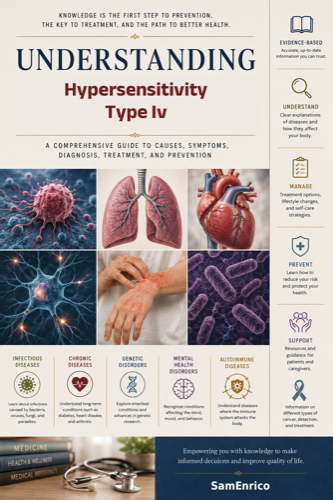
Non-FictionInformativeEducational
Understanding Hypersensitivity Type Iv eBook
This disease publication, published by SamEnrico,
by Roth Alisa
This disease publication, published by SamEnrico, covers Understanding Hypersensitivity Type Iv
Formats
Free sample
Chapter 1: The Immune System's Secret Army--–- The rash appeared on a Tuesday morning. Sarah, a 34-year-old graphic designer, had been wearing her grandmother's vintage watch all weekend at a family wedding. The watch was beautiful—delicate gold-plated links, a small oval face, the kind of heirloom that carries memories. She wore it for three days straight. On Monday, nothing.
On Tuesday morning, a faint redness under the clasp. By Tuesday evening, her wrist looked like a chemical burn: raised, oozing blisters in an angry red band, exactly where the metal had touched her skin. The itch was unbearable, the kind that overrides sleep, concentration, and sanity.Sarah went to urgent care, where the physician asked the standard questions: "Have you eaten anything unusual? Started any new medications? Been exposed to poison ivy?" No, no, and no.
The watch didn't come up. Why would it? She'd worn jewelry before without issue. The doctor prescribed a topical steroid and sent her home with a diagnosis of "contact dermatitis, cause unknown."Three days after that—nearly a full week after she first put on the watch—Sarah's husband noticed the timing. "You put the watch on Friday night.
The rash started Tuesday morning. That's almost four days." He Googled it. "Delayed allergic reaction," he said. "It says here, Type IV hypersensitivity."Sarah had never heard the term. Like most people, she thought allergies happened immediately: eat a peanut, throat closes; get stung by a bee, hives erupt.
The idea of an allergy that takes days to appear seemed absurd. But her wrist was proof.This book is for Sarah. And for the 20% of the population who will experience a delayed hypersensitivity reaction at some point in their lives—often without ever understanding what hit them. It is for the nurse whose hands crack and bleed from latex gloves, but only after the weekend. For the construction worker whose arms erupt in a weeping rash every time he pours concrete, three days after exposure to chromate.
For the patient who took an antibiotic for a sinus infection, felt fine for two weeks, and then woke up covered head-to-toe in a rash that sent her to the emergency room. For the parents of a child with mysterious, recurring eczema that doesn't respond to standard creams.This chapter is the key that unlocks the mystery. It will change how you think about your immune system, your skin, and the medications and products you touch every day. Because Type IV hypersensitivity is not a rare curiosity. It is one of the most common, most misunderstood, and most preventable forms of immune dysfunction in the world.The Case of the Disappearing Doctor Let me tell you another story.
This one is about a dermatologist named Dr. Eleanor Vance (not her real name). For fifteen years, Dr. Vance treated patients with skin rashes. She prescribed topical steroids, ordered patch tests, and counseled patients on allergen avoidance.
She was good at her job. And then she became the patient.It started subtly. A faint redness on her fingertips after long shifts. She assumed it was irritation from frequent handwashing—an occupational hazard. But over several months, the redness worsened.
Her fingertips cracked. The cracks deepened into fissures that bled when she examined patients. She started wearing double gloves, but that made it worse: her hands would be red, swollen, and intensely itchy by the end of the day, with symptoms peaking two days after her busiest shifts.Dr. Vance, like Sarah, was experiencing a delayed reaction. But unlike Sarah, she had the tools to investigate.
She patch-tested herself using the standard series of allergens. The results came back positive for thiuram mix—a rubber accelerator used in the manufacturing of latex and nitrile gloves. She had become sensitized to her own protective equipment.The timeline told the story. She had worn gloves daily for fifteen years without issue. Sensitization—the first exposure that primes the immune system—happened silently, without symptoms.
Then, at some point, her immune system crossed a threshold. After that, every subsequent exposure triggered the delayed response. She would put on gloves in the morning, feel fine, and then two days later—when she was off duty, at home, far from the clinic—her hands would erupt.This is the central paradox of Type IV hypersensitivity. It is not immediate. It does not announce itself.
It follows its own timeline, one that often obscures the cause-and-effect relationship. By the time the rash appears, the patient has forgotten what they touched three days ago. The connection is lost. The reaction goes unexplained.Breaking Open the Gell and Coombs Box To understand Type IV hypersensitivity, we need to step back and look at the bigger picture: how immunologists classify all allergic and hypersensitivity reactions. In 1963, two British immunologists—Robin Gell and Philip Coombs—proposed a classification system that remains the foundation of our understanding today.
They divided hypersensitivity reactions into four types, based on the immune mechanism involved and the speed of the reaction.Type I: The Immediate Reactor. This is what most people think of as "allergy." Ig E antibodies, the same class of antibodies involved in fighting parasitic worms, bind to mast cells in the skin and respiratory tract. When the person encounters the allergen again—peanuts, pollen, bee venom—the allergen cross-links these Ig E antibodies, triggering the mast cell to explode with histamine and other inflammatory chemicals. The result: sneezing, wheezing, hives, and in severe cases, anaphylaxis. Timeline: minutes to hours.Type II: The Cellular Assassin.
Here, antibodies (Ig G or Ig M) bind directly to antigens on the surface of the body's own cells or to foreign cells (like transfused red blood cells). This binding activates a cascade of proteins called complement, which punches holes in the target cells and destroys them. Examples: hemolytic disease of the newborn, autoimmune hemolytic anemia, certain drug-induced blood disorders. Timeline: hours to days.Type III: The Immune Complex Fallout. Antibodies bind to soluble antigens in the blood, forming clusters called immune complexes.
These complexes normally get cleared by the spleen and liver. But when they form in excess or are not cleared properly, they deposit in tissues—especially blood vessel walls, kidneys, and joints—where they trigger massive inflammation via complement activation. Examples: lupus nephritis, serum sickness, farmer's lung (acute form). Timeline: hours to days.Type IV: The Delayed Reaction. No antibodies.
No complement. Instead, T lymphocytes—the generals of the immune system—do the work. When a sensitized T cell encounters its specific antigen, it releases chemical messengers called cytokines that recruit other immune cells (macrophages, eosinophils, neutrophils, or cytotoxic T cells, depending on the subtype). These recruited cells cause inflammation, tissue damage, and in some cases, direct cell killing. The reaction unfolds not in minutes, but in days—typically 48 to 72 hours after exposure.
Examples: poison ivy, nickel allergy, drug reactions like SJS/TEN and DRESS, tuberculin skin test reactions, transplant rejection, and many autoimmune diseases.The Gell and Coombs classification is elegant, but it has a limitation: it suggests that diseases fit neatly into one box. They do not. A patient with asthma has both Type I (immediate wheezing after exposure) and Type IV (chronic airway inflammation…
This is the end of the free sample. Get the eBook to keep going. Buy now
About this book
Details
- Author
- Roth Alisa
- Publisher
- SamEnrico
- Language
- English
- Genre
- Non-Fiction, Informative, Educational
- Released
- 2026-05-18
- Pages (approx.)
- 155
- Available as
- eBook, Audiobook

Read better in the ZLOADR app
Your eBooks on your phone or tablet. Sign in with your SamEnrico account and start reading.
More by Roth Alisa
 Dual Recovery Anonymous GuideRoth Alisa$11.99
 Values And Mission Alignment Performance ReviewsRoth Alisa$11.99
 Franchise Builder's Customer LoyaltyRoth Alisa$11.99
 Calming Breath ObservationRoth Alisa$11.99
 The Great Unraveling: How a Single Bank Brought the World to Its KneesRoth Alisa$11.99
 The Fires of Kilimanjaro: How the Chagga Kings Tamed the MountainRoth Alisa$11.99
 Blockchain Fundamentals PrimerRoth Alisa$12.99
 Financial Knowledge Management AIRoth Alisa$12.99
 How to Start a Multi-layer Paper Obtained By Compression Business (Beginners Guide)Roth Alisa$11.99
 CryptozoologistRoth Alisa$11.99
You may also like
 Hong Kong Handover 1997Dunn Johnnie$11.99
 Zumba For Postnatal Recovery CourseNeal Christian$11.99
 Zumba for BeginnersLadner Nikia$11.99
 YouTube Comment Mining GuideHumes Pandora$12.99
 Worry Box MeditationCarlin Rudy$11.99
 Workplace Stress MeditationNguyen Lynn$11.99
 Workplace Stress and Sleep RepairHawley Ivory$11.99
 Workplace Perfectionism CureDelaney Jeffry$11.99
 Workplace Injustice Anger GuideWallen Isabelle$11.99
 Work Addiction and Burnout LinkGreenwood Ester$11.99
 Women in Yoga and WellnessBeattie Galina$11.99
 Women in Stand Up ComedyChun Evangeline$11.99