
Non-FictionInformativeEducational
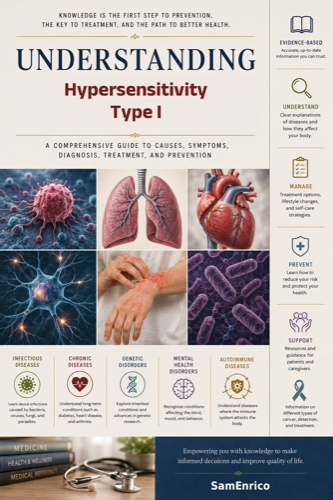
Understanding Hypersensitivity Type I eBook
This disease publication, published by SamEnrico,
This disease publication, published by SamEnrico, covers Understanding Hypersensitivity Type I
Formats
Free sample
Chapter 1: The Friendly Fire--The human immune system is often described as a military force – a vast, silent army of cells and proteins standing guard against foreign invaders. It distinguishes self from non-self, friend from foe, and launches precision strikes against bacteria, viruses, parasites, and fungi. This system is, without exaggeration, the reason you can breathe, eat, touch, and exist in a world teeming with microorganisms without dying of infection before your fifth birthday. It has evolved over hundreds of millions of years to be one of the most sophisticated defense networks in the natural world. But what happens when that perfect army turns its weapons on the wrong targets?
What happens when it mistakes a harmless grain of pollen, a protein in a peanut, or the dander of a beloved pet for a lethal biological weapon? The answer is hypersensitivity – and Type I is the fastest, most dramatic, and in its extreme form, the most immediately dangerous of all immune system errors.This book is about that error. It is about the molecular miscommunication, the cellular overreaction, and the clinical consequences of an immune system that works too well against the wrong things. But to understand Type I hypersensitivity, we must first understand a paradox: the immune system that saves your life is also perfectly capable of ending it. This chapter establishes the foundational concepts that will guide the rest of this book: what hypersensitivity means, how it differs from immunodeficiency, the classification system that organizes our understanding of immune overreactions, and the critical concept of atopy – the genetic tendency that makes some individuals more vulnerable than others to the friendly fire of their own defenses.The Paradox of Protection Consider two patients.
The first patient, a thirty-two-year-old woman named Sarah, has a genetic condition called severe combined immunodeficiency (SCID). Her bone marrow fails to produce functional T cells and B cells. She lives inside a sterile bubble, unable to hug her mother without risking a fatal infection from common skin bacteria. A common cold virus would be a death sentence. Her immune system does too little.
She is under-protected.The second patient, a twenty-four-year-old man named David, has a history of severe allergic reactions. He carries two epinephrine auto-injectors everywhere he goes. Last summer, while eating at a restaurant that had accidentally used peanut-contaminated oil, David's throat began to close within three minutes. His blood pressure plummeted. He injected himself with epinephrine and was rushed to an emergency room, where he spent the night in the intensive care unit.
His immune system did too much. He was over-protected against the wrong target.Both Sarah and David have immune system disorders. But they lie at opposite ends of a spectrum. Immunodeficiency disorders are failures of protection – the immune system is too weak, too incomplete, or too exhausted to defend against genuine threats. Hypersensitivity disorders are failures of discrimination – the immune system is too aggressive, too reactive, or too poorly regulated, attacking harmless environmental substances as if they were deadly pathogens.
Type I hypersensitivity is the most common and fastest of these overreactions, and understanding it requires us to appreciate the full spectrum from under-reaction to over-reaction.The distinction matters profoundly for treatment. If David were treated like Sarah – with immune system boosters, bone marrow transplants, or gene therapy to enhance immunity – his allergic disease would worsen and could become immediately life-threatening. Conversely, if Sarah were treated like David – with immunosuppressants, mast cell stabilizers, or anti-Ig E antibodies – she would succumb to infections within weeks. The same immune pathways, when deficient or excessive, produce opposite clinical pictures. This is the central paradox of clinical immunology: more immunity is not always better, and less immunity is not always worse.
Balance is everything.The Coombs and Gell Framework: Organizing Chaos In 1963, two immunologists – Robin Coombs (who also developed the Coombs test for autoimmune hemolytic anemia) and Philip Gell – proposed a classification system that remains the bedrock of hypersensitivity understanding to this day. They recognized that not all immune overreactions are alike. Different mechanisms, different cells, different antibodies, and different time courses produce entirely different diseases. Their framework divided hypersensitivity into four types, numbered with Roman numerals, each with a distinct pathophysiology.Type I: Immediate Hypersensitivity (Ig E-Mediated) – This is the subject of this entire book. It is called "immediate" because symptoms appear within minutes of re-exposure to an allergen.
It depends on a specific class of antibody called immunoglobulin E (Ig E), which binds to high-affinity receptors on mast cells and basophils. When an allergen cross-links these Ig E molecules, the effector cells degranulate, releasing histamine, leukotrienes, prostaglandins, and cytokines. Common Type I conditions include allergic rhinitis (hay fever), asthma (in its allergic form), food allergies, urticaria (hives), anaphylaxis, and some forms of atopic dermatitis. The reaction is rapid, typically peaking within fifteen to thirty minutes, but as we will see in Chapter 5, a late-phase reaction can extend symptoms for twenty-four hours or more.Type II: Cytotoxic Hypersensitivity (Antibody-Dependent Cell-Mediated Cytotoxicity) – In Type II reactions, antibodies (usually Ig G or Ig M) bind directly to antigens on the surface of the patient's own cells or on foreign cells (such as transfused red blood cells). This antibody coating marks the target cells for destruction by complement proteins or by immune cells such as natural killer cells and macrophages.
Classic examples include autoimmune hemolytic anemia (where antibodies destroy red blood cells), immune thrombocytopenic purpura (destruction of platelets), Goodpasture syndrome (antibodies against basement membrane in kidney and lung), and transfusion reactions (antibodies against donor blood cells). Unlike Type I, Type II reactions typically take hours to days to develop fully.Type III: Immune Complex-Mediated Hypersensitivity – In Type III reactions, antibodies (again, typically Ig G or Ig M) bind to soluble antigens circulating in the blood, forming immune complexes. These complexes are normally cleared by the phagocytic system. However, when they are produced in excess or clearance mechanisms are overwhelmed, they deposit in tissues – particularly in small blood vessels, glomeruli of the kidneys, and synovial joints. The deposited complexes activate complement, recruiting neutrophils that release tissue-damaging enzymes.
The prototypical Type III disease is systemic lupus erythematosus (SLE), where complexes deposit throughout the body. Other examples include serum sickness (a reaction to foreign proteins such as antivenom), post-streptococcal glomerulonephritis, and the Arthus reaction (a localized skin reaction following repeated antigen exposure). Symptoms typically appear four to ten hours after antigen exposure.Type IV: Delayed-Type Hypersensitivity (T-Cell Mediated) – Type IV is fundamentally different from Types I through III because it is not antibody-mediated at all. Instead, it is driven by T lymphocytes, specifically CD4+ Th1 cells and CD8+ cytotoxic T cells. The reaction is called "delayed" because it typically takes twenty-four to seventy-two hours to develop after antigen exposure.
When sensitized T cells encounter their specific antigen, they release cytokines that recruit macrophages and other inflammatory cells. Classic examples include the tuberculin skin test (PPD test for tuberculosis exposure), contact dermatitis (poison ivy, nickel, latex), and granulomatous diseases. Organ transplant rejection and some autoimmune diseases (such as Type 1 diabetes and multiple sclerosis) also have significant Type IV components.This four-type classification remains clinically useful because it predicts therapeutic approaches. Type I diseases are treated with antihistamines, mast cell stabilizers…
This is the end of the free sample. Get the eBook to keep going. Buy now
About this book
Details
- Author
- Randall Chadwick
- Publisher
- SamEnrico
- Language
- English
- Genre
- Non-Fiction, Informative, Educational
- Released
- 2026-05-11
- Pages (approx.)
- 160
- Available as
- eBook, Audiobook

Read better in the ZLOADR app
Your eBooks on your phone or tablet. Sign in with your SamEnrico account and start reading.
More by Randall Chadwick
 Counting Breaths Meditation ManualRandall Chadwick$11.99
 Sex Addicts Anonymous Step StudyRandall Chadwick$11.99
 Franchise Builder's Franchise ConsultantRandall Chadwick$11.99
 Values And Mission Alignment Core GuideRandall Chadwick$11.99
 The Phantom of the Kremlin: The Spy Who Stole the Cold WarRandall Chadwick$11.99
 The Olmec Maestros: Echoes of Ancient Mesoamerican HarmonyRandall Chadwick$11.99
 How to Start a Multiple-walled Insulating Units of Glass Business (Beginners Guide)Randall Chadwick$11.99
 Compliance Business DeveloperRandall Chadwick$11.99
 Creator Business Structure HandbookRandall Chadwick$12.99
 Intelligent Payment Routing GuideRandall Chadwick$12.99
You may also like
 Hong Kong Handover 1997Dunn Johnnie$11.99
 Zumba For Postnatal Recovery CourseNeal Christian$11.99
 Zumba for BeginnersLadner Nikia$11.99
 YouTube Comment Mining GuideHumes Pandora$12.99
 Worry Box MeditationCarlin Rudy$11.99
 Workplace Stress MeditationNguyen Lynn$11.99
 Workplace Stress and Sleep RepairHawley Ivory$11.99
 Workplace Perfectionism CureDelaney Jeffry$11.99
 Workplace Injustice Anger GuideWallen Isabelle$11.99
 Work Addiction and Burnout LinkGreenwood Ester$11.99
 Women in Yoga and WellnessBeattie Galina$11.99
 Women in Stand Up ComedyChun Evangeline$11.99