
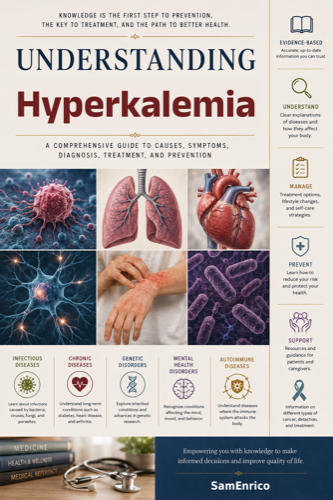
Non-FictionInformativeEducational
Understanding Hyperkalemia eBook
This disease publication, published by SamEnrico,
This disease publication, published by SamEnrico, covers Understanding Hyperkalemia
Formats
Free sample
Chapter 1: The Silent Threat...--The human body is a masterpiece of biological regulation, constantly adjusting temperature, p H, fluid volume, and electrolyte concentrations to maintain the delicate internal environment known as homeostasis. Among these tightly controlled variables, few are as critical—or as potentially dangerous when deranged—as potassium. This unassuming cation, represented by the simple symbol K+, ranks among the most essential electrolytes in human physiology. Yet unlike sodium, which triggers thirst when low or edema when high, or calcium, which announces its presence through muscle cramps and mental status changes, potassium imbalance often operates in near-complete silence until catastrophe strikes.Potassium's primary residence is inside the cell. Of the typical total body potassium content of approximately 50 milliequivalents per kilogram of body weight, 98 percent resides in the intracellular fluid compartment.
The extracellular fluid, including blood plasma, contains merely 2 percent of total body potassium. This stark compartmentalization is not accidental. The enormous concentration gradient—roughly 140 milliequivalents per liter inside the cell versus only 3.5 to 5.0 milliequivalents per liter in the serum—creates the membrane potential essential for nerve impulse transmission, muscle contraction, and cardiac rhythm maintenance.The Narrow Therapeutic Window Understanding why hyperkalemia is dangerous requires appreciating just how narrow the safe range truly is. The normal serum potassium concentration spans from 3.5 to 5.0 milliequivalents per liter. This represents a variation of only 1.5 milliequivalents per liter—approximately 30 percent of the lower limit.
For comparison, normal serum sodium ranges from 135 to 145 milliequivalents per liter, a difference of 10 milliequivalents per liter or only 7 percent of the lower limit. The body tolerates wide sodium fluctuations with relatively modest symptoms, but potassium deviations measured in tenths of a milliequivalent per liter can produce life-threatening consequences.A rise in serum potassium from 4.0 to 6.5 milliequivalents per liter may seem trivial on an absolute scale—merely 2.5 milliequivalents per liter. Yet this increase represents a more than 100 percent elevation in extracellular potassium concentration. Because 98 percent of total body potassium resides inside cells, even small shifts from the intracellular to the extracellular compartment produce dramatic percentage increases in serum levels. A patient with a serum potassium of 7.0 milliequivalents per liter has nearly double the normal extracellular potassium concentration—a change that can stop the heart.Why Potassium Homeostasis Matters The body prioritizes potassium balance second only to p H regulation and perhaps sodium homeostasis.
This prioritization reflects potassium's fundamental role in three critical physiological processes: membrane potential maintenance, enzyme function, and cellular volume regulation.The resting membrane potential of excitable cells—neurons, skeletal muscle fibers, and cardiac myocytes—depends almost entirely on the potassium concentration gradient across the cell membrane. The Na+/K+ ATPase pump continuously transports three sodium ions out of the cell while bringing two potassium ions in, creating an electrochemical gradient. Potassium then leaks back out of the cell through specialized potassium channels, leaving the interior negatively charged relative to the exterior. This negative resting membrane potential allows cells to depolarize when stimulated, generating action potentials that propagate nerve signals, trigger muscle contraction, and coordinate cardiac rhythm.When extracellular potassium rises, this carefully maintained gradient diminishes. The resting membrane potential becomes less negative—closer to threshold.
Initially, this hyperexcitability may manifest as paresthesias or muscle cramps. However, as hyperkalemia worsens, the persistent depolarization inactivates sodium channels, rendering cells inexcitable. The result can be ascending paralysis, respiratory failure, and cardiac arrest.Beyond membrane potential, potassium serves as an essential cofactor for numerous enzymes, including those involved in protein synthesis and carbohydrate metabolism. Intracellular potassium concentration also influences cellular volume by counterbalancing the osmotic effects of proteins and other intracellular anions.Total Body Distribution: The 98 Percent Phenomenon The human body of a 70-kilogram adult contains approximately 3,500 milliequivalents of total body potassium—roughly 50 milliequivalents per kilogram of body weight. Of this total, approximately 3,430 milliequivalents reside in the intracellular fluid, while only 70 milliequivalents circulate in the extracellular fluid.
This remarkable distribution means that shifting just 5 percent of intracellular potassium into the extracellular space would double the serum potassium concentration from 4.0 to 8.0 milliequivalents per liter—a potentially fatal elevation.Skeletal muscle serves as the primary reservoir, containing roughly 75 percent of total body potassium. Other tissues, including the liver, red blood cells, and bone, contain smaller but still significant amounts. This muscular reservoir explains why patients with significant muscle wasting—the elderly, those with cachexia, or prolonged critical illness—have reduced total body potassium stores and may develop hyperkalemia more readily when challenged.The clinical implications of this compartmentalization cannot be overstated. A patient with a serum potassium of 6.5 milliequivalents per liter has approximately 85 percent of the normal total body potassium. The deficit is not an excess of total body potassium but rather a maldistribution.
Similarly, a patient with chronic kidney disease may maintain a serum potassium of 5.5 milliequivalents per liter despite significantly elevated total body potassium stores because the kidneys have adapted to excrete more potassium per functioning nephron. Only when this adaptation fails does the serum level rise precipitously.Daily Potassium Intake: The Western Diet The average Western diet provides between 40 and 100 milliequivalents of potassium per day, with most adults consuming approximately 70 to 80 milliequivalents daily. This potassium comes primarily from fruits, vegetables, legumes, dairy products, and meat. Particularly rich sources include bananas (approximately 12 milliequivalents per medium banana), potatoes (approximately 20 milliequivalents per medium baked potato), tomatoes and tomato products, oranges and orange juice, avocados, spinach, beans, and salt substitutes, which use potassium chloride rather than sodium chloride.A single meal can easily contain 30 to 50 milliequivalents of potassium—enough to raise the serum potassium by several milliequivalents per liter if absorbed rapidly into the extracellular space without concomitant cellular uptake or renal excretion. Fortunately, the body possesses redundant mechanisms to handle this dietary load.
Insulin released in response to the meal drives potassium into cells. Beta-2 adrenergic tone shifts additional potassium intracellularly. And the kidneys, functioning normally, can increase potassium excretion to match intake within hours.The problem arises when these mechanisms fail. A patient with diabetes who misses an insulin dose may develop hyperkalemia not because of excessive intake but because insulin deficiency prevents cellular potassium uptake. A patient with chronic kidney disease may develop hyperkalemia after consuming a potassium-rich meal not because the meal contains more potassium than usual but because the kidneys cannot excrete the load.
A patient taking a beta-blocker may experience blunted cellular potassium uptake in response to endogenous catecholamines.The Three Mechanisms of Hyperkalemia All cases of hyperkalemia—regardless of cause—fall into one of three mechanistic categories: increased potassium intake, transcellular shift from the intracellular to the extracellular space, or decreased renal potassium excretion. Understanding these three mechanisms provides the framework for evaluating any patient with hyperkalemia and will be explored in depth in Chapter 4.Increased intake alone rarely causes hyperkalemia in patients with normal kidney function. The kidneys can increase potassium excretion up to tenfold in response to chronic high intake, although this adaptation takes days. However, increased intake can precipitate hyperkalemia when combined with impaired excretion or when the potassium load is massive and intravenous—such as rapid administration of potassium chloride, transfusion of aged blood (which releases potassium from stored red blood cells), or excessive use of potassium-containing salt substitutes.Transcellular shift occurs when intracellular potassium moves into the extracellular space. This mechanism explains the hyperkalemia of metabolic acidosis…
This is the end of the free sample. Get the eBook to keep going. Buy now
About this book
Details
- Author
- Matson Lashawn
- Publisher
- SamEnrico
- Language
- English
- Genre
- Non-Fiction, Informative, Educational
- Released
- 2026-05-25
- Pages (approx.)
- 142
- Available as
- eBook, Audiobook

Read better in the ZLOADR app
Your eBooks on your phone or tablet. Sign in with your SamEnrico account and start reading.
More by Matson Lashawn
 Anger And Child Food RefusalMatson Lashawn$11.99
 Momentum Time Horizon StrategyMatson Lashawn$11.99
 Scaling Feedback Loops GuideMatson Lashawn$11.99
 Priority Matrix Time BlockingMatson Lashawn$11.99
 The Alchemist of Wall Street: How a 17th-Century Merchant Outsmarted the Dutch East India CompanyMatson Lashawn$11.99
 The Neon Underground: How a Secret 80s Club Shaped Music ForeverMatson Lashawn$11.99
 Green Energy Opportunity MapMatson Lashawn$12.99
 Canadian Express Entry For Trades PrimerMatson Lashawn$12.99
 How to Become a Chemical Reclamation Equipment OperatorMatson Lashawn$11.99
 Elder Abuse IdentificationMatson Lashawn$11.99
You may also like
 Hong Kong Handover 1997Dunn Johnnie$11.99
 Zumba For Postnatal Recovery CourseNeal Christian$11.99
 Zumba for BeginnersLadner Nikia$11.99
 YouTube Comment Mining GuideHumes Pandora$12.99
 Worry Box MeditationCarlin Rudy$11.99
 Workplace Stress MeditationNguyen Lynn$11.99
 Workplace Stress and Sleep RepairHawley Ivory$11.99
 Workplace Perfectionism CureDelaney Jeffry$11.99
 Workplace Injustice Anger GuideWallen Isabelle$11.99
 Work Addiction and Burnout LinkGreenwood Ester$11.99
 Women in Yoga and WellnessBeattie Galina$11.99
 Women in Stand Up ComedyChun Evangeline$11.99