
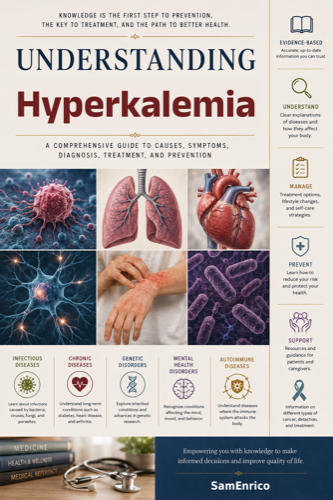
Non-FictionInformativeEducational
Understanding Hyperkalemia Audiobook
This disease publication, published by SamEnrico,
This disease publication, published by SamEnrico, covers Understanding Hyperkalemia
Formats
Free sample
Chapter 1: The Silent Threat...--The human body is a masterpiece of biological regulation, constantly adjusting temperature, p H, fluid volume, and electrolyte concentrations to maintain the delicate internal environment known as homeostasis. Among these tightly controlled variables, few are as critical—or as potentially dangerous when deranged—as potassium. This unassuming cation, represented by the simple symbol K+, ranks among the most essential electrolytes in human physiology. Yet unlike sodium, which triggers thirst when low or edema when high, or calcium, which announces its presence through muscle cramps and mental status changes, potassium imbalance often operates in near-complete silence until catastrophe strikes.Potassium's primary residence is inside the cell. Of the typical total body potassium content of approximately 50 milliequivalents per kilogram of body weight, 98 percent resides in the intracellular fluid compartment.
The extracellular fluid, including blood plasma, contains merely 2 percent of total body potassium. This stark compartmentalization is not accidental. The enormous concentration gradient—roughly 140 milliequivalents per liter inside the cell versus only 3.5 to 5.0 milliequivalents per liter in the serum—creates the membrane potential essential for nerve impulse transmission, muscle contraction, and cardiac rhythm maintenance.The Narrow Therapeutic Window Understanding why hyperkalemia is dangerous requires appreciating just how narrow the safe range truly is. The normal serum potassium concentration spans from 3.5 to 5.0 milliequivalents per liter. This represents a variation of only 1.5 milliequivalents per liter—approximately 30 percent of the lower limit.
For comparison, normal serum sodium ranges from 135 to 145 milliequivalents per liter, a difference of 10 milliequivalents per liter or only 7 percent of the lower limit. The body tolerates wide sodium fluctuations with relatively modest symptoms, but potassium deviations measured in tenths of a milliequivalent per liter can produce life-threatening consequences.A rise in serum potassium from 4.0 to 6.5 milliequivalents per liter may seem trivial on an absolute scale—merely 2.5 milliequivalents per liter. Yet this increase represents a more than 100 percent elevation in extracellular potassium concentration. Because 98 percent of total body potassium resides inside cells, even small shifts from the intracellular to the extracellular compartment produce dramatic percentage increases in serum levels. A patient with a serum potassium of 7.0 milliequivalents per liter has nearly double the normal extracellular potassium concentration—a change that can stop the heart.Why Potassium Homeostasis Matters The body prioritizes potassium balance second only to p H regulation and perhaps sodium homeostasis.
This prioritization reflects potassium's fundamental role in three critical physiological processes: membrane potential maintenance, enzyme function, and cellular volume regulation.The…
This is the end of the free sample. Get the Audiobook to keep going. Buy now
About this book
Details
- Author
- Matson Lashawn
- Publisher
- SamEnrico
- Language
- English
- Genre
- Non-Fiction, Informative, Educational
- Released
- 2026-05-25
- Pages (approx.)
- 142
- Available as
- eBook, Audiobook

Listen in the VoxFlicks app
Audiobooks and audio dramas wherever you go. Sign in with your SamEnrico account and press play.
More by Matson Lashawn
 Anger And Child Food RefusalMatson Lashawn$11.99
 Momentum Time Horizon StrategyMatson Lashawn$11.99
 Scaling Feedback Loops GuideMatson Lashawn$11.99
 Priority Matrix Time BlockingMatson Lashawn$11.99
 The Alchemist of Wall Street: How a 17th-Century Merchant Outsmarted the Dutch East India CompanyMatson Lashawn$11.99
 The Neon Underground: How a Secret 80s Club Shaped Music ForeverMatson Lashawn$11.99
 Green Energy Opportunity MapMatson Lashawn$12.99
 Canadian Express Entry For Trades PrimerMatson Lashawn$12.99
 How to Become a Chemical Reclamation Equipment OperatorMatson Lashawn$11.99
 Elder Abuse IdentificationMatson Lashawn$11.99
You may also like
 Hong Kong Handover 1997Dunn Johnnie$11.99
 Zumba For Postnatal Recovery CourseNeal Christian$11.99
 Zumba for BeginnersLadner Nikia$11.99
 YouTube Comment Mining GuideHumes Pandora$12.99
 Worry Box MeditationCarlin Rudy$11.99
 Workplace Stress MeditationNguyen Lynn$11.99
 Workplace Stress and Sleep RepairHawley Ivory$11.99
 Workplace Perfectionism CureDelaney Jeffry$11.99
 Workplace Injustice Anger GuideWallen Isabelle$11.99
 Work Addiction and Burnout LinkGreenwood Ester$11.99
 Women in Yoga and WellnessBeattie Galina$11.99
 Women in Stand Up ComedyChun Evangeline$11.99