
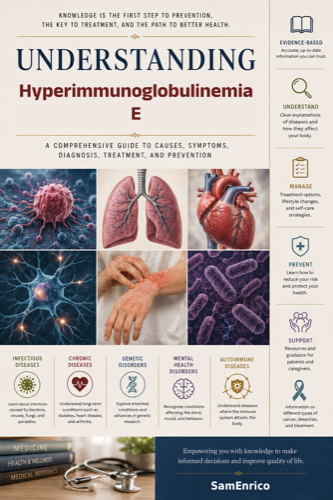
Non-FictionInformativeEducational
Understanding Hyperimmunoglobulinemia E eBook
This disease publication, published by SamEnrico,
by Riddle Nena
This disease publication, published by SamEnrico, covers Understanding Hyperimmunoglobulinemia E
Formats
Free sample
Chapter 1: The Thousand-Dollar Boil...--The first time four-year-old Maya developed a boil on her thigh, her mother, Elena, assumed it was a spider bite. That was what the pediatrician said, too. "Probably a brown recluse," the doctor offered, glancing at the reddened lump for perhaps three seconds before scribbling a prescription for oral antibiotics. "Keep it clean. Call us if it gets worse."It got worse.Within forty-eight hours, the boil had grown from the size of a pea to the size of a golf ball.
It was deep—Elena could feel the hardness of it beneath the skin, a solid knot that seemed to originate from somewhere far below the surface. But here was the thing that Elena would later describe to six different doctors, six different emergency rooms, six different bewildered specialists: the boil wasn't red. It wasn't hot. Maya had no fever. She was still running around the living room, still demanding apple slices, still arguing with her older brother about which cartoon to watch."She doesn't look sick," the second pediatrician said.
And because Maya didn't look sick—because she was laughing and playing and eating—they sent her home again.Three days later, the boil ruptured. Not the dramatic, pus-filled explosion that Elena had braced herself for. Instead, it opened like a slow leak, oozing thin, serosanguinous fluid for hours. The skin around it remained pale. The wound didn't heal.
It gaped open, a crater on a four-year-old's thigh, and Maya finally stopped running around the living room. She started crying when anyone touched her leg.That was when Elena drove two hours to the nearest children's hospital. That was when a surgeon finally drained the abscess properly—deeply, thoroughly—and sent the fluid for culture. That was when the lab called back with a result that made the infectious disease fellow raise her eyebrows: Staphylococcus aureus, heavy growth, sensitive to virtually every antibiotic tested."That's the thing," the fellow said to her attending, loud enough for Elena to hear through the thin hospital curtain. "The bug isn't resistant.
We have drugs that should kill it. So why isn't her immune system clearing it?"It was a good question. It was the right question. It was, Elena would later learn, the question that takes most HIES families seven to ten years to answer.This chapter is about that question. It is about the disease that Maya would eventually be diagnosed with—Hyperimmunoglobulinemia E syndrome—and about why a disease named for a laboratory value (high Ig E) is actually a disease of something far more fundamental.
But before we get to the immunology, before we get to the genes, before we get to the NIH scoring system and the biologics and the bone marrow transplants, we need to start where every HIES journey starts: with a boil that doesn't behave like a boil, a pneumonia that doesn't heal like a pneumonia, and a child who looks healthy until, suddenly, she isn't.This is the story of a disease that hides in plain sight. And it begins with a paradox.The Paradox of Hyperimmunoglobulinemia EHyperimmunoglobulinemia E syndrome—HIES for short, though you will also hear it called Job syndrome, Buckley syndrome, STAT3 deficiency, or DOCK8 deficiency depending on who is doing the naming—is classified as a primary immunodeficiency. That means it is a genetic disorder of the immune system, present from birth, that makes the body vulnerable to infections that a healthy immune system would shrug off without a second thought.But here is where the paradox enters.Most people, when they hear "immune deficiency," think of someone who gets sick all the time. Someone who catches every cold, every flu, every stomach bug that circulates through the school or the office. Someone who lives in fear of germs.
And indeed, many primary immunodeficiencies present exactly that way: low antibody levels, low T-cell counts, a body that simply cannot mount a defense against the ordinary microbial world.HIES is different.Patients with HIES do not necessarily catch more colds than anyone else. They do not necessarily have more frequent viral infections. They are not, in the classic sense, "immunocompromised" in the way that a chemotherapy patient or an organ transplant recipient is compromised.Instead, they have a very specific, very unusual vulnerability: they cannot fight Staphylococcus aureus effectively. And they cannot fight fungi effectively. And when they do fight them—when the immune system finally mounts a response—the response itself is abnormal, inadequate, and often leaves permanent damage in its wake.The paradox, then, is this: patients with HIES have sky-high levels of Immunoglobulin E (Ig E), an antibody most commonly associated with allergies and parasitic infections.
Their Ig E levels can reach 10,000, 20,000, even 50,000 IU/m L, whereas a normal level is below 100 IU/m L. On paper, their immune systems look overactive—hyperactive, even. That is where the "hyper" in Hyperimmunoglobulinemia E comes from.And yet, despite all that Ig E, despite that screaming laboratory value, the immune system fails at one of its most basic jobs: killing Staphylococcus aureus in the skin and the lungs.Imagine a home security system that blares its alarm at full volume every time a leaf blows past the window but goes completely silent when someone actually kicks in the back door. That is HIES. The alarm works.
The alarm is, in fact, too sensitive. But the thing that actually stops the intruder—the police, the security guard, the neighbor with a baseball bat—never shows up.The high Ig E is the false alarm. The real problem is the missing security response.Understanding that distinction—understanding that the name of the disease points to a laboratory finding that is largely a red herring—is the first step toward understanding everything else.What's in a Name: Job, Buckley, STAT3, DOCK8If you have recently been diagnosed with HIES, or if you are a medical professional caring for a patient with suspected HIES, you have likely encountered a bewildering array of names attached to this condition. Depending on which journal article you read, which doctor you ask, or which support group you find online, the same disease might be called:Job syndrome Buckley syndrome Hyperimmunoglobulinemia E syndrome (HIES)STAT3 deficiency DOCK8 deficiency Autosomal dominant HIESAutosomal recessive HIESThese names are not synonyms, exactly, but they are deeply interconnected. Understanding them requires a brief detour into medical history.Job syndrome.
In 1966, Dr. Samuel Davis published a case report describing two young girls who suffered from recurring "cold" abscesses—deep infections that, unlike typical boils, lacked the usual signs of inflammation. Davis, who was both a physician and a biblical scholar, named the condition after the biblical figure Job, who was afflicted with "sore boils from the sole of his foot to the crown of his head." The name stuck, and for decades, "Job syndrome" was the clinical descriptor for patients with this unusual triad of symptoms: severe eczema, recurrent staphylococcal abscesses, and pneumonia that left behind permanent lung cysts.Buckley syndrome. In 1972, Dr. Rebecca Buckley—one of the towering figures in the history of immunology—described three children with a similar clinical picture but added a crucial laboratory finding: all three had…
This is the end of the free sample. Get the eBook to keep going. Buy now
About this book
Details
- Author
- Riddle Nena
- Publisher
- SamEnrico
- Language
- English
- Genre
- Non-Fiction, Informative, Educational
- Released
- 2026-05-08
- Pages (approx.)
- 160
- Available as
- eBook, Audiobook

Read better in the ZLOADR app
Your eBooks on your phone or tablet. Sign in with your SamEnrico account and start reading.
More by Riddle Nena
 Anger Trigger Cognitive DistortionsRiddle Nena$11.99
 Financial Stress And Parental RageRiddle Nena$11.99
 Competitive Defense PlaybookRiddle Nena$11.99
 Pomodoro Technique Scheduling GuideRiddle Nena$11.99
 The Thunderbird's Wrath: How the Sky Warrior Shaped the Pacific NorthwestRiddle Nena$11.99The Thunderbird's Wrath: How the Sky Warrior Shaped the Pacific NorthwestRiddle Nena$11.99
 The Silk Road Code: How a 19th-Century Immigrant Built America’s First Tech EmpireRiddle Nena$11.99
 Channel Account ManagerRiddle Nena$11.99
 Telehealth International Expansion OutlookRiddle Nena$12.99
 Career Gap Resume Fix GuideRiddle Nena$12.99
 How to Become a Screwdown OperatorRiddle Nena$11.99
You may also like
 Hong Kong Handover 1997Dunn Johnnie$11.99
 Zumba For Postnatal Recovery CourseNeal Christian$11.99
 Zumba for BeginnersLadner Nikia$11.99
 YouTube Comment Mining GuideHumes Pandora$12.99
 Worry Box MeditationCarlin Rudy$11.99
 Workplace Stress MeditationNguyen Lynn$11.99
 Workplace Stress and Sleep RepairHawley Ivory$11.99
 Workplace Perfectionism CureDelaney Jeffry$11.99
 Workplace Injustice Anger GuideWallen Isabelle$11.99
 Work Addiction and Burnout LinkGreenwood Ester$11.99
 Women in Yoga and WellnessBeattie Galina$11.99
 Women in Stand Up ComedyChun Evangeline$11.99