
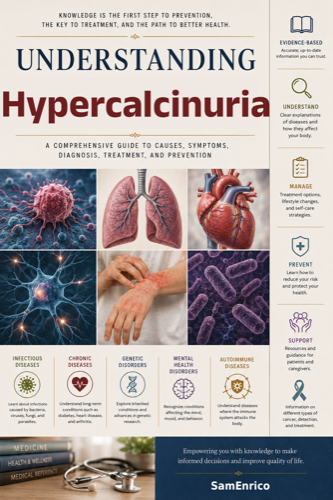
Understanding Hypercalcinuria eBook
This disease publication, published by SamEnrico,
This disease publication, published by SamEnrico, covers Understanding Hypercalcinuria
Formats
Free sample
Chapter 1: The Worst Pain of Your Life...--–- The first time Mark felt it, he was sitting in a business meeting, presenting quarterly earnings to a room of impatient executives. Mid-sentence, a sensation like a hot knife twisting in his lower back stole his breath. He excused himself, walked to the restroom, and within fifteen minutes was curled on the floor, vomiting from pain so intense he could not remember his own name. The emergency room doctor delivered the verdict: a 4mm kidney stone. "Drink more water," the physician said, handing him a strainer and a prescription for flomax.
"You'll pass it." Mark passed the stone three days later, flushed it down the toilet, and forgot about it. That was his first mistake. His second mistake came five years later when another stone lodged in his ureter, requiring emergency surgery. His third mistake was believing, after that surgery, that he was "cured." He wasn't cured. He had never been treated.
He had only been managed. And in the ten years between his first stone and his final diagnosis, hypercalciuria had been silently leeching calcium from his spine, reducing his bone density to that of a woman twenty years his senior. Mark was fifty-two years old when he learned the truth: his kidney stones were not the disease. They were only the smoke alarm. The fire had been burning inside him for decades.This is a book about the fire, not the smoke alarm.
If you are reading these words, you or someone you love has likely been touched by the strange, misunderstood condition known as hypercalciuria. Perhaps you have passed a kidney stone—that singular, unforgettable agony that ranks alongside childbirth and cluster headaches on the pain scale. Perhaps you have been told you have "too much calcium in your urine," a phrase that sounds technical but offers no explanation and no clear path forward. Perhaps you have already been given bad advice: avoid dairy, cut back on calcium, drink less milk. Or perhaps you have no symptoms at all—no stones, no pain, no warning—and you have discovered this condition by accident, through a routine blood test or because a family member was diagnosed and you decided to get checked.Wherever you are on this journey, one thing is true: you have been living with a thief.
Hypercalciuria is a condition of excess—excess calcium excreted in the urine—but the word "excess" is misleading. It suggests too much of a good thing. The reality is darker. Your body is not producing too much calcium. Your body is losing calcium it desperately needs, flushing it out through your kidneys, and stealing the difference from your bones.
Every day that this condition goes undiagnosed and untreated, you lose a little more skeletal strength. Every year that passes without intervention, your risk of kidney stones rises and your bone density falls. The thief works silently, patiently, and without remorse.The Scope of the Silent Epidemic Hypercalciuria is astonishingly common. Depending on the population studied and the diagnostic criteria used, it affects between 5 and 10 percent of the general population. That means in a typical American city of 100,000 people, between 5,000 and 10,000 individuals are living with undiagnosed hypercalciuria right now.
For reasons that researchers do not fully understand, the condition is more common in men than women, though postmenopausal women with hypercalciuria suffer the most severe bone consequences. It runs in families—if you have a first-degree relative (parent, sibling, child) with a history of kidney stones, your risk of hypercalciuria is approximately three times higher than the general population.Yet despite its prevalence, hypercalciuria remains profoundly underdiagnosed. A 2022 study in the Journal of Urology found that among first-time kidney stone formers, fewer than 15 percent received any metabolic evaluation beyond a basic blood test. The vast majority were given the same advice Mark received: drink more water. This is not bad advice—hydration is essential, as you will learn in Chapter 8—but it is incomplete advice.
It addresses one symptom (stone formation) while ignoring the underlying metabolic disorder (calcium wasting). It is the medical equivalent of telling someone with a leaking pipe to keep mopping the floor instead of calling a plumber.Why "Silent" Does Not Mean "Symptom-Free"You will see the word "silent" used throughout medical literature on hypercalciuria, and it is important to understand exactly what that word means—and what it does not mean. Hypercalciuria is called a "silent" disease because the most dangerous consequence, bone loss, produces no pain, no visible changes, and no warning signs until a fracture occurs. You cannot feel your spine thinning. You cannot sense the gradual demineralization of your hip.
By the time osteoporosis is diagnosed on a DEXA scan, the damage has been accumulating for years, often decades.However—and this is a critical clarification—hypercalciuria is not always silent in other ways. Many patients, especially children, experience noticeable symptoms long before any stone forms or any bone fracture occurs. These can include:Gross hematuria (visible blood in the urine), which may appear suddenly and resolve on its own Recurrent abdominal pain that mimics appendicitis or irritable bowel syndrome Frequent urination (urinary frequency) and urgency, often mistaken for a bladder infection Painful urination (dysuria) without evidence of infection Flank pain that comes and goes, often dismissed as muscle strain In adults, the most common "symptom" is no symptom at all—until the first stone announces itself with the unmistakable drama of renal colic. That is the paradox of hypercalciuria: it is both silent (in its bone-destroying work) and spectacularly loud (when a stone decides to travel). Understanding this paradox is the first step toward taking the condition seriously before an emergency forces your attention.The Critical Distinction: Stones vs.
The Underlying Condition One of the most persistent and dangerous misconceptions about hypercalciuria is that it is a "kidney stone disease." This is incorrect. Kidney stones are a complication of hypercalciuria, not the disease itself. The disease is a systemic metabolic disorder affecting how your body handles calcium across three organ systems: the gut (which absorbs calcium), the kidneys (which filter and reabsorb calcium), and the skeleton (which stores and releases calcium). You will explore this "triple threat" in depth in Chapter 5, but for now, understand this: a person with hypercalciuria can pass a single stone, receive standard "drink more water" advice, and go years without another stone while their bones continue to deteriorate. They may never form a second stone.
They may still end up with osteoporosis and a hip fracture at age sixty-five.This is not speculation. It is proven science. A landmark study published in the New England Journal of Medicine followed 1,200 first-time stone formers for twenty years. Those with untreated hypercalciuria had a 40 percent higher rate of incident fractures compared to matched controls without stones. Another study in the Journal of Bone and Mineral Research found that postmenopausal women with a history of kidney stones had spinal bone density that was, on average, 8 percent lower than women without stones—equivalent to five to seven years of age-related bone loss.
The stones were gone. The bone loss remained.Meet Your Three Subtypes (A Preview)Not all hypercalciuria is the same. Based on…
This is the end of the free sample. Get the eBook to keep going. Buy now
About this book
Details
- Author
- Bowles Rosette
- Publisher
- SamEnrico
- Language
- English
- Genre
- Non-Fiction, Informative, Educational
- Released
- 2026-06-02
- Pages (approx.)
- 156
- Available as
- eBook, Audiobook

Read better in the ZLOADR app
Your eBooks on your phone or tablet. Sign in with your SamEnrico account and start reading.
More by Bowles Rosette
 The Police MayorBowles Rosette$11.99
 Relationship Anger PatternsBowles Rosette$11.99
 Financial Stress and Irritability GuideBowles Rosette$11.99
 Scaling Ecommerce OperationsBowles Rosette$11.99
 Whispers in the Wax: The Curse of Okiku's HairBowles Rosette$11.99
 The Last Broadcast: The Mysterious Final Transmission of the S.S. BaychimoBowles Rosette$11.99
 Pediatric Telehealth OutlookBowles Rosette$12.99
 Croatian Digital Resident HandbookBowles Rosette$12.99
 Electrical DrafterBowles Rosette$11.99
 How to Become a Screen PrinterBowles Rosette$11.99