
Non-FictionInformativeEducational
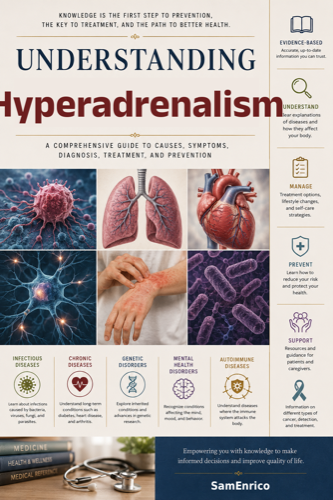
Understanding Hyperadrenalism eBook
This disease publication, published by SamEnrico,
by Jamison Vern
This disease publication, published by SamEnrico, covers Understanding Hyperadrenalism
Formats
Free sample
Chapter 1: The Silent Flood...-- The human body is a masterpiece of equilibrium. It operates through countless feedback loops, chemical conversations, and hormonal handshakes that most of us never think about—until something goes wrong. Among the most important of these conversations is the one between your brain and your adrenal glands, a dialogue that determines everything from how you wake up in the morning to how you respond to a car cutting you off in traffic. When that dialogue becomes a monologue—when your adrenal glands start screaming instead of speaking—the result is a condition called hyperadrenalism. And for the millions of people who suffer from it unknowingly, it feels like their own body has turned against them.This book exists because hyperadrenalism is one of the most underdiagnosed, misunderstood, and treatable conditions in modern medicine.
It masquerades as ordinary obesity, as hard-to-control diabetes, as treatment-resistant depression, as the inevitable weight gain of middle age. Patients spend years—on average, five to seven years—visiting doctors, undergoing tests for other conditions, being told to eat less and exercise more, being prescribed antidepressants and blood pressure medications, all while the real culprit sits silently in their adrenal glands or pituitary gland, flooding their system with too much of a hormone they have probably never thought about: cortisol.Cortisol is not evil. In fact, you cannot survive without it. It is the hormone that wakes you up in the morning, that helps you flee from danger, that modulates your immune system so it does not attack your own tissues, that raises your blood sugar when you have not eaten, that allows you to concentrate during a stressful presentation. Cortisol is your body's built-in emergency response system.
The problem is not cortisol itself but the amount and the duration. Hyperadrenalism is the condition of too much cortisol for too long. It is the difference between a fire alarm that rings for thirty seconds during an actual fire and a fire alarm that rings for three years straight while your house slowly fills with smoke.Understanding hyperadrenalism requires understanding the remarkable organs that produce cortisol: the adrenal glands. These two small, triangular glands sit atop your kidneys like tiny hats, each weighing only about four to five grams. They are disproportionately powerful for their size.
The outer layer, called the adrenal cortex, produces three families of hormones: glucocorticoids (primarily cortisol), mineralocorticoids (primarily aldosterone, which controls blood pressure and electrolyte balance), and androgens (sex hormones that contribute to libido and body hair). The inner core, the adrenal medulla, produces epinephrine and norepinephrine—the classic "fight or flight" chemicals that make your heart race and your palms sweat.The adrenal glands do not act alone. They are the obedient servants of the brain, specifically of a tiny gland called the pituitary, which sits at the base of your skull, protected by a bony saddle called the sella turcica. The pituitary is often called the "master gland" because it orchestrates the activity of many other endocrine glands, including the thyroid, the ovaries or testes, and the adrenals. But even the pituitary takes orders.
Above it lies the hypothalamus, a region of the brain that acts as the body's thermostat for dozens of physiological processes, including stress.This three-part system is called the Hypothalamic-Pituitary-Adrenal (HPA) Axis, and it is one of the most elegant feedback loops in human physiology. Here is how it works. When your brain perceives a stressor—whether physical (an infection, an injury, a missed meal) or psychological (a looming deadline, an argument, a financial worry)—the hypothalamus releases a chemical messenger called corticotropin-releasing hormone, or CRH. This hormone travels a short distance through a specialized blood vessel network to the pituitary gland. In response to CRH, the pituitary releases its own messenger: adrenocorticotropic hormone, or ACTH.
ACTH travels through the general bloodstream to the adrenal glands, where it stimulates the adrenal cortex to produce and release cortisol.Cortisol then travels throughout your body, binding to glucocorticoid receptors on nearly every cell—because nearly every cell has a use for cortisol. It raises blood sugar by stimulating the liver to convert stored glycogen into glucose. It suppresses the immune system, reducing inflammation but also making you more vulnerable to infection. It alters metabolism, encouraging fat storage in certain areas (the abdomen and the back of the neck) while breaking down protein in muscles. It affects memory, mood, and sleep.
It even influences bone density and skin thickness.But the genius of the HPA axis lies not in the forward signal but in the feedback loop. When cortisol levels rise high enough, cortisol travels back to the hypothalamus and the pituitary and says, in effect, "Enough. Turn off the faucet." Cortisol suppresses further release of CRH from the hypothalamus and ACTH from the pituitary. This negative feedback loop keeps cortisol levels within a narrow, healthy range, fluctuating naturally throughout the day in a pattern called the circadian rhythm.In a healthy person, cortisol peaks around 8:00 in the morning, just as you are waking up, giving you the energy and alertness to face the day. It declines throughout the afternoon, dropping to its lowest point around midnight, allowing you to fall asleep and stay asleep.
This pattern is so predictable and so essential that disruptions to it—caused by shift work, chronic sleep deprivation, or certain diseases—have profound health consequences. But the most profound disruption of all is not a disruption of the rhythm but a complete loss of control: cortisol production that no longer responds to the feedback loop, that continues pumping out the hormone regardless of the body's signals to stop.That loss of control is hyperadrenalism.There are three ways the HPA axis can break, leading to chronic cortisol excess. Understanding these three pathways is essential because the treatment depends entirely on which pathway is broken.The first pathway, and the most common among endogenous causes, involves the pituitary gland. A benign tumor—an adenoma—grows on the pituitary and begins producing ACTH on its own, ignoring the negative feedback from cortisol. The adrenal glands, receiving constant high levels of ACTH, grow larger and produce more and more cortisol.
This condition is called Cushing's Disease (named after Harvey Cushing, the neurosurgeon who first described it in 1912). It accounts for approximately 70 to 80 percent of all cases of endogenous hyperadrenalism. The tumor is almost always benign—it does not spread to other parts of the body—but its hormonal effects are devastating.The second pathway involves the adrenal glands themselves. Instead of a pituitary tumor driving excess ACTH, an adrenal tumor—again, usually benign, called an adenoma—begins producing cortisol directly, without any stimulation from ACTH. In these cases, the patient's ACTH levels are very low because the high cortisol has suppressed the pituitary.
The adrenal tumor simply does what it wants, ignoring the off switch. This adrenal-driven hyperadrenalism accounts for about 15 to 20 percent of endogenous cases. A smaller percentage involves adrenal cancer (adrenocortical carcinoma), which is rare but aggressive, or bilateral nodular hyperplasia, where both adrenals become enlarged and overactive.The third pathway is neither pituitary nor adrenal in origin. It is the most common cause of hyperadrenalism overall, but because…
This is the end of the free sample. Get the eBook to keep going. Buy now
About this book
Details
- Author
- Jamison Vern
- Publisher
- SamEnrico
- Language
- English
- Genre
- Non-Fiction, Informative, Educational
- Released
- 2026-05-11
- Pages (approx.)
- 158
- Available as
- eBook, Audiobook

Read better in the ZLOADR app
Your eBooks on your phone or tablet. Sign in with your SamEnrico account and start reading.
More by Jamison Vern
 Value Momentum ForecastingJamison Vern$11.99
 The Governor's Last DayJamison Vern$11.99
 TMJ Pain NeuroscienceJamison Vern$11.99
 Mortgage Stress Coping GuideJamison Vern$11.99
 The Secret Life of the First Female Engineer: How Hedy Lamarr Outsmarted the NazisJamison Vern$11.99
 The Last Maharaja: How a Forgotten Prince Built a Billion-Dollar EmpireJamison Vern$11.99
 VP MarketingJamison Vern$11.99
 Virtual Primary Care OutlookJamison Vern$12.99
 Sales Career Without A DiplomaJamison Vern$12.99
 How to Start a Brick Kiln Construction Business (Beginners Guide)Jamison Vern$11.99
You may also like
 Hong Kong Handover 1997Dunn Johnnie$11.99
 Zumba For Postnatal Recovery CourseNeal Christian$11.99
 Zumba for BeginnersLadner Nikia$11.99
 YouTube Comment Mining GuideHumes Pandora$12.99
 Worry Box MeditationCarlin Rudy$11.99
 Workplace Stress MeditationNguyen Lynn$11.99
 Workplace Stress and Sleep RepairHawley Ivory$11.99
 Workplace Perfectionism CureDelaney Jeffry$11.99
 Workplace Injustice Anger GuideWallen Isabelle$11.99
 Work Addiction and Burnout LinkGreenwood Ester$11.99
 Women in Yoga and WellnessBeattie Galina$11.99
 Women in Stand Up ComedyChun Evangeline$11.99