
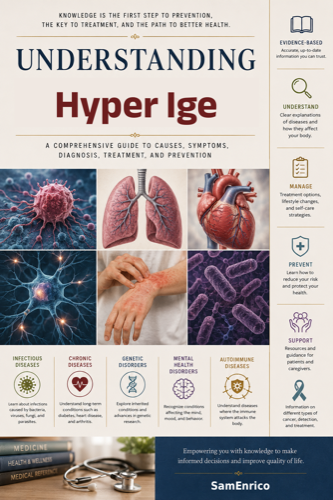
Non-FictionInformativeEducational
Understanding Hyper Ige eBook
This disease publication, published by SamEnrico,
This disease publication, published by SamEnrico, covers Understanding Hyper Ige
Formats
Free sample
Chapter 1: The Hidden Epidemic...–- It begins, as so many medical mysteries do, not in a laboratory with white coats and microscopes, but in a pediatrician’s cramped examination room, with a mother holding a feverish child whose skin has erupted in boils that refuse to heal. The pediatrician, well-meaning and exhausted after a long day, squints at the chart and says the words that will become a refrain for years to come: “It’s just eczema. Probably allergies. Keep using the cream.”The mother nods. She has heard this before.
She will hear it again. What she does not yet know—what the pediatrician does not yet know—is that her child’s body is waging a war that no cream can win. The enemy is not pollen or dust mites or the family cat. The enemy lives inside the child’s own DNA, a single misspelled letter in a gene that should have been a masterpiece of biological engineering. That misspelling is the difference between a healthy immune system and one that leaves its owner vulnerable to the simplest of germs—the kind that most children shake off before breakfast.This is the hidden epidemic.
It is hidden not because it is common—it is vanishingly rare, affecting perhaps one in every 500,000 to one million people worldwide—but because it wears the mask of ordinary childhood illnesses. Eczema. Pneumonia. Dental problems. Each symptom, viewed in isolation, seems unremarkable.
Only when they are assembled, like pieces of a puzzle scattered across multiple medical specialties, does a terrifying picture emerge: a primary immunodeficiency disorder called Hyperimmunoglobulin E syndrome, or HIES.For the families who live with this condition, the name is often the last thing they learn. First comes the suffering. Then comes the diagnostic odyssey—years of appointments, conflicting opinions, and misdiagnoses. Then, finally, a genetic test result that explains everything and changes nothing overnight. The explanation does not cure the child.
It does not erase the scars from a hundred skin infections or restore the lung tissue destroyed by recurrent pneumonia. But it does something almost as powerful: it gives the enemy a name. And once you know the enemy’s name, you can begin to fight.The Most Common Misdiagnosis in Rare Disease Medicine Let us begin with a paradox. Hyperimmunoglobulin E syndrome is named for its most striking laboratory finding: astronomically high levels of immunoglobulin E, or Ig E, in the blood. In a healthy person, Ig E levels typically hover below 100 international units per milliliter (IU/m L).
In a patient with HIES, levels often exceed 2,000 IU/m L—twenty times the upper limit of normal. Some patients have levels above 10,000 IU/m L. The number is so high that laboratory computers sometimes flag it as an error, assuming contamination or equipment malfunction.Here is the paradox: that sky-high Ig E is almost certainly not the cause of the disease. It is a bystander, a smoke alarm that keeps ringing long after the fire has been extinguished. The real problem lies deeper, in the failure of a specific type of immune cell called the Th17 cell.
These cells are the immune system’s first responders to certain kinds of infections—specifically, infections caused by Staphylococcus aureus (staph) and Candida (yeast). When Th17 cells are missing or dysfunctional, as they are in HIES, the body cannot mount an effective defense against these common pathogens. A minor skin abrasion becomes a deep abscess. A routine cold turns into pneumonia. A course of antibiotics that would cure most children barely makes a dent.This misunderstanding—that high Ig E equals allergy equals eczema—is the engine of the diagnostic odyssey.
Most physicians, understandably, see elevated Ig E and think of allergic diseases: asthma, hay fever, atopic dermatitis. They prescribe antihistamines, topical steroids, and avoidance of allergens. These treatments may provide partial relief, but they miss the fundamental problem. The patient is not suffering from an excess of allergy; they are suffering from a deficit of immunity. Treating HIES as an allergic disease is like trying to patch a leaky boat by painting it.
The boat may look better for a while, but the water keeps rising.The Two Faces of One Disease To understand HIES, you must understand that it is not one disease but two—or more accurately, two families of genetic mutations that produce superficially similar but fundamentally different clinical pictures. This distinction is not academic. It determines which infections a patient will face, which organs will be affected, and how long they are likely to live.Autosomal dominant HIES, caused by mutations in the STAT3 gene, is the classic form of the disease. It was the first to be described, in 1966, and for decades it was thought to be the only form. Patients with STAT3 mutations have what immunologists call the “Job’s syndrome” phenotype: coarse facial features, retained baby teeth, hyperextensible joints, and a tendency to develop pneumatoceles—air-filled cysts in the lungs that become permanent reservoirs for fungus.
Their infections are primarily bacterial and fungal. They suffer from staph abscesses, candidiasis (yeast infections of the nails and mucous membranes), and recurrent pneumonias that slowly destroy their lung tissue over decades.Autosomal recessive HIES, caused primarily by mutations in the DOCK8 gene, was recognized later and is generally more severe. These patients also have high Ig E and eczema, but their infection profile is dramatically different. They suffer from widespread viral infections: molluscum contagiosum (those flesh-colored bumps that typically resolve on their own in healthy children but can number in the hundreds in DOCK8 deficiency), severe and treatment-resistant warts caused by human papillomavirus (HPV), and recurrent herpes simplex infections. They also have severe food allergies, asthma, and a strikingly high risk of lymphoma and other cancers.
A child with DOCK8 deficiency who reaches adulthood has a significant chance of developing a malignancy that may prove fatal.Why does this distinction matter to a newly diagnosed patient? Because the management of these two forms diverges almost immediately. A child with STAT3 mutation needs aggressive pulmonary care: prophylactic antibiotics, antifungal medications, and regular chest imaging to monitor for pneumatoceles. A child with DOCK8 mutation needs aggressive viral surveillance, cancer screening, and consideration of hematopoietic stem cell transplantation—the only curative therapy currently available. Confusing one for the other can lead to years of suboptimal care.The NIH Scoring System: Putting Numbers on Suffering For decades, there was no diagnostic test for HIES.
Physicians relied on pattern recognition, identifying clusters of symptoms that suggested the disease. In 1999, a team at the National Institutes of Health (NIH) led by Dr. Steven Holland and Dr. Jennifer Puck published a scoring system that transformed diagnosis from an art into a science. The NIH HIES score assigns points to specific clinical and laboratory features:Ig E level greater than 2,000 IU/m L: 4 points for each decade of life (so 8 points if levels remain high into the second decade)Recurrent pneumonia (confirmed by chest X-ray or CT): 4 points for each episode, up to a maximum of 8 points Neonatal rash (an eczematous eruption in the first month of life): 5 points Deep-seated abscesses (requiring surgical drainage): 4 points Characteristic facial…
This is the end of the free sample. Get the eBook to keep going. Buy now
About this book
Details
- Author
- Ferrell Bryanna
- Publisher
- SamEnrico
- Language
- English
- Genre
- Non-Fiction, Informative, Educational
- Released
- 2026-05-09
- Pages (approx.)
- 143
- Available as
- eBook, Audiobook

Read better in the ZLOADR app
Your eBooks on your phone or tablet. Sign in with your SamEnrico account and start reading.
More by Ferrell Bryanna
 Mobile App Growth PlaybookFerrell Bryanna$11.99
 Brand Value Decay ModelFerrell Bryanna$11.99
 Financial Stress and Anxiety GuideFerrell Bryanna$11.99
 Governor of the Opioid CrisisFerrell Bryanna$11.99
 The Comeback Kid: How a Fallen Star Reclaimed His CrownFerrell Bryanna$11.99
 The Great Gathering: How the 1978 Jonestown Massacre Was Sold to the WorldFerrell Bryanna$11.99
 Vending Machine TechnicianFerrell Bryanna$11.99
 Telehealth Reimbursement Outlook 2026Ferrell Bryanna$12.99
 Remote Work No Degree BlueprintFerrell Bryanna$12.99
 How to Start a Brick Furnace Construction Business (Beginners Guide)Ferrell Bryanna$11.99
You may also like
 Hong Kong Handover 1997Dunn Johnnie$11.99
 Zumba For Postnatal Recovery CourseNeal Christian$11.99
 Zumba for BeginnersLadner Nikia$11.99
 YouTube Comment Mining GuideHumes Pandora$12.99
 Worry Box MeditationCarlin Rudy$11.99
 Workplace Stress MeditationNguyen Lynn$11.99
 Workplace Stress and Sleep RepairHawley Ivory$11.99
 Workplace Perfectionism CureDelaney Jeffry$11.99
 Workplace Injustice Anger GuideWallen Isabelle$11.99
 Work Addiction and Burnout LinkGreenwood Ester$11.99
 Women in Yoga and WellnessBeattie Galina$11.99
 Women in Stand Up ComedyChun Evangeline$11.99