
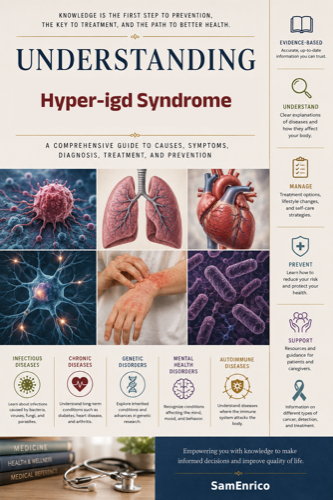
Non-FictionInformativeEducational
Understanding Hyper-igd Syndrome eBook
This disease publication, published by SamEnrico,
by Ricker Edyth
This disease publication, published by SamEnrico, covers Understanding Hyper-igd Syndrome
Formats
Free sample
Chapter 1: Beyond the Fever...--The first time two-year-old Maya’s temperature spiked to 105°F, her parents rushed her to the emergency room. Doctors diagnosed a viral infection and sent them home. The second time, three weeks later, they ran a full sepsis workup—blood cultures, lumbar puncture, chest x-ray—all negative. By the tenth episode, one exhausted emergency physician suggested Maya might have “fever phobia,” a polite way of saying her parents were imagining things.It would take four more years, fourteen different physicians, one unnecessary appendectomy, and a chance encounter with a rheumatology fellow who happened to remember a rare condition from her board review before Maya received a diagnosis: Hyper-Ig D Syndrome.Maya’s story is not unusual. It is, in fact, the rule.For most families affected by Hyper-Ig D Syndrome (HIDS), the journey to diagnosis is measured not in weeks but in years—an average of 15 months in the best-case scenarios, and up to two decades for those who fall through the cracks of the medical system.
During that time, children endure recurrent fevers so high that thermometers cannot read them, abdominal pain severe enough to mimic appendicitis, and joint swelling that makes walking impossible. Parents watch helplessly, are told it is “just a virus,” and are sent home to wait for the next attack.This book exists to change that.Welcome to the first comprehensive guide to Hyper-Ig D Syndrome written for patients, families, and the clinicians who care for them. Published by Sam Enrico, this book bridges the gap between cutting-edge immunology and the practical, day-to-day reality of living with a rare autoinflammatory disease. Whether you are a parent searching for answers, a patient who has finally received a diagnosis after years of uncertainty, a medical student encountering HIDS for the first time, or a primary care physician who suspects a periodic fever syndrome in an undiagnosed child—this book is for you.In this opening chapter, we will establish the essential foundation for everything that follows. We will explore what autoinflammatory diseases are and how they differ from the more familiar autoimmune conditions.
We will trace the history of HIDS from its discovery in 1984 to our current understanding. We will introduce the concept of the clinical spectrum—why some patients have mild, intermittent symptoms while others face devastating neurological disease—and we will end with a roadmap for the rest of this book. By the time you finish this chapter, you will understand not just what HIDS is, but why it has been so difficult to diagnose, and why there has never been a more hopeful time to be affected by this condition.What Are Autoinflammatory Diseases?To understand Hyper-Ig D Syndrome, we must first understand the broader category of diseases to which it belongs: the autoinflammatory disorders. This is a relatively new concept in medicine—the term “autoinflammation” was only coined in 1999—and it represents a fundamental shift in how we think about the immune system.The human immune system has two major branches: the innate immune system and the adaptive immune system. Think of the innate system as the body’s rapid-response security force.
It is always on duty, ready to recognize broad patterns of danger—the presence of bacterial cell walls, viral genetic material, or signals of cellular damage. It responds within minutes to hours, but it is not particularly precise. It does not remember past invaders; it treats every encounter as a new threat.The adaptive immune system, by contrast, is the body’s special forces unit. It takes days to mount a response, but that response is exquisitely specific. It produces antibodies that target precise molecular shapes and T cells that remember past infections for decades.
This is why you only get chickenpox once—your adaptive immune system remembers the virus and destroys it before it can cause illness again.Autoimmune diseases, such as lupus, rheumatoid arthritis, and multiple sclerosis, involve dysfunction of the adaptive immune system. In these conditions, the body produces autoantibodies—antibodies that target the body’s own tissues—and autoreactive T cells that attack healthy cells. The hallmark of autoimmune disease is the presence of these adaptive immune effectors.Autoinflammatory diseases, including HIDS, are fundamentally different. They involve dysregulation of the innate immune system in the complete absence of autoantibodies or autoreactive T cells. The innate system becomes activated inappropriately, not because it has mistaken self for non-self, but because the regulatory mechanisms that normally keep it in check have failed.
The result is uncontrolled inflammation—fever, pain, swelling—without an identifiable trigger.This distinction matters enormously for treatment. Autoimmune diseases typically respond to therapies that suppress the adaptive immune system: corticosteroids, methotrexate, biologics that deplete B cells or block T cell activation. Autoinflammatory diseases, by contrast, respond to therapies that block the innate immune system, particularly the cytokine interleukin-1 (IL-1). A patient with rheumatoid arthritis might improve on rituximab (which depletes B cells); a patient with HIDS might improve on anakinra (which blocks the IL-1 receptor). Choosing the wrong therapy for the wrong disease category not only fails to help—it can cause harm.HIDS is now considered a prototypical autoinflammatory condition.
It was one of the first diseases recognized to fit this new paradigm, and our understanding of its mechanisms has illuminated the pathophysiology of many other autoinflammatory disorders. If you understand HIDS, you understand the template for an entire class of diseases.The History of Hyper-Ig D Syndrome: From Mystery to Mechanism Every rare disease has a discovery story, and HIDS is no exception. The year was 1984. A Dutch internist named Jos van der Meer—who would later become one of the world’s foremost authorities on autoinflammatory diseases—encountered a series of patients who did not fit any known diagnostic category.These patients, six in total, shared a striking pattern. All had experienced recurrent episodes of high fever since early childhood.
All had significant abdominal pain during attacks, often accompanied by vomiting and diarrhea. All had painful swelling of the lymph nodes in the neck. And all had something unexpected in their blood tests: markedly elevated levels of immunoglobulin D (Ig D), an antibody whose function remained (and largely still remains) mysterious.Van der Meer published his findings in the prestigious journal The Lancet, describing a “new syndrome” characterized by recurrent fever, abdominal pain, lymphadenopathy, and hyper-Ig D. He named it Hyper-Ig D Syndrome, and for the next fifteen years, that name was essentially the sum total of what medicine understood about the condition.The syndrome was rare—van der Meer estimated its prevalence at less than one in a million—but case reports began to trickle in from other countries, particularly the Netherlands, France, and Germany. Patients were predominantly of Northern European descent, suggesting a genetic founder effect: a mutation that arose in a common ancestor and spread through generations.For nearly two decades, the cause of HIDS remained a complete mystery.
Clinicians could diagnose it based on the clinical pattern and elevated Ig D, but they had no idea why these patients got sick, why the attacks came and went, or why Ig D was elevated. Was it an immune deficiency? A metabolic disorder? A new category of…
This is the end of the free sample. Get the eBook to keep going. Buy now
About this book
Details
- Author
- Ricker Edyth
- Publisher
- SamEnrico
- Language
- English
- Genre
- Non-Fiction, Informative, Educational
- Released
- 2026-05-18
- Pages (approx.)
- 154
- Available as
- eBook, Audiobook

Read better in the ZLOADR app
Your eBooks on your phone or tablet. Sign in with your SamEnrico account and start reading.
More by Ricker Edyth
 Anger With Special Needs Child GuideRicker Edyth$11.99
 Brand Ranking Acquisition TargetingRicker Edyth$11.99
 PNE for Massage TherapistsRicker Edyth$11.99
 Financial Stress Inflation Coping GuideRicker Edyth$11.99
 The Velvet Revolution: How a Dress Changed a NationRicker Edyth$11.99
 Silk & Sabotage: The Rise and Fall of the First Fashion TycoonRicker Edyth$11.99
 UN World Bank Career GuideRicker Edyth$12.99
 Telehealth Customer Support OutlookRicker Edyth$12.99
 Arizona Cypress HarvestingRicker Edyth$11.99
 How to Become a Screw-machine Set-up OperatorRicker Edyth$11.99
You may also like
 Hong Kong Handover 1997Dunn Johnnie$11.99
 Zumba For Postnatal Recovery CourseNeal Christian$11.99
 Zumba for BeginnersLadner Nikia$11.99
 YouTube Comment Mining GuideHumes Pandora$12.99
 Worry Box MeditationCarlin Rudy$11.99
 Workplace Stress MeditationNguyen Lynn$11.99
 Workplace Stress and Sleep RepairHawley Ivory$11.99
 Workplace Perfectionism CureDelaney Jeffry$11.99
 Workplace Injustice Anger GuideWallen Isabelle$11.99
 Work Addiction and Burnout LinkGreenwood Ester$11.99
 Women in Yoga and WellnessBeattie Galina$11.99
 Women in Stand Up ComedyChun Evangeline$11.99