
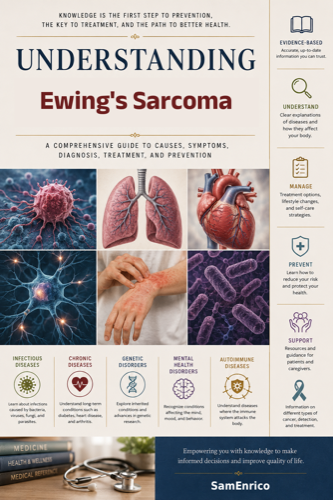
Non-FictionInformativeEducational
Understanding Ewing's Sarcoma eBook
This disease publication, published by SamEnrico,
by Santana Dyan
This disease publication, published by SamEnrico, covers Understanding Ewing's Sarcoma
Formats
Free sample
Chapter 1: The Silent Masquerader...--The pain started as a whisper.For seventeen-year-old Marcus, it was nothing more than a dull ache in his left thigh after basketball practice. He told himself it was shin splints, or maybe a stress fracture from that hard landing during the championship game. His mother, a nurse, checked for swelling. Nothing. His coach told him to ice it and stretch more.
So Marcus did what any teenager would do: he ignored it, popped over-the-counter pain relievers, and kept playing.But whispers have a way of becoming shouts.Three months later, that whisper was a roar. Marcus woke up at two in the morning with a pain so deep, so unlike anything he had ever felt, that it brought tears to his eyes. The ache was no longer just during practice. It was there when he rested. It was there when he tried to sleep.
It was there when he sat in class, a relentless gnawing sensation that felt like someone was drilling into his bone from the inside out. His mother noticed a firm, warm swelling on his mid-thigh. He had also lost twelve pounds without trying, and his usual boundless energy had evaporated into a fog of fatigue.This, right here, is where the story of Ewing's sarcoma almost always begins. Not with a dramatic fall or a sudden catastrophe, but with a quiet, persistent, and easily dismissed pain.The Most Deceptive Symptom in Pediatric Oncology Ewing's sarcoma is a master of disguise. Its earliest and most common symptom—bone pain—is also one of the most common complaints in the entire pediatric and adolescent population.
Millions of young people experience growing pains, sports injuries, shin splints, and muscle strains every day. The vast majority of them are right to ignore it. But for approximately two hundred to two hundred fifty families in the United States each year, that pain is the first warning sign of a rare and aggressive bone or soft tissue cancer.Understanding Ewing's sarcoma begins, therefore, not with genetics or chemotherapy regimens, but with a single, critical question: How do you tell the difference between a harmless ache and a life-threatening tumor?The answer lies in the specific character of the pain, the accompanying symptoms, and the timeline. This chapter will walk you through the clinical presentation of Ewing's sarcoma with the precision of an experienced clinician, but with the language of a trusted friend. By the end, you will understand what the medical literature calls the symptom interval, why Ewing's is known as the great masquerader, and most importantly, when to insist on further testing.Primary Pain: The Bone's Cry for Help The pain of Ewing's sarcoma is not random.
It follows a pattern that, once recognized, is highly suggestive of an underlying bone tumor. Let us break down that pattern in detail.Location, Location, Location Ewing's sarcoma has preferred homes within the skeleton. While it can occur in almost any bone, it shows a strong predilection for the long bones of the arms and legs—specifically the diaphysis, or shaft, of the femur, tibia, and humerus—and the flat bones of the axial skeleton, including the pelvis, ribs, spine, and scapula. In younger children, the femur is the most common site. In adolescents and young adults, the pelvis and sacrum become increasingly frequent primary locations.This anatomical preference matters immensely.
Pain in the pelvis or spine is even more easily dismissed than extremity pain. A teenager with hip pain is often told they have a pulled muscle or hip flexor strain. A child with back pain is assumed to have poor posture or a heavy backpack. Meanwhile, a tumor is quietly expanding within the bone, stretching the periosteum—the pain-sensitive membrane covering the bone—and eroding cortical bone from the inside out. The periosteum is richly innervated with pain fibers.
As the tumor grows, it puts tension on this membrane, generating a deep, poorly localized ache that patients struggle to describe.The Pain Profile: Night Pain and Rest Pain The single most important red flag in the history of a patient with Ewing's sarcoma is pain at rest or pain that awakens the patient from sleep.Mechanical pain—the kind from an overuse injury or a stress fracture—typically improves with rest. You stop running, the pain subsides. You lie down, the muscle relaxes. Tendons and ligaments recover when they are not under load. But the pain of a bone tumor is not mechanical.
It is biological. The tumor grows regardless of what the patient is doing. It does not take a break when you lie down. In fact, lying down can worsen the pain because the periosteum is no longer under the protective tension of surrounding muscles. During activity, muscles contract and compress the underlying bone, providing a kind of natural splinting.
At night, when the muscles relax, that splinting effect disappears, and the full force of the tumor's pressure on the periosteum is unmasked.Marcus's two AM awakening is a classic presentation that every pediatric oncologist recognizes. Patients describe the pain as deep, boring, gnawing, or throbbing. It is often severe enough to limit sleep to short fragmented naps. It may temporarily improve with over-the-counter analgesics like ibuprofen or acetaminophen, only to return when the medication wears off a few hours later. Parents frequently report that their child has started sleeping in odd positions, avoiding pressure on the affected limb, or has become irritable and withdrawn due to chronic sleep disruption.
Children may cry out in their sleep. Teenagers may become moody and aggressive, not from adolescence, but from months of untreated pain.The NSAID Trap A dangerous clinical trap involves the use of non-steroidal anti-inflammatory drugs. These medications are remarkably effective at reducing the inflammatory component of bone tumor pain. A child with Ewing's sarcoma who takes ibuprofen may experience significant relief for four to six hours. Parents and physicians may interpret this improvement as evidence of a benign inflammatory condition like tendinitis or growing pains.
The child is sent home with a prescription for more NSAIDs and a follow-up appointment in six weeks. Meanwhile, the tumor continues its relentless growth, and the symptom interval lengthens.The key distinction is complete versus partial resolution. A true mechanical injury should eventually heal. The pain should gradually diminish over days to weeks. In a bone tumor, the pain may temporarily improve with medication, but it will return to baseline just as quickly.
And over time, the baseline pain escalates. The child requires higher doses, more frequent dosing, or stronger medications just to achieve the same level of relief.Progression Over Time: The Growing Mass In the early weeks, there may be no visible mass at all. The tumor is confined within the bone, hidden from view beneath the cortical shell. It is only when the tumor erodes through the cortex and invades the surrounding soft tissue that a palpable mass becomes apparent. This process typically takes weeks to months, which is why the symptom interval is so long.This mass has characteristic features that distinguish it from benign swellings.
It is typically firm, not fluctuant like a cyst or abscess. It is fixed to the underlying bone, meaning it…
This is the end of the free sample. Get the eBook to keep going. Buy now
About this book
Details
- Author
- Santana Dyan
- Publisher
- SamEnrico
- Language
- English
- Genre
- Non-Fiction, Informative, Educational
- Released
- 2026-05-11
- Pages (approx.)
- 158
- Available as
- eBook, Audiobook

Read better in the ZLOADR app
Your eBooks on your phone or tablet. Sign in with your SamEnrico account and start reading.
More by Santana Dyan
 Body Image for Ostomy Patients CourseSantana Dyan$11.99
 Shift Work Earplug GuideSantana Dyan$11.99
 Vanadium And Blood SugarSantana Dyan$11.99
 The Referral EngineSantana Dyan$11.99
 Self Esteem and Different LibidosSantana Dyan$11.99
 The Silk Road of Science: How China’s Secret Genome Heist Changed Biology ForeverSantana Dyan$11.99
 The Last Transmission: The Haunting of Shortwave RadioSantana Dyan$11.99
 How to Become a Internal-combustion-engine SubassemblerSantana Dyan$11.99
 ToS Common MistakesSantana Dyan$12.99
 Executive Summary Cheat Sheet for ManagersSantana Dyan$12.99
 Network Operations AdministratorSantana Dyan$11.99
You may also like
 Hong Kong Handover 1997Dunn Johnnie$11.99
 Zumba For Postnatal Recovery CourseNeal Christian$11.99
 Zumba for BeginnersLadner Nikia$11.99
 YouTube Comment Mining GuideHumes Pandora$12.99
 Worry Box MeditationCarlin Rudy$11.99
 Workplace Stress MeditationNguyen Lynn$11.99
 Workplace Stress and Sleep RepairHawley Ivory$11.99
 Workplace Perfectionism CureDelaney Jeffry$11.99
 Workplace Injustice Anger GuideWallen Isabelle$11.99
 Work Addiction and Burnout LinkGreenwood Ester$11.99
 Women in Yoga and WellnessBeattie Galina$11.99
 Women in Stand Up ComedyChun Evangeline$11.99