
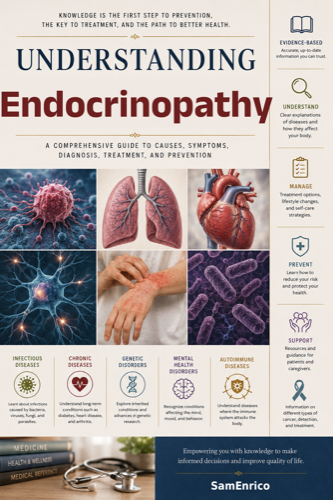
Understanding Endocrinopathy eBook
This disease publication, published by SamEnrico,
by Hodge Margo
This disease publication, published by SamEnrico, covers Understanding Endocrinopathy
Formats
Free sample
Chapter 1: The Silent Conversation...--The human body is speaking to itself at this very moment. You cannot hear it. You cannot see it. But beneath your skin, trillions of messages are traveling through rivers of blood, crossing cellular borders, and knocking on molecular doors. This is the silent conversation—the endocrine system at work—and when it falters, the whispers become symptoms, and the symptoms become diseases.Most people go their entire lives without thinking about their hormones until something goes wrong.
A woman in her thirties gains twenty pounds despite eating the same meals and exercising the same routine. A man in his forties wakes up exhausted after eight hours of sleep, convinced he must have a sleep disorder. A teenager grows taller than every peer but complains of headaches that blur the edges of the world. A grandfather, sharp as a tack for eighty years, suddenly becomes confused and constipated, and the family whispers about dementia.These are not separate mysteries. They are the same story told in different voices.
Each of these patients has an endocrinopathy—a derangement of the silent conversation. And each of them will be misdiagnosed, sometimes for years, because the language of hormones is not taught in most medical schools as a living, breathing narrative. It is taught as memorization: gland A makes hormone B, which acts on organ C. That is like learning to read by memorizing the alphabet without ever forming a word.This book is different. Understanding Endocrinopathy teaches you to listen to the conversation.
By the time you finish these twelve chapters, you will not merely know facts about hormones. You will understand why a patient with normal thyroid labs can still feel unwell. You will know why a woman with polycystic ovaries and a man with low testosterone are often suffering from the same underlying metabolic problem. And you will recognize that the endocrine system is not a collection of isolated glands but an integrated network of feedback loops, rhythms, and checks and balances that evolution has spent millions of years perfecting.But before we can understand the diseases, we must understand the language. And before we can understand the language, we must meet the speakers.The Definition of an Endocrinopathy Let us begin with precision.
Throughout this book, we will use a single, consistent definition:An endocrinopathy is a clinically significant derangement of hormone secretion, action, or clearance, whether absolute or relative.This definition is carefully chosen. It contains three critical elements.First, clinically significant distinguishes true disease from normal physiologic variation. A pregnant woman has elevated cortisol and estrogen—that is not Cushing's syndrome or hyperestrogenism. A teenager in a growth spurt has high growth hormone—that is not acromegaly. An athlete after a marathon has suppressed thyroid function—that is not hypothyroidism.
The body is designed to bend without breaking. Endocrinopathy begins only when that bending causes harm.Second, derangement of secretion, action, or clearance captures the three ways hormones can fail. A gland may secrete too much (hyperfunction) or too little (hypofunction). Even with normal secretion, the target organ may fail to respond (resistance syndrome). Or the liver and kidneys may fail to clear a hormone properly, leading to accumulation despite normal production.Third, absolute or relative acknowledges that some endocrinopathies are binary (either you have it or you do not), while others exist on a spectrum.
Type 1 diabetes is absolute insulin deficiency—without exogenous insulin, death follows. Type 2 diabetes, by contrast, is relative deficiency: the pancreas makes insulin, but not enough for the body's demands. Both are endocrinopathies. Both kill slowly. But they require different thinking, different testing, and different treatment.With this definition anchored, we can now explore the instruments of the conversation itself.The Three Hormone Classes: Peptides, Steroids, and Amines Every hormone belongs to one of three chemical families.
This is not an academic distinction. The family determines how the hormone is made, how it travels, how long it lasts, and how it speaks to its target cells. A clinician who confuses a peptide for a steroid will misinterpret lab results, choose the wrong stimulation test, and fail to understand why some hormones work instantly while others take hours.Peptide Hormones: The Fast Messengers Peptide hormones are chains of amino acids. They range from small strings (thyrotropin-releasing hormone has just three amino acids) to large proteins (growth hormone has 191). They are water-soluble, which means they dissolve in blood plasma and travel freely without carrier proteins.
But being water-soluble comes with a price: they cannot cross the fatty membrane of a cell.Because peptides cannot enter cells, they must knock on the door. That door is a receptor on the cell surface. When the peptide binds, it triggers a cascade of intracellular messengers—secondary signals that amplify the original message. This is why peptide hormones act in seconds to minutes. Think of insulin lowering blood glucose within minutes of a meal, or epinephrine racing through the bloodstream during a fright, raising heart rate and blood pressure before you have consciously registered the danger.Peptide hormones are synthesized in advance and stored in vesicles, like a warehouse stocking shelves.
This explains why stimulation tests work: when you inject a releasing hormone, the gland dumps pre-made peptides into the blood within minutes. It also explains why peptide hormone excess can be episodic—a tumor that releases stored hormone in unpredictable bursts.Common peptide hormones include insulin, glucagon, growth hormone, prolactin, PTH, calcitonin, and all hypothalamic releasing hormones.Steroid Hormones: The Slow Architects Steroid hormones are derived from cholesterol. Unlike peptides, they are lipid-soluble. This means they require carrier proteins to travel through blood (cholesterol does not dissolve in plasma any more than oil dissolves in water), but once they reach a target cell, they slip directly through the cell membrane without needing a surface receptor.Inside the cell, steroids bind to intracellular or nuclear receptors, and that complex travels to the nucleus to directly turn genes on or off. This is a slow process—minutes to hours, sometimes days—but the effects are profound and long-lasting.
Cortisol does not save you from a threat in the next five seconds; it prepares your body for the next five hours. Estrogen does not trigger ovulation instantly; it builds the uterine lining over two weeks.Because steroids are synthesized on demand from cholesterol, their secretion cannot be instantly triggered by a stimulation test the way peptides can. A cosyntropin stimulation test works for cortisol because the adrenal cortex stores small amounts of intermediate compounds, not because it stores finished cortisol in large quantities. This is a subtle but critical distinction for clinicians choosing dynamic tests.Common steroid hormones include cortisol, aldosterone, estradiol, progesterone, and testosterone. The adrenal cortex produces the first three; the gonads produce the last three, though with significant overlap (the adrenals produce weak androgens, the ovaries produce some testosterone).Amine Hormones: The Hybrids Amine hormones are derived from single amino acids—tyrosine or tryptophan.
They blur the line between peptides and steroids. The two families of amines behave so differently that they are best considered separately.Catecholamines (epinephrine, norepinephrine, dopamine) are water-soluble like peptides. They travel freely in blood, bind to surface receptors, and…
This is the end of the free sample. Get the eBook to keep going. Buy now
About this book
Details
- Author
- Hodge Margo
- Publisher
- SamEnrico
- Language
- English
- Genre
- Non-Fiction, Informative, Educational
- Released
- 2026-05-08
- Pages (approx.)
- 160
- Available as
- eBook, Audiobook

Read better in the ZLOADR app
Your eBooks on your phone or tablet. Sign in with your SamEnrico account and start reading.
More by Hodge Margo
 Chunking and Active RecallHodge Margo$11.99
 Assertive Anger WorkbookHodge Margo$11.99
 Self Hypnosis For Anxiety Relief GuideHodge Margo$11.99
 Student Mental Health First AidHodge Margo$11.99
 Beginner's Jump Rope GuideHodge Margo$11.99
 The Grand Illusion: How the Ritz-Carlton Empire Built a Kingdom of LuxuryHodge Margo$11.99
 The Great Airline Heist: How a Rogue Pilot Stole a Plane and Changed Aviation ForeverHodge Margo$11.99
 How to Start a Precious Stones (wholesale) Business (Beginners Guide)Hodge Margo$11.99
 SAFe for Microsoft StartupsHodge Margo$12.99
 Redbubble Product PricingHodge Margo$12.99
 Front Desk RepresentativeHodge Margo$11.99