
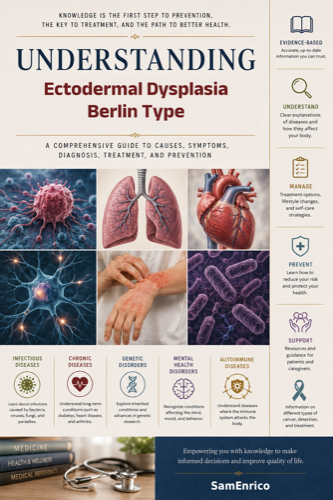
Non-FictionInformativeEducational
Understanding Ectodermal Dysplasia Berlin Type eBook
This disease publication, published by SamEnrico,
This disease publication, published by SamEnrico, covers Understanding Ectodermal Dysplasia Berlin Type
Formats
Free sample
Chapter 1: The Leopard’s Secret...--The first time a mother sees her newborn's skin mottled with patches of dark and light, she is told not to worry. "Birthmarks," the nurses say. "They fade." But they do not fade. They deepen. By the time the first tooth fails to arrive – and then the second, and then the third – the worry has become a quiet, grinding dread.
The pediatrician calls it "delayed development." The dermatologist says "possible pigmentary disorder." The geneticist shrugs and writes "syndrome, unspecified." And somewhere in the stack of medical records, buried under years of consultations and second opinions, a single footnote might mention a 1961 paper from Berlin describing three children who looked exactly like yours.This is the diagnostic odyssey of Ectodermal Dysplasia Berlin Type. It is a journey measured not in miles but in years of uncertainty, in the space between what doctors can name and what they cannot. For the families who live it, the condition is not an abstract collection of symptoms in a medical journal. It is the daily reality of explaining to a school nurse why your child cannot regulate temperature like other children. It is the heartbreak of watching a teenager avoid mirrors because her hair never grew in.
It is the exhaustion of fighting insurance companies for dental implants that cost more than a car.And yet, for all its weight on the lives of those affected, Ectodermal Dysplasia Berlin Type remains one of the most poorly understood conditions in all of medical genetics. As of this writing, the entire published literature on the syndrome consists of a single case series from 1961. No gene has been identified. No clinical trials have been conducted. No foundation exists solely for this diagnosis.
Families who receive this label are handed a piece of paper with a name and sent home with nothing but questions.This book is the answer to those questions. It is the first comprehensive guide to Ectodermal Dysplasia Berlin Type ever written, and it exists because no family should navigate the unknown alone.Before we can understand what this condition is, we must first understand what it is not. We must place it within the vast and confusing landscape of ectodermal dysplasias – a family of over 100 genetic disorders that share a common origin in the earliest days of human development. We must confront the uncomfortable truth that much of what is "known" about Berlin Type comes from a single source, and we must learn to distinguish between what the data actually says and what experts reasonably infer. And we must begin with the most fundamental question of all: What happens when the ectoderm goes wrong?The Embryonic Blueprint: How You Became You Every human being begins as a single cell, no larger than the period at the end of this sentence.
Within days, that cell divides and organizes into three distinct layers. These layers, called germ layers, are the architectural plans for every structure in the human body.The innermost layer, the endoderm, becomes the lining of the gut and the lungs. The middle layer, the mesoderm, becomes muscles, bones, blood, and the heart. And the outermost layer – the one that matters most for this book – is the ectoderm.The ectoderm is the body's surface layer. Its name comes from the Greek words ektos (outside) and derma (skin), and its job is to build everything that touches the outside world.
From the ectoderm arise:The epidermis (the outer layer of the skin) and all its associated structures: hair follicles, nails, sweat glands, and sebaceous glands The teeth, from the enamel to the supporting structures The lens of the eye and parts of the cornea The inner ear The entire nervous system, including the brain and spinal cord When the ectoderm develops correctly, these structures form in harmony, each one taking its proper place and function. But when something goes wrong – when a genetic mutation disrupts the instructions – the result can be a syndrome affecting multiple ectodermal structures simultaneously.This is the unifying theme of all ectodermal dysplasias. They are not diseases of infection or injury or immune dysfunction. They are errors in the blueprint, written in the language of DNA, that manifest as absent or malformed ectodermal structures.The Ectodermal Dysplasia Umbrella: More Than 100 Different Conditions The term "ectodermal dysplasia" was first used in the medical literature in the 1920s, but it took decades for researchers to realize that not all ectodermal dysplasias are the same. Today, the National Foundation for Ectodermal Dysplasias recognizes over 100 distinct types, each with its own genetic cause and clinical features.Some are relatively common, at least in the world of rare diseases.
X-linked hypohidrotic ectodermal dysplasia (also known as Christ-Siemens-Touraine syndrome) affects approximately 1 in 20,000 people worldwide. It is characterized by sparse hair, missing teeth, and an inability to sweat – a potentially dangerous combination in hot weather.Others are vanishingly rare, known only from a handful of families or even a single case report. These conditions often lack formal diagnostic criteria, have no identified genetic cause, and exist primarily as footnotes in the medical literature. Ectodermal Dysplasia Berlin Type belongs to this latter group.The challenge for clinicians and families alike is that many ectodermal dysplasias look similar at first glance. A child with missing teeth and sparse hair could have any of a dozen different syndromes.
The differences lie in the details: the pattern of skin pigmentation, the presence or absence of sweating, the involvement of nails, the presence of intellectual disability or growth delay, the specific shape of the facial features.This is why diagnosis matters. Giving a condition a name is not merely an academic exercise. It is the first step toward understanding prognosis, anticipating complications, and connecting with other families who share the same journey.What We Know – And What We Do Not Know – About Berlin Type Ectodermal Dysplasia Berlin Type was first described in 1961 by a physician named Dr. Berlin (whose full name and institutional affiliation have been lost to time, a casualty of incomplete record-keeping in the pre-digital era). The original publication, written in German, described a family in which multiple children presented with a distinctive combination of features:Generalized melanoleukoderma – a striking pattern of hyperpigmented (dark) and hypopigmented (light) patches covering much of the body, resembling a leopard's coat Palmoplantar keratoderma – thickened, calloused skin on the palms of the hands and soles of the feet Hypotrichosis – sparse hair on the scalp, eyebrows, and body, including absence of the fine lanugo hair that normally covers newborns Hypodontia – congenitally missing teeth, with the remaining teeth often delayed in eruption and abnormal in shape Short stature – growth delay resulting in adult height significantly below average Intellectual disability – cognitive impairment of varying severity Infantilism and hypogonadism – delayed or absent puberty, particularly in males Distinctive craniofacial features – including a depressed nasal bridge and telangiectasias (small dilated blood vessels) on the lips Since that 1961 publication, no additional cases have been described in the peer-reviewed medical literature.
This raises an obvious and uncomfortable question: Does Ectodermal Dysplasia Berlin Type still exist?The honest answer is that we do not know. There are several possibilities:Possibility One: The condition is so extraordinarily rare that the original family represents the…
This is the end of the free sample. Get the eBook to keep going. Buy now
About this book
Details
- Author
- Garrison Dona
- Publisher
- SamEnrico
- Language
- English
- Genre
- Non-Fiction, Informative, Educational
- Released
- 2026-06-03
- Pages (approx.)
- 158
- Available as
- eBook, Audiobook

Read better in the ZLOADR app
Your eBooks on your phone or tablet. Sign in with your SamEnrico account and start reading.
More by Garrison Dona
 Personal Ing For Success LeadershipGarrison Dona$11.99
 Conference Panel Speaking GuideGarrison Dona$11.99
 Self Hypnosis For Allergy ReliefGarrison Dona$11.99
 Home Office Distraction WorkbookGarrison Dona$11.99
 Herbal Remedies for PMSGarrison Dona$11.99
 The Silk and the Scandal: The Divorce That Split an EmpireGarrison Dona$11.99
 The Billionaire’s Secret War: How One Man Bankrolled the Cold WarGarrison Dona$11.99
 Dental Lab TechnicianGarrison Dona$11.99
 Voiceover Union MembershipGarrison Dona$12.99
 Turkish Data Breach GuideGarrison Dona$12.99
 How to Become a Automobile-body CustomizerGarrison Dona$11.99
You may also like
 Hong Kong Handover 1997Dunn Johnnie$11.99
 Zumba For Postnatal Recovery CourseNeal Christian$11.99
 Zumba for BeginnersLadner Nikia$11.99
 YouTube Comment Mining GuideHumes Pandora$12.99
 Worry Box MeditationCarlin Rudy$11.99
 Workplace Stress MeditationNguyen Lynn$11.99
 Workplace Stress and Sleep RepairHawley Ivory$11.99
 Workplace Perfectionism CureDelaney Jeffry$11.99
 Workplace Injustice Anger GuideWallen Isabelle$11.99
 Work Addiction and Burnout LinkGreenwood Ester$11.99
 Women in Yoga and WellnessBeattie Galina$11.99
 Women in Stand Up ComedyChun Evangeline$11.99