
Non-FictionInformativeEducational
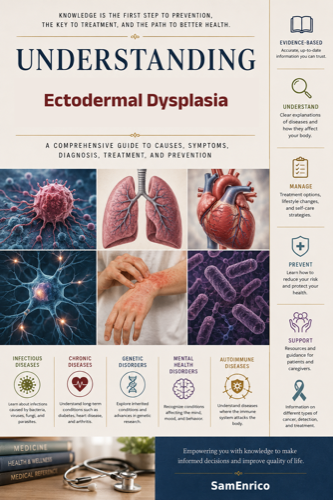
Understanding Ectodermal Dysplasia eBook
This disease publication, published by SamEnrico,
This disease publication, published by SamEnrico, covers Understanding Ectodermal Dysplasia
Formats
Free sample
Chapter 1: The Silent Origin...--Every human journey begins with a single cell. For most people, that first cell divides, differentiates, and unfolds according to a plan written over millions of years of evolution. But for individuals with ectodermal dysplasia, something subtle and significant goes differently in those earliest moments of development—not necessarily better or worse, but different in ways that shape an entire life.Imagine, for a moment, the third week of pregnancy. The fertilized egg has embedded itself in the uterine wall. Cells are multiplying rapidly, and something remarkable begins to happen: they start organizing themselves into three distinct layers.
The innermost layer, the endoderm, will become the lungs, digestive tract, and internal organs. The middle layer, the mesoderm, will form muscles, bones, blood vessels, and the heart. And the outermost layer—the one that matters most for this story—is called the ectoderm.The ectoderm is, quite literally, the surface of you. From this single thin sheet of cells arise your skin, the protective barrier between your body and the world. From the same layer come your hair, your nails, the enamel of your teeth, and your sweat glands.
In a very real sense, the ectoderm creates everything that connects you to the outside world and everything that lets the outside world see you.For reasons that scientists have spent decades trying to understand, the ectoderm does not always develop according to the usual blueprint. Sometimes the signals between cells get crossed. Sometimes a single gene—one letter out of three billion in the human genome—carries a typo that changes everything downstream. And when that happens, the structures that should form from the ectoderm may be missing, underdeveloped, or shaped differently than expected.That is ectodermal dysplasia. It is not one disease but a family of over one hundred distinct genetic conditions, all united by a common theme: something went slightly off in the development of the ectoderm.
The word "dysplasia" simply means abnormal development. Put the two together, and you have a name that describes exactly what happens when those embryonic layers fail to follow their original instructions.What the Ectoderm Builds To understand ectodermal dysplasia, you must first appreciate what the ectoderm does in a typical pregnancy. This thin layer of cells, no thicker than a piece of tissue paper in those early weeks, undergoes an extraordinary transformation.The Skin Your skin is the largest organ of your body, and all of it comes from the ectoderm. The outermost layer, the epidermis, develops directly from these cells. Beneath it, the dermis comes from the mesoderm, but the ectoderm sends signals telling the dermis how to form.
In ectodermal dysplasia, the epidermis itself may be thin, fragile, or prone to inflammation. Some individuals experience chronic dryness—xerosis—because the skin cannot retain moisture properly. Others develop eczematous rashes that come and go without clear triggers. The skin may be more sensitive to sun exposure, to abrasive fabrics, or to ordinary environmental irritants that most people never notice.The Hair Every hair on your body—from the fine vellus hairs on your forehead to the thicker terminal hairs on your scalp—develops from hair follicles that originate in the ectoderm. The process is remarkably complex, requiring precise signaling between the ectoderm and the underlying mesoderm.
In ectodermal dysplasia, the hair follicles may be sparse, absent, or malformed. Hair that does grow may be fine, slow-growing, fragile, or lacking pigment. Some individuals have hair only on certain parts of the scalp. Others have eyebrows and eyelashes that are thin or missing entirely. For many families, the hair changes are the first visible sign that something is different.The Nails Fingernails and toenails are specialized structures derived from the ectoderm.
They form from the nail matrix, a cluster of cells at the base of each nail that continuously produces new keratin. In ectodermal dysplasia, the nails may be small, thin, brittle, or entirely absent. Some individuals have nails that grow slowly and peel easily. Others develop thickened, dystrophic nails that resemble fungal infections but are actually caused by the underlying genetic condition. Nail problems may be present from birth or may become more apparent as the child grows.The Teeth Teeth are perhaps the most complex structures derived from the ectoderm, but with an important twist.
The enamel—the hard outer layer—comes from the ectoderm. The dentin, cementum, and pulp come from the mesoderm. This means teeth require cooperation between both embryonic layers, and they are exquisitely sensitive to disruptions in signaling. In ectodermal dysplasia, the most common dental finding is hypodontia: missing teeth. Some individuals are missing only a few teeth, often the lateral incisors or second premolars.
Others are missing most or all of their teeth. The teeth that do erupt may be conical (pegged), small, or delayed. The enamel may be thin, pitted, or discolored. For many people with ED, the dental challenges are the most significant daily obstacles they face.The Sweat Glands Sweat glands, specifically the eccrine glands that produce the watery sweat responsible for cooling, develop directly from the ectoderm. They form when the ectoderm sends fingerlike projections down into the dermis, curling into small balls that will become the secretory coils of the glands.
In hypohidrotic ectodermal dysplasia (the most common form), these glands may be reduced in number, malformed, or completely absent. The result is hypohidrosis (reduced sweating) or anhidrosis (complete inability to sweat). Without the ability to sweat, the body cannot cool itself through evaporative cooling. This makes individuals with this form of ED vulnerable to hyperthermia—dangerous overheating—in warm environments or during physical exertion.Other Ectodermal Structures The ectoderm also gives rise to several other structures that can be affected in various forms of ED. These include the lenses of the eyes, parts of the inner ear, the mammary glands, and portions of the nervous system.
Some types of ED involve hearing loss, vision problems, or cleft lip and palate. Others affect the immune system or lead to neurological differences. The specific combination of features depends entirely on which gene is involved and how severely it is affected.The Spectrum of Differences One of the most important concepts to grasp about ectodermal dysplasia is that it exists on a spectrum. No two people with ED are exactly alike, even within the same family and even with the same genetic mutation.At one end of the spectrum are individuals with very mild forms of ED. They might have a few missing teeth, slightly sparse hair, and no other obvious signs.
They may go through childhood without ever receiving a diagnosis, assuming their features are just family traits. At the other end are individuals with severe, multi-system involvement: complete absence of sweat glands, no teeth at all, very sparse hair, fragile nails, and additional complications affecting their eyes, ears, or other organs.Between these extremes lies every possible combination. A person might have normal sweating but severe dental involvement. Another might have thick, dystrophic nails but a full head of hair. A third might have all the classic features of hypohidrotic ED but with such mild expression that the diagnosis is not made until adulthood when their own child…
This is the end of the free sample. Get the eBook to keep going. Buy now
About this book
Details
- Author
- Draper Vanesa
- Publisher
- SamEnrico
- Language
- English
- Genre
- Non-Fiction, Informative, Educational
- Released
- 2026-06-01
- Pages (approx.)
- 146
- Available as
- eBook, Audiobook

Read better in the ZLOADR app
Your eBooks on your phone or tablet. Sign in with your SamEnrico account and start reading.
More by Draper Vanesa
 Sales Relationship Building GuideDraper Vanesa$11.99
 Self Hypnosis For Emotional RegulationDraper Vanesa$11.99
 Procrastination Cure for StudentsDraper Vanesa$11.99
 Physical Strain ManualDraper Vanesa$11.99
 Menopause Transition PeriodsDraper Vanesa$11.99
 Shadows of the Silk Road: The Forgotten War of the SteppeDraper Vanesa$11.99
 The Clockwork Tide: Medieval Automation in the Indian OceanDraper Vanesa$11.99
 Data Operations SpecialistDraper Vanesa$11.99
 How to Become a Career-guidance TechnicianDraper Vanesa$11.99
 Voiceover Website GuideDraper Vanesa$12.99
 Brazil Data Protection GuideDraper Vanesa$12.99
You may also like
 Hong Kong Handover 1997Dunn Johnnie$11.99
 Zumba For Postnatal Recovery CourseNeal Christian$11.99
 Zumba for BeginnersLadner Nikia$11.99
 YouTube Comment Mining GuideHumes Pandora$12.99
 Worry Box MeditationCarlin Rudy$11.99
 Workplace Stress MeditationNguyen Lynn$11.99
 Workplace Stress and Sleep RepairHawley Ivory$11.99
 Workplace Perfectionism CureDelaney Jeffry$11.99
 Workplace Injustice Anger GuideWallen Isabelle$11.99
 Work Addiction and Burnout LinkGreenwood Ester$11.99
 Women in Yoga and WellnessBeattie Galina$11.99
 Women in Stand Up ComedyChun Evangeline$11.99