
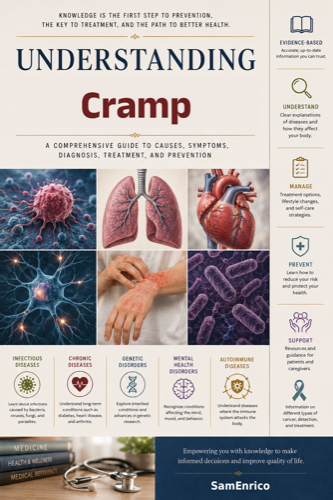
Non-FictionInformativeEducational
Understanding Cramp eBook
This disease publication, published by SamEnrico,
This disease publication, published by SamEnrico, covers Understanding Cramp
Formats
Free sample
Chapter 1: The 3 AM Scream--–- The sound came from deep in his throat, somewhere between a gasp and a cry. James Chen, a fifty-two-year-old architect from Portland, Oregon, had been sleeping soundly when his left calf transformed into what he later described as "a fist squeezing from the inside." His eyes flew open. He grabbed his leg. The muscle felt like a rock—hard, immovable, impossibly tense. His wife stirred beside him.
"What's wrong?" she whispered. James couldn't answer. He was pinned to the bed by his own body, a prisoner in a pain that seemed to have no source and no end. Twenty seconds passed. Thirty.
He bit his lip until he tasted copper. Finally, slowly, the muscle began to unlock. He sat up, drenched in sweat, trembling. His calf throbbed with a dull, angry ache. He looked at the clock: 3:17 AM.
It was the third time that month.–- James is not alone. He is one of an estimated 100 million adults in North America and Europe who experience muscle cramps regularly. Yet when he mentioned the cramps to his doctor during a routine physical, the response was brief and unsatisfying: "Drink more water. Eat a banana. It's probably nothing." James left the office with a prescription for reassurance and a lingering sense that something was being missed.
He tried the water. He ate the bananas. The cramps continued.–- This book exists because answers like "drink more water" are not just unhelpful—they are wrong. Worse, they keep millions of people from understanding what is actually happening inside their bodies when a cramp strikes. The purpose of this opening chapter is to give you something that James did not receive: a clear, scientifically accurate, and immediately useful explanation of what a muscle cramp is, how common they really are, and why the standard advice you have heard for decades is based on a misunderstanding of human physiology.
By the end of this chapter, you will understand the single most important concept that underpins this entire book: cramps are not a muscle problem. They are a nerve problem. And once you understand that, everything changes.The Anatomy of an Event–- Let us begin with precision. A muscle cramp—medically termed a "cramp" or, more formally, a "benign idiopathic muscle cramp" when no underlying disease is found—is defined as a sudden, involuntary, painful contraction of one or more skeletal muscles. The key words here are "involuntary" (you cannot stop it by an act of will), "painful" (the degree of pain ranges from uncomfortable to incapacitating), and "contraction" (the muscle fibers are actively shortening, not simply stiff or sore).
During a cramp, the affected muscle becomes visibly hard and may even change shape, bulging or distorting as individual muscle fascicles contract at maximal intensity.–- To understand what this feels like, imagine trying to voluntarily make a fist as hard as you possibly can—then multiply that intensity by three, add a complete inability to let go, and apply it to any muscle in your body. That is a cramp. The experience is not merely uncomfortable; it is biomechanically extraordinary. During a full-blown cramp, the muscle generates tension that can exceed voluntary maximum contraction by fifty to one hundred percent. This is why cramps can actually cause visible muscle distortion or even, in rare cases, avulsion fractures where the tendon pulls a piece of bone away from its attachment.–- Cramps can occur in any skeletal muscle, but they show a strong preference for certain locations.
The calf muscles (gastrocnemius and soleus) are the most common site, accounting for approximately sixty to seventy percent of all cramps. The hamstrings, quadriceps, feet (particularly the arch), hands, and paraspinal muscles of the lower back follow in descending order. This distribution is not random; it reflects the neurological and mechanical demands placed on these muscles. Muscles that cross two joints (like the gastrocnemius, which crosses both the knee and the ankle) are particularly vulnerable because they operate under complex stretch and load conditions.–- The duration of a typical cramp ranges from a few seconds to several minutes. Most cramps last between thirty and sixty seconds, though the subjective experience of time during a cramp is notoriously distorted.
A thirty-second cramp feels like an eternity. After the cramp subsides, the muscle enters a post-cramp state characterized by soreness, tenderness, and residual tightness that can persist for hours or even days. This after-effect, which we will explore in depth in Chapter 9, is not "just" soreness—it is evidence of microscopic muscle fiber damage and neurological hyperexcitability that requires active rehabilitation.The Numbers That Demand Attention–- How common are cramps? The answer depends on which population you examine, but the overall picture is striking. Among healthy adults with no known neurological or metabolic disorders, the one-year prevalence of muscle cramps ranges from fifty to sixty percent.
This means that in any given year, more than half of all healthy adults will experience at least one cramp. For adults over the age of fifty, the numbers rise significantly. Approximately forty percent of adults over fifty experience night cramps specifically—cramps that occur during sleep or at rest—and this percentage increases steadily with age.–- But the most revealing statistic comes from a very different population. Among patients with amyotrophic lateral sclerosis (ALS), a progressive neurodegenerative disease that selectively destroys motor neurons, the prevalence of muscle cramps approaches ninety-five percent. This is not a coincidence.
ALS attacks the alpha motor neurons—the very same nerve cells that signal muscles to contract. When these neurons become hyperexcitable, as they do in ALS, cramping becomes nearly universal. The relevance of this data to healthy cramp sufferers is profound. It demonstrates, beyond any reasonable doubt, that cramps can occur in perfectly healthy muscles when the nervous system malfunctions. The muscle itself is not the problem.
The nerve is.–- Other populations with elevated cramp prevalence include pregnant individuals (thirty to fifty percent, with the highest frequency in the third trimester), patients on dialysis (thirty-three to eighty-six percent), endurance athletes (up to sixty-seven percent of triathletes and marathon runners cramp during or immediately after competition), and individuals with peripheral neuropathy, cirrhosis, or thyroid disorders. These numbers are not academic. They represent tens of millions of people whose sleep is interrupted, whose athletic performance is destroyed, whose recovery from illness is complicated, and whose quality of life is diminished by a phenomenon that medical science has, until recently, largely ignored.What This Book Is—And Is Not–- This book is about skeletal muscle cramps. That means we will focus on cramps in the legs, feet, hands, back, and occasionally the abdominal wall. These are the cramps that affect the vast majority of sufferers.
We will not deeply cover smooth muscle cramps, such as menstrual cramps (which involve uterine smooth muscle) or intestinal cramps (which involve the smooth muscle of the digestive tract). These conditions have different mechanisms, different treatments, and different underlying physiology. They deserve their own books.–- We will also not cover cardiac cramps—a term that has no medical meaning because cardiac muscle does not cramp in the same way skeletal muscle does. Chest pain that feels…
This is the end of the free sample. Get the eBook to keep going. Buy now
About this book
Details
- Author
- Bernard Latanya
- Publisher
- SamEnrico
- Language
- English
- Genre
- Non-Fiction, Informative, Educational
- Released
- 2026-05-11
- Pages (approx.)
- 150
- Available as
- eBook, Audiobook

Read better in the ZLOADR app
Your eBooks on your phone or tablet. Sign in with your SamEnrico account and start reading.
More by Bernard Latanya
 TM PTSD RecoveryBernard Latanya$11.99
 Emotional Intelligence in Addiction RecoveryBernard Latanya$11.99
 Async M&A Due Diligence ManualBernard Latanya$11.99
 Long Acting Injectable BuprenorphineBernard Latanya$11.99
 Evidence Log for Imposter RecoveryBernard Latanya$11.99
 The Ghosts of Operation Cyclone: How the CIA’s Secret War in Afghanistan Shaped the Modern WorldBernard Latanya$11.99
 The Jungle’s Silent War: Tom Harrisson and the Borneo ResistanceBernard Latanya$11.99
 How to Start a Breakfast Cereal (uncooked) Business (Beginners Guide)Bernard Latanya$11.99
 Reddit Marketing Zero CostBernard Latanya$12.99
 Lease Renewal Negotiation TipsBernard Latanya$12.99
 Earth Oven Cook (Hāngī)Bernard Latanya$11.99
You may also like
 Hong Kong Handover 1997Dunn Johnnie$11.99
 Zumba For Postnatal Recovery CourseNeal Christian$11.99
 Zumba for BeginnersLadner Nikia$11.99
 YouTube Comment Mining GuideHumes Pandora$12.99
 Worry Box MeditationCarlin Rudy$11.99
 Workplace Stress MeditationNguyen Lynn$11.99
 Workplace Stress and Sleep RepairHawley Ivory$11.99
 Workplace Perfectionism CureDelaney Jeffry$11.99
 Workplace Injustice Anger GuideWallen Isabelle$11.99
 Work Addiction and Burnout LinkGreenwood Ester$11.99
 Women in Yoga and WellnessBeattie Galina$11.99
 Women in Stand Up ComedyChun Evangeline$11.99