
Non-FictionInformativeEducational
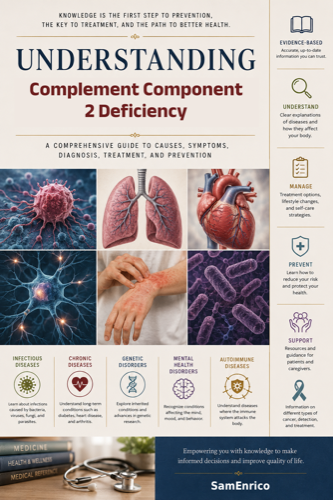
Understanding Complement Component 2 Deficiency eBook
This disease publication, published by SamEnrico,
by Gough Misha
This disease publication, published by SamEnrico, covers Understanding Complement Component 2 Deficiency
Formats
Free sample
Chapter 1: The Silent Army...--–- The human body is home to a silent army, one that works around the clock without rest, without recognition, and without complaint. This army does not carry weapons in the conventional sense, nor does it march in formation. Instead, it patrols your bloodstream, your tissues, and the thin membranes that line your lungs and gut. It is composed of more than fifty different proteins, each with a specific job, and together they form one of the most elegant and powerful defense systems in the natural world. This is the complement system, and without it, a simple paper cut or a common cold could spiral into a life-threatening catastrophe.Most people have never heard of the complement system.
Even many physicians, unless they specialize in immunology or rheumatology, may only dimly recall its existence from medical school lectures. And yet, this system is responsible for some of the most critical tasks your immune system performs: identifying invading bacteria, marking them for destruction, calling other immune cells to the site of infection, and literally punching holes in the walls of harmful microbes. When the complement system works properly, you never notice it. When it fails, the consequences can be devastating.This book is about one specific failure of this silent army: Complement Component 2 Deficiency, or C2 deficiency. It is a rare genetic condition that leaves a critical gap in the body’s defenses, yet it is also the most common inherited complement deficiency in Western populations.
Approximately one in every twenty thousand people carries two defective copies of the C2 gene, meaning they cannot produce a functional C2 protein. Many of these individuals will go through life without ever knowing they have this condition, suffering from recurrent infections or unexplained autoimmune symptoms that are misattributed to other causes. Others will discover their deficiency only after a catastrophic illness—meningitis, sepsis, or a devastating case of pneumonia—lands them in an intensive care unit.But before we can understand what goes wrong in C2 deficiency, we must first understand what should happen. We must meet the silent army in its full glory: how it is activated, how it fights, and how it cleans up the battlefield after the fight is over. Only then can we appreciate the specific role of the C2 protein, the consequences of its absence, and the strategies that patients and physicians can use to compensate for its loss.This chapter is your introduction to the complement system.
Think of it as basic training before you join the fight. By the end of this chapter, you will understand the three pathways that activate complement, the cascade of reactions that amplifies the initial signal, the three essential jobs complement performs, and why a deficiency in a single protein—C2—can cripple two of those three pathways. Whether you are a patient, a family member, a medical student, or a practicing clinician, this foundation will serve you for the rest of this book and, more importantly, for the rest of your journey with C2 deficiency.The Forgotten Branch of Immunity When most people think of the immune system, they think of antibodies and white blood cells. They recall getting vaccinated against measles or influenza, and they understand, at least vaguely, that their body produces defenses against specific germs. This is the adaptive immune system, a remarkable learning machine that remembers every pathogen it has ever encountered and mounts a faster, stronger response the second time around.But there is another branch of the immune system that does not need to learn, does not need to remember, and does not wait for an invitation.
This is the innate immune system, and the complement system is one of its oldest and most powerful components. Evolutionarily speaking, complement has been around for more than 600 million years. It predates antibodies by a wide margin. Simple animals like sea urchins and horseshoe crabs have complement-like systems, even though they have no adaptive immunity at all. This ancient lineage tells us something important: complement is foundational.
It is the immune system’s first responder, the cavalry that arrives before anyone has even placed the call.The complement system got its name in the late nineteenth century, when scientists discovered that antibodies alone could not kill bacteria. Something else in the blood had to “complement” the action of antibodies. That something turned out to be a cascade of more than thirty circulating proteins, most of them produced by the liver, that work together in a carefully ordered sequence. One protein activates the next, which activates the next, like a row of dominoes falling in rapid succession. At the end of this cascade, the complement system can destroy invading microbes directly, tag them for destruction by other immune cells, or summon additional reinforcements to the site of infection.Understanding this cascade is the single most important step to understanding C2 deficiency.
Because if the cascade is broken at the C2 step, then everything downstream of that step is compromised. The dominoes stop falling. The silent army cannot do its job.The Three Pathways to Activation The complement system does not activate itself randomly. It has three distinct pathways, each triggered by a different type of threat, but all of them converge on the same critical step: the cleavage of a protein called C3. Once C3 is activated, the rest of the cascade proceeds in a common pathway, regardless of which trigger started the process.
Think of the three pathways as three different roads that all lead to the same destination. The destination is the destruction of the invader. The roads are the classical, lectin, and alternative pathways.The Classical Pathway: The Antibody Connection The classical pathway is the one that first gave complement its name. It is triggered when antibodies of certain classes—specifically Ig M and certain subclasses of Ig G—bind to the surface of a pathogen. These antibodies are the adaptive immune system’s way of saying, “This thing is dangerous.
Destroy it.” The complement system listens. When an antibody attaches to a bacterium, it creates a docking station for the first protein in the classical pathway, a large and complex protein called C1. C1 is actually a cluster of three proteins—C1q, C1r, and C1s—that work together as a single unit. When C1 binds to the tail of an antibody, it changes shape and becomes enzymatically active. It then cleaves the next two proteins in the cascade: C4 and then C2.And here we arrive at the star of our story.
C2 is split by C1 into two fragments, one of which—called C2b—combines with a fragment of C4 to form the C3 convertase of the classical pathway. This enzyme complex is the engine that drives the entire classical pathway forward. Without a functional C2 protein, that engine cannot be built. The classical pathway grinds to a halt.The Lectin Pathway: Recognizing Sugars The lectin pathway is the classical pathway’s close cousin. Instead of being triggered by antibodies, it is triggered by proteins called lectins that recognize specific sugar molecules on the surface of bacteria, fungi, and some viruses.
The most important of these lectins is mannose-binding lectin, or MBL, which binds to mannose residues that are common on…
This is the end of the free sample. Get the eBook to keep going. Buy now
About this book
Details
- Author
- Gough Misha
- Publisher
- SamEnrico
- Language
- English
- Genre
- Non-Fiction, Informative, Educational
- Released
- 2026-06-02
- Pages (approx.)
- 154
- Available as
- eBook, Audiobook

Read better in the ZLOADR app
Your eBooks on your phone or tablet. Sign in with your SamEnrico account and start reading.
More by Gough Misha
 Values And Mission Alignment Remote Teams GuideGough Misha$11.99
 Morning Dream Recall GuideGough Misha$11.99
 Food Addiction and ADHD ConnectionGough Misha$11.99
 Sitting Still Made SimpleGough Misha$11.99
 Pinterest VA Client Offboarding GuideGough Misha$11.99
 The Last Flight of the Concorde: Supersonic Dreams and the End of an EraGough Misha$11.99
 The Bone Whisperers of the Nile: Unraveling Egypt's Lost IdentitiesGough Misha$11.99
 Glauconite MiningGough Misha$11.99
 Pre Seed Data Room SetupGough Misha$12.99
 Medical School Country GuideGough Misha$12.99
 A Beginners Guide to Attack! (Volume 1)Gough Misha$11.99
You may also like
 Hong Kong Handover 1997Dunn Johnnie$11.99
 Zumba For Postnatal Recovery CourseNeal Christian$11.99
 Zumba for BeginnersLadner Nikia$11.99
 YouTube Comment Mining GuideHumes Pandora$12.99
 Worry Box MeditationCarlin Rudy$11.99
 Workplace Stress MeditationNguyen Lynn$11.99
 Workplace Stress and Sleep RepairHawley Ivory$11.99
 Workplace Perfectionism CureDelaney Jeffry$11.99
 Workplace Injustice Anger GuideWallen Isabelle$11.99
 Work Addiction and Burnout LinkGreenwood Ester$11.99
 Women in Yoga and WellnessBeattie Galina$11.99
 Women in Stand Up ComedyChun Evangeline$11.99