
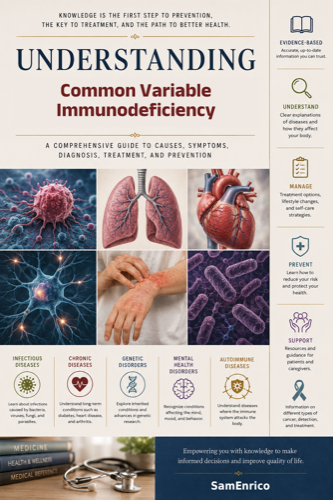
Non-FictionInformativeEducational
Understanding Common Variable Immunodeficiency eBook
This disease publication, published by SamEnrico,
This disease publication, published by SamEnrico, covers Understanding Common Variable Immunodeficiency
Formats
Free sample
Chapter 1: The Invisible Siege...--–- Emma had stopped counting her pneumonia hospitalizations somewhere between her fourth and fifth. By age thirty-four, she had developed a quiet expertise in the rituals of the infectious disease ward: the cool press of the stethoscope against her back, the specific gravity of intravenous antibiotics dripping into her veins, the way nurses would say “you’re back” with a mixture of familiarity and concern. What she had not developed was a diagnosis. For twelve years, doctors had told her she was unlucky. One pulmonologist, frustrated by her normal CT scan between infections, suggested she might have “health anxiety.” Another, after a cursory review of her chart, noted that “some people just get pneumonia.” Emma believed them.
She believed them until the day she woke up covered in bruises she could not explain—purple and red constellations scattered across her arms and thighs like a map of her own failing body. That was the morning her immunologist finally said the words: Common Variable Immunodeficiency. Not “bad luck.” Not “anxiety.” A real disease. A treatable one.This chapter dismantles the confusion surrounding the diagnosis of Common Variable Immunodeficiency—what it is, what it is not, and why the word “variable” is the most important word in the name. We will trace the disease’s history from its first description in the 1950s to its modern classification as a primary immunodeficiency (PID).
We will explore who gets CVID, when it appears, and how to distinguish it from other conditions that mimic it. Most importantly, we will establish a framework that the rest of this book will build upon: CVID is not a single disease but a syndrome, an umbrella term covering dozens of different biological failures that share a common feature—the inability to produce enough protective antibodies. By the end of this chapter, you will understand why Emma’s story and the story of a middle-aged woman with autoimmune thrombocytopenia and no infections at all can both be stories of the same disease.The Disease That Wasn’t a Disease In 1953, a Swiss physician named Dr. Walter Hitzig published a case report of two young brothers who died from recurrent bacterial infections. Both had profoundly low levels of gamma globulins—the protein fraction of blood that contains antibodies.
Hitzig called the condition acquired hypogammaglobulinemia, believing it to be a late-onset form of congenital immune deficiency. For the next two decades, scattered case reports appeared in medical literature: adults in their twenties and thirties presenting with pneumonia, sinusitis, and ear infections that did not respond to standard antibiotics. Some had autoimmune phenomena—low platelets, low red blood cells, unexplained arthritis. A few developed lymphoma. What united them was the laboratory finding of low immunoglobulins.In 1971, a World Health Organization committee formally named the condition Common Variable Immunodeficiency, acknowledging two key observations.
First, it was not truly “acquired” in the sense of being caused by an external agent; rather, it appeared to be an intrinsic defect of the immune system that manifested later in life than classical childhood immunodeficiencies. Second, it was “variable”—both in its clinical presentation and in its underlying biology. The name stuck, but it also created a problem. By calling CVID “common” (it is, by primary immunodeficiency standards) and “variable” (it is, enormously), the WHO inadvertently gave physicians a diagnosis that sounded vague and imprecise. For decades, CVID was treated as a diagnosis of exclusion: you ruled out everything else, and whatever remained was CVID.
This approach led to diagnostic delays averaging five to eight years, as we will explore in Chapter 7.Today, we understand CVID differently. It is not a wastebasket diagnosis but a syndrome with identifiable immunological and genetic subtypes. The “variable” in CVID refers not to diagnostic uncertainty but to genuine biological diversity. One patient may have a mutation in the TACI gene, leading to mild disease with Ig A deficiency and few infections. Another may have a mutation in NFKB1, causing severe autoimmunity, bronchiectasis, and early-onset disease.
A third may have no identifiable genetic mutation at all but profound B-cell failure nonetheless. All three have CVID. All three require immunoglobulin replacement therapy. But their prognoses, complications, and treatment needs differ substantially.The Umbrella: What All CVID Patients Share Despite the diversity, all patients with CVID share a common immunological core: failure of antibody production. To understand this failure, we must briefly visit the biology of B-cells, the immune system’s antibody factories.
(Chapter 2 will provide a full immunology crash course; here we offer only the essentials.)B-cells develop in the bone marrow and migrate to the lymph nodes, spleen, and other lymphoid tissues. When a B-cell encounters an antigen—a fragment of a bacterium, virus, or other invader—it undergoes a process called activation. Activated B-cells travel to specialized structures within lymph nodes called germinal centers, where they receive help from T-cells. In the germinal center, B-cells multiply, mutate their antibody genes to improve affinity, and most importantly, undergo class-switch recombination—the process that changes an antibody from Ig M (the first responder) to Ig G or Ig A (the long-term memory and mucosal antibodies). The end product of this process is a plasma cell, a B-cell that has terminally differentiated into a factory capable of producing thousands of antibodies per second.In CVID, this process breaks down at one or more points.
Some patients have too few B-cells to begin with. Others have normal numbers of B-cells but cannot activate them properly. Still others can activate B-cells but fail at class-switching, producing only Ig M and never transitioning to Ig G or Ig A. The most severely affected patients cannot form plasma cells at all. Regardless of the specific defect, the final common pathway is the same: low levels of Ig G, often accompanied by low Ig A and sometimes low Ig M, and a failure to produce protective antibodies in response to infection or vaccination.This antibody failure explains the infectious phenotype that defines CVID for most physicians.
Without adequate Ig G, patients cannot opsonize—or “tag”—encapsulated bacteria like Streptococcus pneumoniae and Haemophilus influenzae. These bacteria have polysaccharide coats that hide them from the innate immune system. In a healthy person, antibodies bind to the polysaccharide coat, marking the bacteria for destruction by phagocytes. In a person with CVID, the bacteria go untagged. They multiply unchecked, leading to recurrent pneumonia, sinusitis, and otitis media.
Over years of repeated infection, the lung tissue becomes scarred and dilated—a condition called bronchiectasis, which we will explore in Chapter 3.The Many Faces: Why No Two CVID Patients Are Alike If the antibody failure is common to all CVID patients, why do their stories differ so dramatically? The answer lies in the immune system’s complexity. Antibody production is not an isolated process; it is embedded in a web of regulatory and effector functions. When the antibody machinery breaks, the rest of the immune system compensates in unpredictable ways.Consider two hypothetical patients. Patient A is a twenty-five-year-old man with recurrent pneumonia since childhood.
His B-cell numbers are low, and his Ig G is undetectable. He has never had an autoimmune problem. Patient B is a forty-five-year-old woman who was healthy…
This is the end of the free sample. Get the eBook to keep going. Buy now
About this book
Details
- Author
- Kessler Margarette
- Publisher
- SamEnrico
- Language
- English
- Genre
- Non-Fiction, Informative, Educational
- Released
- 2026-06-02
- Pages (approx.)
- 157
- Available as
- eBook, Audiobook

Read better in the ZLOADR app
Your eBooks on your phone or tablet. Sign in with your SamEnrico account and start reading.
More by Kessler Margarette
 Kazakh Organized Crime GuideKessler Margarette$11.99
 The Beginner Breath AnchorKessler Margarette$11.99
 Pinterest VA UGC Pin CreationKessler Margarette$11.99
 Meditation for Chronic Eye PainKessler Margarette$11.99
 Sugar Addiction and Mental HealthKessler Margarette$11.99
 The Ancient Pacific Automata: Lost Engineering of the LapitaKessler Margarette$11.99
 The Boardroom Blitz: How a 1980s Toy War Reshaped Global PlayKessler Margarette$11.99
 Front End Team LeadKessler Margarette$11.99
 Application Process ComparisonKessler Margarette$12.99
 Co Founder Agreement GuideKessler Margarette$12.99
 A Beginners Guide to Australian football (Volume 1)Kessler Margarette$11.99
You may also like
 Hong Kong Handover 1997Dunn Johnnie$11.99
 Zumba For Postnatal Recovery CourseNeal Christian$11.99
 Zumba for BeginnersLadner Nikia$11.99
 YouTube Comment Mining GuideHumes Pandora$12.99
 Worry Box MeditationCarlin Rudy$11.99
 Workplace Stress MeditationNguyen Lynn$11.99
 Workplace Stress and Sleep RepairHawley Ivory$11.99
 Workplace Perfectionism CureDelaney Jeffry$11.99
 Workplace Injustice Anger GuideWallen Isabelle$11.99
 Work Addiction and Burnout LinkGreenwood Ester$11.99
 Women in Yoga and WellnessBeattie Galina$11.99
 Women in Stand Up ComedyChun Evangeline$11.99