
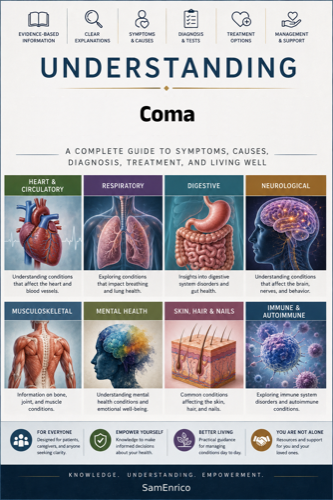
Non-FictionInformativeEducational
Understanding Coma eBook
This condition publication, published by SamEnrico
This condition publication, published by SamEnrico, covers Understanding Coma
Formats
Free sample
Chapter 1: The Unwaking Silence...--The first thing you need to understand about coma is that the movies have lied to you.In Hollywood, coma is a dramatic pause. The hero crashes the car, closes their eyes, and lies motionless while loved ones gather around a sunlit hospital bed. Days or weeks later—always at the most emotionally opportune moment—the patient's eyelids flutter. Fingers twitch. Eyes open.
Sometimes the first word is a whispered name, telegraphed perfectly to the sobbing family member clutching their hand. The music swells. The credits roll.This is not how coma works.In reality, there is no swelling music. There are no perfectly timed awakenings. The transition from unconsciousness to awareness—when it happens at all—is almost never dramatic.
It is slow, confusing, agonizingly uncertain, and often invisible to the naked eye. The patient does not open their eyes and ask for water. They might open their eyes weeks before they show any sign of recognizing a face. They might squeeze a hand seemingly in response to a command—and then never do it again. They might appear to be awake, eyes tracking around the room, while experiencing no conscious awareness whatsoever.
Or they might be fully aware, hearing every word spoken at the bedside, trapped inside a body that will not move.The gap between what we think we know about coma and what actually happens in the neurointensive care unit is vast. And that gap is where families drown.This book exists to close that gap.Understanding Coma is not a textbook written for doctors, though doctors may learn from it. It is not a memoir, though it contains stories of real patients and real families. It is a guide—a map through the darkest, most disorienting territory a family can ever enter. It is written for the woman sitting in a plastic chair at 3 AM, watching her husband breathe on a machine, wondering if he can hear her.
It is written for the father who has just been told that his teenage daughter opened her eyes today but did not look at him. It is written for the adult child who must decide whether to remove a feeding tube from a parent who never wrote an advance directive.And it is written for you, because one day, someone you love may fall into the unwaking silence. Or you may fall into it yourself.Before we go any further, let us be clear about what this chapter—and this book—will do for you. By the time you finish reading these pages, you will understand what coma actually is, how it differs from the states that look like coma but are not, and why the distinction between these states can mean the difference between life and death. You will learn the universal language that every doctor uses to measure consciousness—the Glasgow Coma Scale—and you will be able to interpret what those numbers mean when a physician speaks them in a hallway.
You will be equipped to ask better questions, to recognize false hope when it is offered, and to find genuine hope where it actually exists.Most important, you will understand something that most families learn too late: coma is not a final destination. It is a doorway. And what lies on the other side of that doorway—recovery, permanent disability, the vegetative state, or death—depends on factors you can learn to recognize, track, and discuss with the medical team.Let us begin.The Definition of Coma: What It Is and What It Is Not The word "coma" comes from the Greek koma, meaning "deep sleep." This is unfortunate, because the comparison to sleep is deeply misleading. A sleeping person can be awakened by a loud noise, a gentle shake, or even the smell of coffee. A comatose person cannot.
Sleep follows a predictable cycle of REM and non-REM stages that can be measured on an EEG. Coma has no such cycles. Sleep is restorative. Coma is pathological.Medically, coma is defined as a state of unarousable unresponsiveness. This means three things simultaneously.
First, the patient cannot be awakened by any stimulus—not shouting, not shaking, not pain. Second, the patient's eyes remain closed. (This is a critical distinction from the vegetative state, in which the eyes open even though the patient is not aware.) Third, the patient does not demonstrate any purposeful response to the environment.Let us pause on that third criterion, because it is the most misunderstood. "Purposeful" means intentional, goal-directed behavior. A comatose patient may still move.
They may withdraw a limb in response to a painful stimulus—this is a reflex, not a choice. They may exhibit decorticate or decerebrate posturing, abnormal positions of the arms and legs that indicate specific patterns of brain damage. They may even yawn, cough, or swallow. None of these movements require consciousness. They are generated by the brainstem and spinal cord, the most primitive parts of the nervous system, which can function even when the higher brain centers responsible for awareness have been catastrophically damaged.The key word is "unresponsive." Not paralyzed—unresponsive.
The difference matters enormously for prognosis and for treatment.The Timeline of Coma: Why Temporary Does Not Mean Reversible Coma is, by definition, a temporary state. This is not a promise of recovery. It is a clinical reality: the human brain cannot remain in true coma indefinitely.The natural history of severe brain injury follows a predictable sequence. In the first hours to days after the injury, the patient is in coma: eyes closed, unarousable, no sleep-wake cycles. Over the course of days to weeks—usually two to four weeks, though the exact timing varies—the brain either begins to recover or transitions into a different state of disordered consciousness.In the best-case scenario, the patient progresses from coma to a state of emerging awareness, then to a minimally conscious state, and eventually to recovery of function.
In the worst-case scenario, the patient dies. And in the gray zone that occupies the vast middle ground, the patient may transition from coma into the vegetative state—eyes open, sleep-wake cycles present, but no behavioral evidence of awareness—or into a minimally conscious state, in which there is fluctuating but reproducible evidence of consciousness.Here is the crucial point that every family must understand: the fact that coma is temporary does not mean that the patient will wake up. It means that the patient's condition will change. That change may be toward recovery, toward permanent disability, toward a prolonged vegetative state, or toward death. The job of the medical team—and the job of this book—is to help you understand which direction the change is moving and to prepare you for what comes next.The Spectrum of Disordered Consciousness: Six States That Are Not Coma Coma is one point on a spectrum of disordered consciousness.
To understand where your loved one stands, you must understand the other points on that spectrum. The distinctions between these states are not academic hair-splitting. They determine prognosis, guide treatment decisions, and shape the conversations that families must have with physicians about the future.Stupor: The Halfway State Stupor is often described…
This is the end of the free sample. Get the eBook to keep going. Buy now
About this book
Details
- Author
- Altman Brianna
- Publisher
- SamEnrico
- Language
- English
- Genre
- Non-Fiction, Informative, Educational
- Released
- 2026-05-11
- Pages (approx.)
- 151
- Available as
- eBook, Audiobook

Read better in the ZLOADR app
Your eBooks on your phone or tablet. Sign in with your SamEnrico account and start reading.
More by Altman Brianna
 Tim McGraw Humble Kind LifeAltman Brianna$11.99
 Name Recall for YouTubersAltman Brianna$11.99
 Bank Account Monthly Fee ChurnAltman Brianna$11.99
 Talking Under TensionAltman Brianna$11.99
 Psychosocial Support In DisastersAltman Brianna$11.99
 F1 Blue Flag EtiquetteAltman Brianna$11.99
 Family Support During DetoxAltman Brianna$11.99
 Clergy Family ImpactAltman Brianna$11.99
 The Siege of the Banco República: Colombia's Bloodiest Hostage CrisisAltman Brianna$11.99
 Midnight Code: The Secret Songs of the North StarAltman Brianna$11.99
 How to Produce Football Protective GearAltman Brianna$11.99
 DIY Tutorials Using Stock VideoAltman Brianna$12.99
You may also like
 Hong Kong Handover 1997Dunn Johnnie$11.99
 Zumba For Postnatal Recovery CourseNeal Christian$11.99
 Zumba for BeginnersLadner Nikia$11.99
 YouTube Comment Mining GuideHumes Pandora$12.99
 Worry Box MeditationCarlin Rudy$11.99
 Workplace Stress MeditationNguyen Lynn$11.99
 Workplace Stress and Sleep RepairHawley Ivory$11.99
 Workplace Perfectionism CureDelaney Jeffry$11.99
 Workplace Injustice Anger GuideWallen Isabelle$11.99
 Work Addiction and Burnout LinkGreenwood Ester$11.99
 Women in Yoga and WellnessBeattie Galina$11.99
 Women in Stand Up ComedyChun Evangeline$11.99