
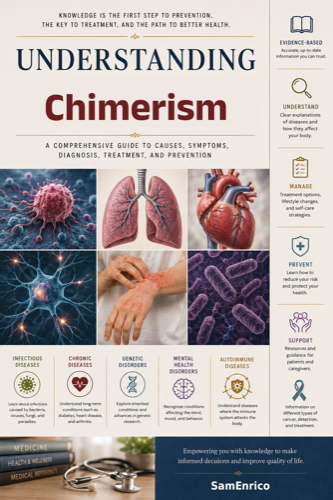
Understanding Chimerism eBook
This disease publication, published by SamEnrico,
This disease publication, published by SamEnrico, covers Understanding Chimerism
Formats
Free sample
Chapter 1: The Vanishing Twin...--–- The call came on a Tuesday afternoon, and Lydia Fairchild almost didn’t answer it. She was twenty-six years old, pregnant with her fourth child, and already late to pick up her three children from her mother’s house. The number on her caller ID was unfamiliar—a local area code but not one she recognized. She let it go to voicemail. Later that evening, after the children were fed, bathed, and finally asleep, she listened to the message.
The voice on the recording was professional but hesitant, as if the speaker was choosing every word carefully. “Ms. Fairchild, this is Patricia from the Washington State Division of Child Support. We need you to come in and discuss the results of your DNA tests. There are some… discrepancies we need to resolve.”Discrepancies.
It was such a bloodless word for something that would, within weeks, threaten to tear her family apart.Lydia had submitted to DNA testing as part of a routine welfare application. She was seeking state assistance to support her children while she looked for work, and Washington State required genetic testing to establish paternity—even though there was no dispute about who the father was. Her ex-partner had already acknowledged his children. The testing was supposed to be a formality. What came back was anything but.The laboratory’s report stated, in the flat, unambiguous language of science, that Lydia Fairchild was not the biological mother of her own children.At first, everyone assumed a lab error.
The samples must have been swapped, mislabeled, contaminated. Lydia herself laughed when the social worker told her. “That’s impossible,” she said. “I gave birth to them. I have pictures.
I have witnesses.” But a second test was ordered, and a third. Each one returned the same impossible result. The DNA extracted from Lydia’s blood did not match the DNA extracted from her children’s cheek swabs. According to the laws of genetics, those children belonged to someone else.The state pressed charges. Lydia was accused of fraud—specifically, “surrogacy fraud,” the allegation that she had falsely claimed another woman’s children as her own to collect benefits.
Her children were nearly removed from her custody. Her ex-partner, who had never doubted his paternity, was suddenly uncertain. Her own mother wondered, aloud and in tears, whether Lydia had lied about being pregnant at all.It would take months, a legal battle, and a chance phone call from a biologist who had read about a similar case in Boston before anyone understood what was happening. Lydia Fairchild was not a fraud. She was not a liar.
She was a chimera.Lydia’s case, which would eventually become one of the most famous examples of tetragametic chimerism in medical literature, shattered a fundamental assumption that most of us carry without ever thinking about it: the belief that one person has one genome. One set of DNA. One genetic identity. The belief that a simple cheek swab or blood draw can tell us who someone really is, down to their very molecules.That belief is wrong.The False Promise of a Single Self Every day, millions of people spit into tubes and mail their saliva to companies like 23and Me and Ancestry DNA. They do so believing that the results will tell them something definitive about themselves—their ethnic heritage, their risk of disease, their connection to distant relatives.
Forensic laboratories send DNA profiles to CODIS, the national database, believing that a match conclusively identifies a suspect. Courts admit DNA evidence as though it were fingerprinting, a unique and unalterable signature of a single human being. Hospitals use genetic testing to determine paternity, diagnose disease, and guide treatment decisions.In the vast majority of cases, these assumptions hold true. The human genome is remarkably stable, and most people carry one consistent set of DNA in every cell of their bodies. But not everyone.
And the exceptions, rare as they are, reveal something profound about the nature of identity, the limits of our technology, and the strange and winding paths that conception and development can take.Chimerism—the presence of two distinct populations of DNA in a single organism—is not a disease. It is not an illness or a condition that requires treatment. For most people who have it, chimerism is a silent passenger, a hidden genetic twin that never announces its presence. They live their entire lives without knowing that their bodies carry two genomes. They get sick, they heal, they age, they die, and their chimerism is discovered only after death, if at all, during an autopsy or a research study that happens to sample multiple tissues.But for those who discover it—through a routine blood test, an ancestry DNA kit, a paternity dispute, or a criminal investigation—the revelation can be world-shattering.
It forces a confrontation with questions most of us never ask: Who am I, really? Can I be more than one person? And if my DNA doesn’t define me, what does?This chapter begins the story of chimerism where all human stories begin: at conception. But it is a conception unlike the one you learned in high school biology class.Two Become One: The Making of a Tetragametic Chimera To understand Lydia Fairchild’s case—and the dozens of similar cases that have emerged since hers first made headlines—we must start with the earliest moments of human development. Standard human reproduction follows a predictable script.
One sperm fertilizes one egg, producing a single zygote. That zygote divides and divides again, becoming an embryo, then a fetus, then a baby. Every cell in that baby’s body is a clone of the original zygote, carrying identical DNA.But the script can be rewritten in ways that evolution never anticipated.Tetragametic chimerism begins not with one fertilization but with two. Two separate eggs. Two separate sperm.
Two separate fertilizations that produce two separate zygotes—fraternal twins in the making. Under normal circumstances, these two zygotes would implant in the uterine wall, develop their own placentas, and eventually be born as a pair of fraternal twins, as genetically distinct as any two siblings born years apart.But sometimes, very early in development—usually within the first week after conception—something extraordinary happens. The two zygotes, each no larger than a speck of dust, fuse together. Their cell membranes dissolve. Their genetic material mingles.
Instead of two separate embryos developing side by side, a single composite embryo continues onward. That embryo contains two distinct populations of cells: some descended from the first zygote, some from the second. The two sets of DNA do not merge. They do not exchange material. They simply coexist, like two different-colored marbles rolling together in the same jar.This fused embryo is a tetragametic chimera.
“Tetragametic” comes from the Greek words tetra (four) and gamete (reproductive cell), reflecting the four gametes—two eggs and two sperm—that gave it life. “Chimera” comes from Greek mythology: a fire-breathing monster with the head of a lion, the body of a goat, and the tail of a serpent. The mythological Chimera was a creature of impossible parts, a single being assembled from…
This is the end of the free sample. Get the eBook to keep going. Buy now
About this book
Details
- Author
- Blakely Roselle
- Publisher
- SamEnrico
- Language
- English
- Genre
- Non-Fiction, Informative, Educational
- Released
- 2026-05-11
- Pages (approx.)
- 158
- Available as
- eBook, Audiobook

Read better in the ZLOADR app
Your eBooks on your phone or tablet. Sign in with your SamEnrico account and start reading.
More by Blakely Roselle
 Mnemonics for Medical ExamsBlakely Roselle$11.99
 Deep Work Habit Formation GuideBlakely Roselle$11.99
 Kigali E learning Platform GuideBlakely Roselle$11.99
 Etsy Digital Planner Pricing StrategyBlakely Roselle$11.99
 Memory Loss Sleep DisordersBlakely Roselle$11.99
 The Vanishing of Flight 370: Decoding the Data That Was Never FoundBlakely Roselle$11.99
 The Silk Road of the Mind: Ibn Battuta's Anthropological OdysseyBlakely Roselle$11.99
 How to Start a Audio Visual Engineering Business (Beginners Guide)Blakely Roselle$11.99
 Global Recognition ProgramsBlakely Roselle$12.99
 Cooperative Innovation FundBlakely Roselle$12.99
 Ideation Session LeaderBlakely Roselle$11.99