
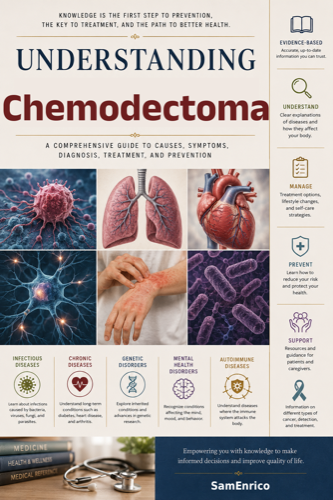
Understanding Chemodectoma
This disease publication, published by SamEnrico,
by Cordova Codi
This disease publication, published by SamEnrico, covers Understanding Chemodectoma
Formats
About this book
Free sample
Chapter 1: The Forgotten Naming War...--– In the quiet corridors of medical history, few debates have been as quietly ferocious as the one surrounding what we now call the paraganglioma. For nearly two centuries, pathologists, surgeons, and anatomists argued past one another, using three different names for the same tumor—each name carrying its own flawed assumptions, each term revealing as much about the biases of its era as about the disease itself. To understand chemodectoma—or paraganglioma, or glomus tumor, depending on which textbook you open—one must first understand how language shapes diagnosis, how nomenclature influences treatment decisions, and why a simple name change can save lives.This chapter is not merely a historical curiosity. The terminology surrounding this family of tumors has direct clinical consequences. A patient told they have a "glomus tumor" might consult a dermatologist (since true glomus tumors are benign skin lesions), delaying appropriate head and neck imaging.
A pathology report using "chemodectoma" might fail to trigger genetic testing for SDH mutations, missing a familial cancer syndrome. And a surgeon searching the literature for "paraganglioma" might miss critical case series indexed under older terms. The naming war is not academic pedantry—it is patient safety.The Accidental Discovery: Von Haller and the Carotid Body The story begins not with a tumor, but with normal anatomy. In 1762, the Swiss anatomist Albrecht von Haller was meticulously dissecting the neck when he noticed a small, reddish-brown nodule nestled precisely at the bifurcation of the common carotid artery. He described it as the ganglion minutum—a tiny ganglion—but admitted he had no idea what it did.
For the next century, anatomists would periodically rediscover this structure, give it a new name, and then move on. The carotid body, as it would eventually be called, remained an anatomical curiosity without a function.What von Haller could not have known was that this tiny nodule represented an entire organ system scattered throughout the body. Paraganglia—clusters of neuroendocrine cells derived from the neural crest—exist along major blood vessels and nerves, serving as chemoreceptors. They sample blood for oxygen, carbon dioxide, and…
This is the end of the free sample. Get the eBook to keep going. Buy now
Contents
- Chapter 1
- Chapter 2
- Chapter 3
- Chapter 4
- Chapter 5
- Chapter 6
- Chapter 7
- Chapter 8
- Chapter 9
- Chapter 10
- Chapter 11
- Chapter 12
Details
- Author
- Cordova Codi
- Publisher
- SamEnrico
- Language
- English
- Genre
- Non-Fiction, Informative, Educational
- Released
- 2026-05-08
- Pages (approx.)
- 135
- Available as
- eBook, Audiobook

Read better in the ZLOADR app
Your eBooks on your phone or tablet. Sign in with your SamEnrico account and start reading.
More by Cordova Codi
 Pretesting Study Strategy GuideCordova Codi$11.99
 Pre Learning Sleep BenefitsCordova Codi$11.99
 Testosterone and Skin HealthCordova Codi$11.99
 Nairobi Cryptocurrency Exchange GuideCordova Codi$11.99
 Polio Vaccine Race Against ParalysisCordova Codi$11.99
 The Silk Road Reborn: Rediscovering Central Asia's Forgotten FrontiersCordova Codi$11.99
 The Last Voyage of the SS United States: A Race Against TimeCordova Codi$11.99
 Head of Research and InnovationCordova Codi$11.99
 All Hands Meeting Global GuideCordova Codi$12.99
 Cooperative Turnaround GuideCordova Codi$12.99
 How to Become a Building InspectorCordova Codi$11.99