
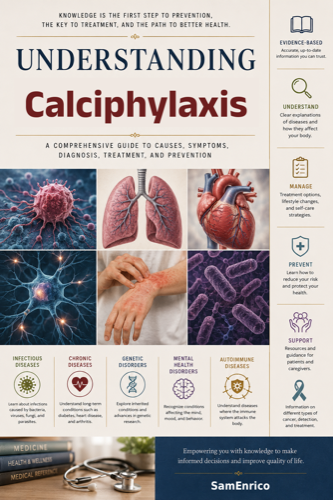
Understanding Calciphylaxis eBook
This disease publication, published by SamEnrico,
This disease publication, published by SamEnrico, covers Understanding Calciphylaxis
Formats
Free sample
Chapter 1: The Calcium Killer--It begins not with a bang, but with a bruise that refuses to fade.For Margaret, a fifty-four-year-old grandmother of three and a dialysis patient of six years, the first sign was nothing more than a purplish patch on her lower abdomen. She had bumped into the kitchen counter―or so she told herself. Her daughter, a nurse, noticed it during a Sunday visit. "Mom, that doesn't look like a bruise," she said, pressing gently. Margaret winced.
The pain was sharp, deep, and entirely disproportionate to the light touch. "It's nothing," Margaret replied. "Just tender."That tenderness was the opening salvo of a disease that would, over the following eight months, consume her abdomen, spiral her into septic shock, and very nearly kill her. Margaret survived. Thousands do not.This is the reality of calciphylaxis.
It is rare, terrifying, and profoundly misunderstood. And yet, as you will learn in these pages, ignorance―of patients, of families, and most critically, of doctors―is its greatest ally. Knowledge is its only true enemy.What You Will Learn in This Chapter Before we can fight calciphylaxis, we must name it, define it, and understand where it came from. This chapter will accomplish four goals:First, you will learn the formal name of this disease—Calcific Uremic Arteriolopathy (CUA)—and what each part of that name means for the human body.Second, you will journey back to 1962, to the laboratory of a brilliant and controversial scientist named Hans Selye, whose experiments on rats gave the disease its name and established the foundational concept of "two hits" that still guides research today.Third, you will unlearn a dangerous misconception: calciphylaxis is not a rash, not a skin disease, and not an infection. It is a vascular disease—a disease of the smallest arteries—that manifests on the skin because the skin is dying from the inside out.Fourth, you will confront the numbers.
How common is this disease? Who gets it? And why do so many die? These statistics are sobering, but they are not static. Modern treatment is changing the math.By the end of this chapter, you will understand what calciphylaxis is at its most fundamental level.
You will be prepared for the deeper science of Part II, the treatment strategies of Part III, and the practical guidance of Part IV. More importantly, you will never mistake this disease for a simple bruise again.The Name: Calcific Uremic Arteriolopathy Let us begin by dissecting the formal name of this condition, because names matter. The medical establishment officially classifies calciphylaxis under the term Calcific Uremic Arteriolopathy, abbreviated as CUA. Each word reveals a piece of the puzzle.Calcific refers to calcium. Not the calcium you drink in milk or the calcium that builds strong bones, but calcium in the wrong place.
In calciphylaxis, microscopic crystals of calcium phosphate precipitate out of the bloodstream and embed themselves in the walls of tiny arteries. This is not the slow, age-related calcification that occurs in atherosclerosis. This is an aggressive, pathological process that can destroy a blood vessel in weeks.Uremic refers to kidney failure. The word "uremia" comes from the Greek ouron (urine) and haima (blood)—literally "urine in the blood." In healthy bodies, the kidneys filter waste products, including excess phosphorus and other minerals. When kidneys fail, those waste products accumulate.
Dialysis removes some but not all of them. Over time, the mineral imbalance creates a bloodstream that is supersaturated with calcium and phosphorus, like a solution that has been heated beyond its capacity to hold dissolved solids. This supersaturation sets the stage for crystallization.Arteriolopathy breaks down into arteriole (the smallest branches of the arterial tree, just one step above capillaries) and pathy (disease). This is the crucial distinction: calciphylaxis is not a disease of the heart's major coronary arteries (though it can co-exist with heart disease). It is not a disease of the large vessels of the legs (though peripheral artery disease is a common comorbidity).
It is a disease of the arterioles—vessels so small that they cannot be seen without a microscope, vessels that deliver oxygen to the skin, the fat, and the deeper soft tissues. When these arterioles become calcified, the downstream tissue starves and dies.Put it all together: Calcific Uremic Arteriolopathy means "calcium-related disease of the small arteries in patients with kidney failure."The term calciphylaxis, which is the common name used throughout this book, was coined under different circumstances. It comes from the Greek words calc (calcium), phylax (guard or protection), and axis (arrangement). The history of that term is both fascinating and controversial, and it brings us to the laboratory of Dr. Hans Selye.The Strange History: Selye's Rats and the Birth of a Name In 1962, a Hungarian-Canadian endocrinologist named Hans Selye published a monograph titled "Calciphylaxis." Selye was already famous for his work on stress and the "general adaptation syndrome." He was a prolific, theatrical, and occasionally controversial scientist who believed that the body's responses to various insults followed predictable patterns.Selye's calciphylaxis experiments followed a specific protocol.
First, he would "sensitize" rats by administering a triggering agent—usually high doses of vitamin D or parathyroid hormone (PTH). Then, after a specific waiting period (the "critical period"), he would administer a "challenger"—often iron salts, egg white, or even mechanical trauma. When the challenger arrived during the critical period, the rats developed dramatic calcified deposits at the site of the challenger. Iron injected into the skin produced a calcified nodule. Egg white injected into the peritoneum produced abdominal calcification.
Even simple scratching of the skin produced calcification if the timing was right.Selye called this phenomenon "calciphylaxis," believing he had discovered a universal biological mechanism by which the body becomes temporarily sensitized to calcium deposition. He proposed that calciphylaxis explained not only his rat experiments but also a range of human diseases, from arthritis to atherosclerosis.Here is the crucial point for readers of this book: Selye's model is not exactly the same as human calciphylaxis. Human calciphylaxis is not caused by a single sensitizer followed by a single challenger. It is not something that passes after a "critical period." And most patients do not have dramatic calcification at sites of minor trauma (though trauma can trigger new lesions—a phenomenon called the Koebner phenomenon, discussed in Chapter 11).However, Selye's work established two concepts that remain valuable today.First, the two-hit model: many diseases, including calciphylaxis, require a predisposing condition (the "sensitizer") plus a triggering event (the "challenger"). In human calciphylaxis, the sensitizers are chronic kidney disease, diabetes, obesity, autoimmune disease, and certain medications.
The challengers may include warfarin, steroids, trauma, infection, or simply the passage of time.Second, the name stuck. Despite its mechanistic inaccuracy, "calciphylaxis" remains the common term used by patients, doctors, and researchers. It is short, memorable, and—once you understand the history—a useful shorthand for a complex process.Modern understanding has moved far beyond Selye. We now know that human calciphylaxis involves not just calcium deposition but also inflammation, clotting, and failure of natural inhibitors. We know that the process is not temporary but progressive unless interrupted.
And we have developed treatments—sodium thiosulfate, hyperbaric oxygen, aggressive debridement—that Selye never imagined.But we owe Selye a debt. His rats…
This is the end of the free sample. Get the eBook to keep going. Buy now
About this book
Details
- Author
- Frierson Lyla
- Publisher
- SamEnrico
- Language
- English
- Genre
- Non-Fiction, Informative, Educational
- Released
- 2026-05-08
- Pages (approx.)
- 152
- Available as
- eBook, Audiobook

Read better in the ZLOADR app
Your eBooks on your phone or tablet. Sign in with your SamEnrico account and start reading.
More by Frierson Lyla
 Parenting with Chronic PainFrierson Lyla$11.99
 The Gaming Sensory OverloadFrierson Lyla$11.99
 Nonverbal Cues In Healthcare CourseFrierson Lyla$11.99
 Symmetry OCD Overcoming GuideFrierson Lyla$11.99
 Survey Response Validation Using AIFrierson Lyla$11.99
 Echoes of the Iron Curtain: The Spy Who Sang FreedomFrierson Lyla$11.99
 The Ghosts of the Andes: A 19th-Century Astronomer’s Descent into MadnessFrierson Lyla$11.99
 How to Become a Card Changer - Jacquard LoomFrierson Lyla$11.99
 Writing Sample for PhD Without PubsFrierson Lyla$12.99
 Citizenship Eligibility After PRFrierson Lyla$12.99
 Ye'elimite MiningFrierson Lyla$11.99