
Non-FictionInformativeEducational
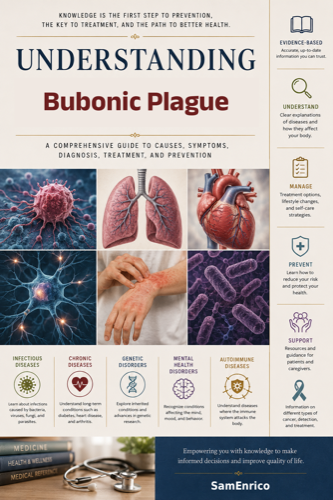
Understanding Bubonic Plague eBook
This disease publication, published by SamEnrico,
by Franco Rolf
This disease publication, published by SamEnrico, covers Understanding Bubonic Plague
Formats
Free sample
Chapter 1: The Bamboo Hut...--The year is 1894. The place is Hong Kong. And the man who will solve one of history’s greatest medical mysteries has no laboratory, no funding, no permission, and no backup plan.His name is Alexandre Yersin. He is thirty-one years old. He is Swiss-born, French-trained, and deeply disliked by the colonial establishment.
He arrives in Hong Kong during the worst outbreak of bubonic plague the city has ever seen. Bodies pile up in the streets faster than the coolies can cart them away. The British colonial government has imposed a strict quarantine, but the disease ignores boundaries. It jumps from neighborhood to neighborhood, from ship to ship, from living body to cooling corpse.Yersin has come because he believes the plague is caused by a germ. This is not an obvious belief in 1894.
Many of the most respected physicians in Europe still insist that diseases like plague arise spontaneously from "bad air"—miasma—or from filth or from divine punishment. The germ theory of disease is barely a generation old. Louis Pasteur and Robert Koch have proved that specific bacteria cause specific illnesses, but the medical establishment is slow to accept it. When Yersin arrives in Hong Kong, he is not a famous scientist. He is a former assistant to Pasteur, which means he is brilliant, stubborn, and nearly unemployable.He has one advantage over his rivals.
He knows how to look.The Race to Identify the Killer The story of how we came to understand bubonic plague begins not in a medieval cemetery or a history book, but in a bamboo hut on the outskirts of a dying city. Yersin’s rival, a Japanese scientist named Shibasaburo Kitasato, has arrived in Hong Kong at the same time. Kitasato is a student of Robert Koch, the German giant of bacteriology. He has a proper laboratory, a team of assistants, and the backing of the Japanese government. Yersin has a microscope, a stained-glass staining kit, and a willingness to bribe sailors to steal corpses from the morgue.Kitasato publishes first.
He announces that he has discovered the bacillus that causes plague. But his description is vague, his methods are sloppy, and his samples are contaminated. Later historians will question whether Kitasato ever actually saw the plague bacterium at all, or whether he saw something else—perhaps the common postmortem contaminant Streptococcus. Yersin, working in his bamboo hut, takes a different approach. Instead of culturing bacteria from the air or from surfaces, he goes directly to the source.
He aspirates fluid from the buboes—the swollen, pus-filled lymph nodes—of dying patients. He stains the fluid with aniline dye. And then he looks.What he sees is unmistakable. Under the lens, tiny rods appear, motionless, stained deep blue at the ends, giving them the characteristic "safety pin" appearance that will become the diagnostic hallmark of Yersinia pestis. The rods are Gram-negative, meaning they do not retain the crystal violet stain used in the Gram staining protocol, but instead take up the counterstain and appear pink or red.
This is not a trivial detail. Gram-negative bacteria have a different cell wall structure than Gram-positive bacteria, and that difference is directly related to how deadly they are.Yersin has found the killer. But finding it is only the first step. He must prove that this bacterium, and no other, causes the plague.The Proof: Koch's Postulates The late nineteenth century had established a gold standard for proving that a specific microbe causes a specific disease. These were called Koch's postulates, after Robert Koch, and they were simple, elegant, and demanding.
First, the microorganism must be found in all cases of the disease but not in healthy individuals. Second, the microorganism must be isolated from a diseased individual and grown in pure culture. Third, the cultured microorganism must cause the same disease when introduced into a healthy susceptible host. Fourth, the same microorganism must be re-isolated from the experimentally infected host.Yersin satisfied every postulate. He found the bacillus in every plague patient he examined.
He grew it in pure culture. He injected the cultured bacteria into healthy laboratory animals—mice, rats, guinea pigs—and watched them develop buboes and die. And then he re-isolated the same bacillus from their bodies. The chain of proof was unbreakable. Yersin had done what Kitasato could not.
He had identified the cause of bubonic plague.But identification is not the same as understanding. Yersin had found the what. The rest of this book is about the how—how this tiny bacterium kills, how it spreads, how it has shaped human history, and what it still threatens to do.The Bacterium Itself: A Portrait of a Killer Let us look closely at the organism that Yersin saw through his lens. Yersinia pestis is a facultative anaerobic bacterium, which means it can grow with or without oxygen. It is nonmotile—it cannot swim or crawl on its own.
It is rod-shaped, approximately 1 to 2 micrometers in length, and it has a bizarre, almost alien appearance under electron microscopy, with a wrinkled, rough surface that helps it attach to host cells.But the most important feature of Y. pestis is not what it looks like. It is what it does.The bacterium possesses a set of virulence factors—biological weapons encoded in its DNA—that make it one of the most efficient killers in the microbial world. The first of these is the pla gene, which produces an enzyme called plasminogen activator. This enzyme does something remarkable: it breaks down blood clots.
When a flea bites a human, the body naturally tries to wall off the bite wound with a tiny clot of fibrin. The plasminogen activator dissolves that clot, allowing the bacteria to escape from the initial wound site and enter the lymphatic system. The bacterium literally cuts its way out of jail.The second set of virulence factors is encoded in the yop genes, which stand for Yersinia outer proteins. These proteins are injected directly into host immune cells—specifically macrophages, the very cells sent to destroy invading bacteria. Once inside the macrophage, the Yop proteins disable it.
They block its ability to send chemical signals. They prevent it from engulfing and digesting bacteria. They even cause the macrophage to self-destruct through a process called apoptosis. Y. pestis does not merely evade the immune system.
It assassinates the immune system's frontline soldiers.The third virulence factor is the lipopolysaccharide (LPS) that coats the bacterial cell wall. This molecule is a potent trigger of the human inflammatory response. When LPS binds to receptors on immune cells, it unleashes a cascade of cytokines—chemical alarm signals—that cause fever, vasodilation, and capillary leakage. In small amounts, inflammation is protective. In large amounts, it is lethal.
The massive release of LPS during a systemic Y. pestis infection leads to septic shock, organ failure, and death.The Ancient Strain: How Old Is This Killer?For decades, historians assumed that bubonic plague emerged relatively recently in human history, perhaps around the time of the first recorded pandemic in the sixth century AD. Genomic research has shattered that assumption.In 2015, a team of scientists led by Simon Rasmussen and Eske Willerslev sequenced the…
This is the end of the free sample. Get the eBook to keep going. Buy now
About this book
Details
- Author
- Franco Rolf
- Publisher
- SamEnrico
- Language
- English
- Genre
- Non-Fiction, Informative, Educational
- Released
- 2026-05-09
- Pages (approx.)
- 124
- Available as
- eBook, Audiobook

Read better in the ZLOADR app
Your eBooks on your phone or tablet. Sign in with your SamEnrico account and start reading.
More by Franco Rolf
 Parent of Special Needs Self CareFranco Rolf$11.99
 Low HGH Symptoms ChecklistFranco Rolf$11.99
 The Daily Quest UnhookFranco Rolf$11.99
 The Parent Post Scream RepairFranco Rolf$11.99
 AI Video Production for Online CoursesFranco Rolf$11.99
 The Phantom of the Pacific: The Vanishing of the SS BaychimoFranco Rolf$11.99
 The Frozen Frontier: The First European Crossing of the Himalayan Ice CapFranco Rolf$11.99
 Small Business 1099 Processing AIFranco Rolf$12.99
 Police Certificate For CanadaFranco Rolf$12.99
 Quality Assurance Team LeadFranco Rolf$11.99
 How to Become a Scarf GluerFranco Rolf$11.99
You may also like
 Hong Kong Handover 1997Dunn Johnnie$11.99
 Zumba For Postnatal Recovery CourseNeal Christian$11.99
 Zumba for BeginnersLadner Nikia$11.99
 YouTube Comment Mining GuideHumes Pandora$12.99
 Worry Box MeditationCarlin Rudy$11.99
 Workplace Stress MeditationNguyen Lynn$11.99
 Workplace Stress and Sleep RepairHawley Ivory$11.99
 Workplace Perfectionism CureDelaney Jeffry$11.99
 Workplace Injustice Anger GuideWallen Isabelle$11.99
 Work Addiction and Burnout LinkGreenwood Ester$11.99
 Women in Yoga and WellnessBeattie Galina$11.99
 Women in Stand Up ComedyChun Evangeline$11.99