
Non-FictionInformativeEducational
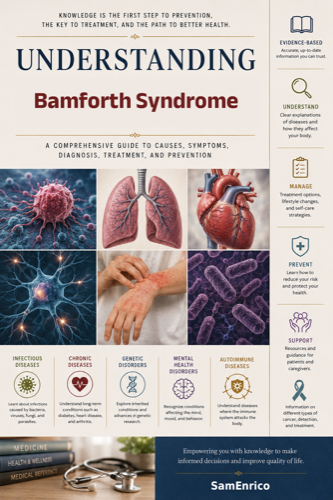
Understanding Bamforth Syndrome eBook
This disease publication, published by SamEnrico,
by Cross Ben
This disease publication, published by SamEnrico, covers Understanding Bamforth Syndrome
Formats
Free sample
Chapter 1: The Forgotten Children...–- The call came at 2:47 on a Tuesday morning, as it always does when a newborn is dying and no one knows why. Dr. Margaret Chen, the attending neonatologist at St. Luke's Medical Center, had been asleep for barely ninety minutes when the page shattered her brief respite. She dressed in the dark, pulling yesterday's white coat over fresh scrubs, and drove the twelve minutes to the hospital reciting the only information the charge nurse had provided: "Term newborn, respiratory distress, abnormal thyroid screen, unusual physical findings."Unusual physical findings.
In twenty-three years of neonatology, Chen had learned that those three words were the most dangerous phrase in medicine. They meant the textbooks had failed. They meant the algorithms would not help. They meant a family was about to hear a word they had never heard before, attached to a disease they had never imagined, and she would have to look them in the eyes and explain something she herself did not fully understand.The infant in Bed 4 of the NICU was forty-seven hours old. He had been born at 39 weeks via uncomplicated vaginal delivery to Sarah and David Whitman, a schoolteacher and a pharmacist from a small town seventy miles north of the city.
The pregnancy had been routine—normal anatomy scan, negative genetic screening, no gestational diabetes, no hypertension. The delivery was textbook. The first problem appeared during the first feeding."A weak suck," the night nurse had noted. "Milk coming out of his nose. I thought maybe a cleft palate, but I couldn't see it clearly."Within twenty-four hours, the baby—they had named him Leo, after Sarah's grandfather—had developed a bluish tinge around his lips during feeds.
His oxygen saturation, which had been 98% on room air at birth, was now dipping to 84% whenever he tried to eat. The pediatrician on call ordered a sepsis workup, started antibiotics, and called a stat head ultrasound to rule out intraventricular hemorrhage. All tests were normal.Then the newborn screening results came back.The Silence Before the Diagnosis Chen pulled Leo's chart from the rack outside his isolation room. She flipped past the routine vital signs and growth parameters—length 49 cm, weight 3.2 kg, head circumference 34 cm, all unremarkable—and went straight to the lab results. There it was.
TSH: 478 m IU/L. Free T4: less than 0.4 ng/d L.She had seen numbers like this before. They meant one thing: the baby had no functional thyroid gland. But congenital hypothyroidism occurred in roughly 1 in 3,000 births, and Chen had managed dozens of such cases. The treatment was simple—levothyroxine replacement, started immediately, continued for life.
Those babies grew up normal, went to school, played sports, lived full lives. So why had the night nurse described "unusual physical findings"? Why was Leo in respiratory distress? Why was milk coming out of his nose?She pushed open the door.Leo was small but not alarmingly so. His color was good when he was calm, though his lips had a faint bluish cast that deepened when he cried.
His hair—Chen stopped and looked again. His hair was extraordinary. It stood straight up from his scalp in stiff, spiky tufts, like the bristles of a test tube brush or the quills of a frightened porcupine. It was not the soft, downy lanugo hair of most newborns. It was coarse, dark, and unruly, growing in whorls that defied any attempt to smooth them down."Have you noticed his hair?" Chen asked the nurse."We thought maybe it was just a family trait.
The father has thick hair."Chen shook her head. Something about that hair pattern triggered a memory, a half-remembered lecture from fellowship training twenty years earlier, a single slide about a syndrome so rare that most clinicians would never see a case. She pulled out her phone and typed three words into a search engine: spiky hair hypothyroidism.The results were few but specific. A syndrome called Bamforth-Lazarus. An alternate name: Bamforth Syndrome.
A gene called FOXE1. Total reported cases worldwide: fewer than twenty families.Chen's heart rate accelerated. She looked back at Leo. Then she asked the nurse to open his mouth wide and shine a penlight at the back of his throat.The Anatomy of a Mystery What Chen saw next confirmed her suspicion. Leo's palate—the roof of his mouth—was not intact.
There was a small, slit-like opening in the soft palate, what a specialist would call a submucous cleft. It was not the dramatic, gaping hole that some cleft palate babies had, but it was enough to allow milk to pass from the mouth into the nasal cavity, explaining the respiratory distress during feeds.A submucous cleft. Spiky hair. Congenital hypothyroidism confirmed by lab work. That was three for three.But Chen knew that a clinical diagnosis was not enough.
She needed imaging. She needed genetic confirmation. And she needed to have a conversation with the Whitmans that would change their lives forever.She found Sarah and David in the family lounge, a small windowless room with two vinyl chairs and a coffee maker that had not been cleaned in weeks. Sarah was crying. David was staring at the wall."We were supposed to go home today," Sarah said.
"They told us it was just a feeding problem. They said babies sometimes need extra time to learn to eat."Chen sat down across from them. She had delivered bad news hundreds of times, but she had never forgotten the weight of it. She took a breath and spoke."Leo has a condition we are still trying to understand completely. The newborn screening shows that his thyroid gland did not develop normally.
That is why his TSH is so high—his body is desperately trying to signal a gland that isn't there. We need to start medication for that tonight. It is safe, it is effective, and it will prevent brain damage if we start quickly."David leaned forward. "You said 'if we start quickly.' How quickly?""Within the first two to four weeks. We are within that window.
We will start tonight."Sarah wiped her eyes. "But you said there's more."Chen nodded. "Leo also has a cleft palate—a small opening in the roof of his mouth. That is why milk comes out of his nose. And his hair—the spiky appearance—is also part of the same condition.""What condition?" David's voice was tight.
"What do you call this?"Chen hesitated. She had to be careful. She had to be honest without being terrifying. "There is a rare genetic syndrome called Bamforth Syndrome. I believe Leo may have it.
I need to order some tests to confirm—an ultrasound of his neck to see if there is any thyroid tissue, a CT scan to look at his airway, and genetic testing to look for mutations in a gene called FOXE1.""How rare?" Sarah asked."Fewer than twenty families have been reported in the medical literature. Worldwide."The room went silent. Chen watched the information land on them like a physical weight. Twenty families. Worldwide.
Their son was not just sick—he was statistically impossible, a medical miracle in the worst possible way.The History We Carry…
This is the end of the free sample. Get the eBook to keep going. Buy now
About this book
Details
- Author
- Cross Ben
- Publisher
- SamEnrico
- Language
- English
- Genre
- Non-Fiction, Informative, Educational
- Released
- 2026-05-11
- Pages (approx.)
- 148
- Available as
- eBook, Audiobook

Read better in the ZLOADR app
Your eBooks on your phone or tablet. Sign in with your SamEnrico account and start reading.
More by Cross Ben
 The Movie Theater SeatingCross Ben$11.99
 The Lottery Addiction WorkbookCross Ben$11.99
 Gen Z Talent Mobility GuideCross Ben$11.99
 Daily Review for Entrepreneurs CourseCross Ben$11.99
 Sauna Growth Hormone ElevationCross Ben$11.99
 The Billion-Dollar Bet: How a Gambler Built a Tech EmpireCross Ben$11.99
 Love, Lies, and a $1.5 Billion Divorce: The Untold Story of Jeff Bezos and MacKenzie ScottCross Ben$11.99
 Financial Reporting AccountantCross Ben$11.99
 Baby Boomer Healthcare Spending PrimerCross Ben$12.99
 One Page Local Marketing BlueprintCross Ben$12.99
 How to Start a Hobby in Hothouse GardeningCross Ben$11.99
You may also like
 Hong Kong Handover 1997Dunn Johnnie$11.99
 Zumba For Postnatal Recovery CourseNeal Christian$11.99
 Zumba for BeginnersLadner Nikia$11.99
 YouTube Comment Mining GuideHumes Pandora$12.99
 Worry Box MeditationCarlin Rudy$11.99
 Workplace Stress MeditationNguyen Lynn$11.99
 Workplace Stress and Sleep RepairHawley Ivory$11.99
 Workplace Perfectionism CureDelaney Jeffry$11.99
 Workplace Injustice Anger GuideWallen Isabelle$11.99
 Work Addiction and Burnout LinkGreenwood Ester$11.99
 Women in Yoga and WellnessBeattie Galina$11.99
 Women in Stand Up ComedyChun Evangeline$11.99