
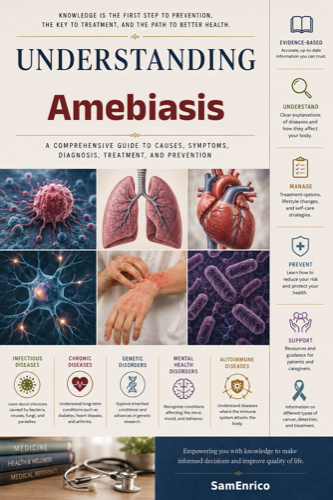
Understanding Amebiasis eBook
This disease publication, published by SamEnrico,
This disease publication, published by SamEnrico, covers Understanding Amebiasis
Formats
Free sample
Chapter 1: The Water Whispered Death...--The first thing Tamar remembered was the taste. Not of chlorine or iron, which she had grown up with in her Tbilisi apartment, but something else—a faint, earthy sweetness that clung to the back of her tongue like a secret. It was late October 1998, and the water pressure had been low for three days. When it returned, her neighbor joked that the reservoir must have been stirring up sediment from the bottom. No one laughed.
No one knew that within two weeks, 1,000 people would be hospitalized, and the sweet-tasting water would be identified as the vector for a parasite most Georgians had never heard of: Entamoeba histolytica.Tamar’s six-year-old son, Guram, was the first in their family to fall ill.It began with a cramp—the kind parents dismiss as a gas bubble or too much bread at dinner. By morning, Guram had visited the bathroom six times. His stool was loose, brown, unremarkable. Tamar gave him tea and kept him home from school. By the second day, the cramps had sharpened into knives.
Guram doubled over, unable to stand straight. His stool turned to mucus streaked with blood. The local polyclinic diagnosed bacterial dysentery and prescribed an antibiotic that did nothing. On the fourth day, Guram’s fever spiked to 39.5°C. He stopped drinking.
His eyes sank into their sockets. Tamar carried him to the Republican Hospital, where a young infectious disease doctor—overworked, under-supplied, and deeply curious—decided to look through a microscope at a fresh stool sample.What he saw changed how Georgia thought about water.Floating among the debris were spherical objects with four nuclei, each the size of a red blood cell. Cysts of Entamoeba histolytica. The doctor had read about them in a Soviet-era textbook but had never seen one in practice. He pulled Tamar aside.
“Your son has amebiasis,” he said. “I need to know everything he drank in the past ten days.”Tamar thought of the tap water. The sweet-tasting tap water.A Disease of Disparities Amebiasis is not a disease of the rich. It is not a disease that commands press conferences or inspires Hollywood thrillers. It is a disease of open sewers and untreated well water, of crowded urban slums and rural villages where the nearest clinic is a day’s walk away.
It is a disease that kills an estimated 40,000 to 100,000 people every year—mostly children and young adults in South Asia, sub-Saharan Africa, and parts of Central and South America—while attracting a fraction of the research funding allocated to diseases with similar mortality burdens.To understand why, one must understand the concept of the neglected disease. The World Health Organization (WHO) defines neglected tropical diseases (NTDs) as a diverse set of conditions that thrive in impoverished environments, where access to clean water, sanitation, and healthcare is limited. Amebiasis qualifies on all counts, yet it has never been formally included in the WHO’s official NTD list—a bureaucratic omission with real consequences. Without NTD status, amebiasis does not trigger the same streamlined drug donation programs, research grants, or international control initiatives that target diseases like schistosomiasis, lymphatic filariasis, or soil-transmitted helminths.The numbers tell a stark story. A 2020 systematic review published in The Lancet Global Health estimated that amebiasis causes 50 million symptomatic cases annually.
Of those, roughly 10 to 20 percent—5 to 10 million people—suffer from invasive disease, either amebic dysentery (bloody diarrhea with tissue destruction) or amebic liver abscess (a collection of pus within the liver that can rupture and kill within days). Case fatality rates in resource-limited settings range from 1 to 5 percent for dysentery and 2 to 10 percent for liver abscess. In the United States and Europe, where diagnosis is faster and intensive care is available, fatality rates drop below 1 percent—but only if the diagnosis is made at all.And that is the second reason amebiasis remains underrecognized: it is a master of disguise.The Great Mimic For centuries, physicians have been fooled by Entamoeba histolytica. Ancient Greek texts describe “dysenteria” with bloody stools and tenesmus (the painful, ineffective urge to defecate), but they did not distinguish between amebic and bacterial causes. In Ayurvedic medicine, the condition rakta-atisara (bloody diarrhea) was treated with herbal formulations that occasionally worked—probably by reducing inflammation rather than killing the parasite.
The first definitive description of the parasite came in 1875 from a Russian physician named Friedrich Lösch, working in St. Petersburg. Lösch examined the stool of a farmer with chronic dysentery, saw motile organisms he called Amoeba coli, and experimentally infected a dog with the same material, producing identical lesions. He knew he had discovered something important. He did not know that half the world would forget it within a century.The problem is twofold.
First, amebic dysentery looks, smells, and feels almost identical to bacterial dysentery caused by Shigella, Campylobacter, or enteroinvasive Escherichia coli. All produce bloody, mucoid stools, lower abdominal pain, fever, and tenesmus. Without a microscope or a molecular test, no clinician can reliably tell them apart. In many low-resource settings, the standard of care is to treat empirically with antibiotics for bacterial causes—ciprofloxacin or azithromycin—which have no effect on Entamoeba. The patient fails to improve, returns to the clinic or hospital, and may be diagnosed only after days of deterioration.Second, even when a microscope is available, the diagnosis is not straightforward.
Entamoeba histolytica is morphologically identical to a harmless commensal species called Entamoeba dispar. For most of the 20th century, scientists believed they were the same organism, with some strains causing disease and others not. It was not until 1993—just five years before the Tbilisi outbreak—that researchers definitively proved they were separate species using isoenzyme analysis and, later, DNA sequencing. This discovery meant that millions of people who tested positive for Entamoeba in stool studies had actually been colonized by E. dispar, which never causes disease.
Conversely, some patients with true E. histolytica infection tested negative because the test could not distinguish between the two. The clinical implications were enormous: a positive test did not necessarily mean treatment; a negative test did not necessarily mean safety.The 1998 Tbilisi outbreak exposed all of these diagnostic failures in real time.Tbilisi, 1998: A Case Study in Infrastructure Failure The Republic of Georgia, newly independent after the collapse of the Soviet Union, was struggling in 1998. Water infrastructure had decayed during the civil wars of the early 1990s, and the municipal water supply in Tbilisi—the capital city of 1.2 million people—was intermittently chlorinated and rarely filtered. In late October, a break in the main water line allowed contaminated surface water to enter the system.
The parasite Entamoeba histolytica, in its hardy cyst form, survived the insufficient chlorine residual and flowed into thousands of homes.The outbreak unfolded like a slow-motion disaster.From October 26 to November 15, hospitals across Tbilisi reported a sudden increase in patients with bloody diarrhea. The Georgian Ministry of Health, working with the U.S. Centers for Disease Control and Prevention (CDC), launched an investigation. They interviewed 196 patients hospitalized with acute diarrhea and compared them with 196 healthy neighbors matched by age and neighborhood. The results were unequivocal: drinking tap water during the outbreak period was…
This is the end of the free sample. Get the eBook to keep going. Buy now
About this book
Details
- Author
- Reddick Drusilla
- Publisher
- SamEnrico
- Language
- English
- Genre
- Non-Fiction, Informative, Educational
- Released
- 2026-05-11
- Pages (approx.)
- 159
- Available as
- eBook, Audiobook

Read better in the ZLOADR app
Your eBooks on your phone or tablet. Sign in with your SamEnrico account and start reading.
More by Reddick Drusilla
 The Interruption Email FilterReddick Drusilla$11.99
 Letting Go of Social Media ResentmentReddick Drusilla$11.99
 Turkey Living Abroad Business GuideReddick Drusilla$11.99
 Commercial Real Estate CrowdfundingReddick Drusilla$11.99
 Chunking for Grocery ShoppingReddick Drusilla$11.99
 The Hoarder’s Child Recovery GuideReddick Drusilla$11.99
 Pelvic Floor Exercises GuideReddick Drusilla$11.99
 Partner Anger De escalationReddick Drusilla$11.99
 Body Image For Plus SizeReddick Drusilla$11.99
 Quantum Leap: The Untold Story of the First Commercial Quantum ComputerReddick Drusilla$11.99
 The Spark of the East: Japan's Hidden Electromagnetic PioneersReddick Drusilla$11.99
 The Billionaire's Gambit: How a Single Trade Shattered a DynastyReddick Drusilla$11.99