
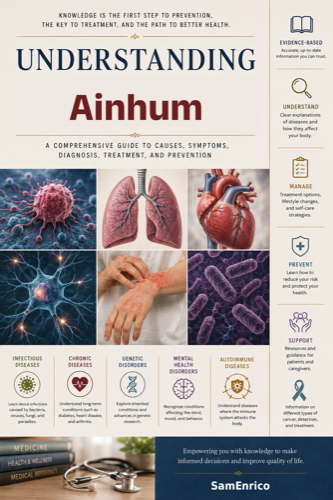
Understanding Ainhum eBook
This disease publication, published by SamEnrico,
This disease publication, published by SamEnrico, covers Understanding Ainhum
Formats
Free sample
Chapter 1: The Silent Severance...--–- In the humid lowlands of coastal Nigeria, a fifty-three-year-old farmer named Adebayo noticed something peculiar one evening as he washed the red laterite soil from his feet. A thin, almost invisible groove had appeared at the base of his right fifth toe—no redness, no swelling, no memory of injury. He dismissed it as a callus, a consequence of decades of walking barefoot to his yam fields. Eighteen months later, he wrapped his hand around that same toe during a routine inspection and found that it twisted like a dried twig. Two weeks after that, his wife found the toe lying in the dust beside their sleeping mat, completely separated from his foot without a single drop of blood.
Adebayo felt nothing—no pain, no tearing, no warning. His body had simply cut off its own digit while he slept. He was not injured. He was not diseased in any conventional sense. He had just experienced the final stage of one of medicine's most perplexing and poorly understood conditions: Ainhum, also known as dactylolysis spontanea.For most physicians practicing outside of West Africa, Brazil, India, or the Caribbean, the word "Ainhum" appears only in board examination review books or forgotten colonial-era medical journals.
For the patients who live with it, however, this condition is neither obscure nor academic. It is a slow, inexorable process that transforms a normal toe into a constricted, bulbous, bone-destroying deformity that ultimately self-amputates. Yet despite being described formally in 1867, Ainhum remains shrouded in myth, misdiagnosis, and neglect. Patients are frequently told they have leprosy, fungal infections, or diabetic foot complications—diagnoses that carry devastating social and psychological consequences. Families hide affected members.
Clinicians shrug with unfamiliarity. And researchers, faced with a disease that primarily affects impoverished tropical populations, have devoted remarkably few resources to understanding its cause or finding reliable treatments.This book exists to change that reality.Understanding Ainhum is the first comprehensive, patient-centered, clinically rigorous guide to this condition ever written for a general audience. It synthesizes the best available medical literature—from the original descriptions of Silva Lima to the most recent case series from teaching hospitals in Lagos and São Paulo—into a single, accessible volume. Whether you are a patient who has just received this diagnosis, a family member seeking answers, a clinician encountering your first case, or a researcher looking for a concise summary of what is known and what remains unknown, this chapter—and those that follow—will provide you with a complete education.But before we can understand the disease, we must first understand its name, its history, and the fundamental question that has haunted physicians for more than 150 years: what kind of condition causes a perfectly healthy toe to fall off for no apparent reason?The Name and Its Origins The word "Ainhum" enters Western medical literature through a linguistic detour that reveals much about the colonial context in which the disease was first studied. In 1867, the Brazilian physician José Francisco da Silva Lima published a series of case reports describing a peculiar condition he had observed among enslaved and free Black populations in the province of Bahia.
His patients presented with a progressive, painless constriction around the fifth toe, followed by swelling of the distal segment, bone resorption, and eventual spontaneous amputation. Silva Lima needed a name for this entity, and he turned to the local languages of West Africa—specifically the Nago and Yago dialects (now recognized as branches of the Yoruba language), which were spoken by many of his patients who had been forcibly transported to Brazil as part of the Atlantic slave trade.In these languages, the word ayun or ainhum translates roughly to "to saw" or "fissure"—a verb describing the action of cutting wood with a serrated blade. Silva Lima found this metaphor irresistible. The progressive groove of Ainhum does not tear or rupture the toe; it slowly saws through the soft tissues, then the bone, as though an invisible blade were working its way circumferentially around the digit. The name was accepted into medical nomenclature and has persisted ever since, even as the condition has been given a more formal scientific label: dactylolysis spontanea, from the Greek daktylos (finger or toe) and lysis (loosening or dissolution), with spontanea indicating the absence of an identifiable external cause.This name is both precise and misleading.
It is precise because it captures the essence of the disease: a spontaneous dissolution of the toe. It is misleading because the word "spontaneous" has historically been interpreted to mean "without any cause whatsoever," which has discouraged research into environmental triggers, genetic predispositions, and immunologic mechanisms. As we will see in Chapter 2, the truth is almost certainly more complex than either pure spontaneity or simple mechanical trauma.What Ainhum Is Not: Clearing the Diagnostic Ground Before diving into the details of what Ainhum is, it is essential to establish what it is not. This is not merely an academic exercise. Misdiagnosis of Ainhum has led to unnecessary amputations, inappropriate treatment with antileprosy drugs, and—in some of the most tragic cases—social ostracism for conditions that patients did not actually have.Ainhum is not leprosy (Hansen's disease).
This is the most common and most damaging misdiagnosis. Leprosy can cause neuropathy, ulceration, and auto-amputation of the digits, but it does so through completely different mechanisms: bacterial infection, nerve damage, and secondary trauma to insensate tissue. Patients with Ainhum retain normal sensation in the affected toe until the very late stages. They do not have skin patches, thickened nerves, or acid-fast bacilli on biopsy. Yet in many endemic regions, the visible loss of a toe leads immediately to a presumptive diagnosis of leprosy—and to the social exile that still accompanies that diagnosis in some communities.Ainhum is not a fungal infection.
Mycetoma, also known as Madura foot, can cause swelling, sinus tracts, and bone destruction of the foot, but it does not produce the characteristic circumferential groove of Ainhum. Fungal infections are typically progressive, destructive, and accompanied by significant inflammation and discharge—features that are conspicuously absent in early Ainhum.Ainhum is not a complication of diabetes mellitus. Diabetic foot ulcers can lead to amputation, but they do so through a combination of neuropathy, peripheral arterial disease, and poor wound healing. The patient with Ainhum is typically younger (30–50 years), nondiabetic, and otherwise metabolically healthy. The auto-amputation in Ainhum is clean, painless, and heals without the infected, gangrenous deterioration seen in diabetic foot disease.Ainhum is not a congenital anomaly.
Amniotic band syndrome can produce constriction rings around the digits of newborns, but these are present at birth and do not progress through the characteristic stages of Ainhum. Similarly, pseudoainhum associated with genetic syndromes (discussed at length in Chapter 3) presents earlier in life and is accompanied by other clinical features such as palmoplantar keratoderma, hearing loss, or nail abnormalities.Ainhum is not a traumatic injury. No patient with Ainhum reports a specific cut, crush, or laceration that preceded the groove. The condition begins insidiously, often with nothing more than a painless plantar callus that could easily be mistaken for ordinary friction-induced skin thickening from walking barefoot.This list of negative definitions serves…
This is the end of the free sample. Get the eBook to keep going. Buy now
About this book
Details
- Author
- Finney Stacie
- Publisher
- SamEnrico
- Language
- English
- Genre
- Non-Fiction, Informative, Educational
- Released
- 2026-06-02
- Pages (approx.)
- 147
- Available as
- eBook, Audiobook

Read better in the ZLOADR app
Your eBooks on your phone or tablet. Sign in with your SamEnrico account and start reading.
More by Finney Stacie
 Road Rage and Revenge DrivingFinney Stacie$11.99
 Farm Equipment Depreciation GuideFinney Stacie$11.99
 Constipation Relief AyurvedaFinney Stacie$11.99
 Day Theming for CreativesFinney Stacie$11.99
 Metta for a Co ParentFinney Stacie$11.99
 Immigrant Real Estate Mogul GuideFinney Stacie$11.99
 Hourglass Dream ArchetypeFinney Stacie$11.99
 Working Memory for SeniorsFinney Stacie$11.99
 Observations Without EvaluationFinney Stacie$11.99
 The Silent War Beneath the Waves: The Submarine Arms Race of the Cold WarFinney Stacie$11.99
 The Great Banana Bread Bake-Off: How a Pandemic Recipe Went ViralFinney Stacie$11.99
 Longwu: The Dragon King’s OathFinney Stacie$11.99