
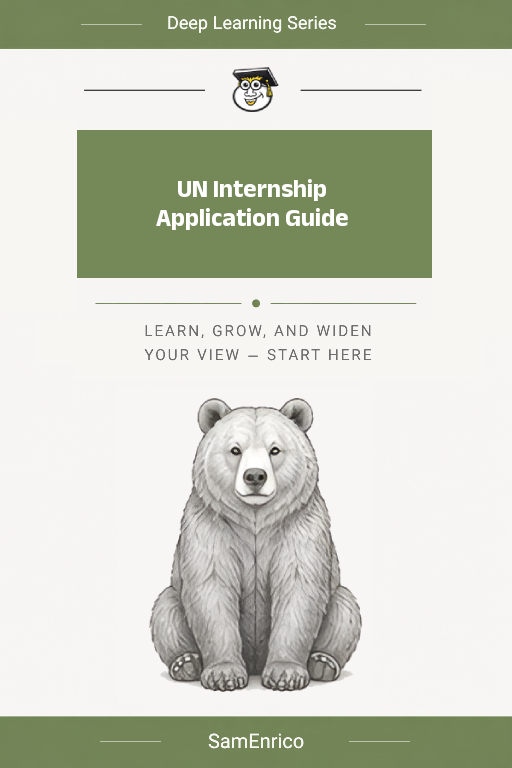
UN Internship Application Guide eBook
Land a paid or unpaid UN internship that leads to
Land a paid or unpaid UN internship that leads to full-time roles.
Formats
Free sample
Chapter 1: The Internship Trap--–- It is a Tuesday morning in Geneva. You are twenty-two years old, freshly graduated, and you have just done something that 98% of your peers would call insane. You have accepted an unpaid internship at the United Nations. Your parents are worried. Your friends think you have been scammed.
Your student loan officer is sending increasingly aggressive emails. And yet, here you are, sitting on a borrowed laptop in a shared apartment with three other interns, staring at a spreadsheet of visa requirements for a country you have never visited.You are not alone.Every year, approximately ten thousand young people from every corner of the globe walk through the doors of UN offices in New York, Geneva, Nairobi, Vienna, Bangkok, Addis Ababa, and Beirut. They arrive with Master's degrees from prestigious universities, fluency in two or three languages, and a burning desire to contribute to something larger than themselves. They work sixty-hour weeks. They draft reports that will be read by ministers and ambassadors.
They sit in meetings where decisions affecting millions of lives are made. And at the end of their six-month internship, approximately 80 percent of them will be told: "Thank you for your service. There is no budget to extend your contract. Good luck."This chapter is about why that happens, and more importantly, how you can be among the 20 percent who beat the odds.The Great Misunderstanding Most people who want to work at the United Nations suffer from what I call the "Nobel Prize Fallacy." They believe that the UN is a meritocracy where the most passionate, hardest-working, and most qualified candidates naturally rise to the top. They imagine a system where a brilliant intern is spotted by a senior official, fast-tracked through HR, and offered a permanent contract with a diplomatic passport and a corner office overlooking Lake Geneva.This is not how the UN works.The United Nations is not a meritocracy.
It is a bureaucracy. And bureaucracies, by their very design, do not reward passion. They reward patience, precision, and an almost obsessive attention to rules that were written before you were born. The UN does not hire people because they deserve a job. It hires people because a vacancy exists, a budget line has been approved, and a hiring manager has found a candidate who checks every single box on a sixteen-page job description.Here is the truth that no UN career fair will ever tell you: The internship program is not designed to recruit future staff members.
It is designed to provide temporary labor at minimal cost. The UN Secretariat, for example, has operated under "zero nominal growth" budgets for over a decade. This means that for every new staff member hired, another must leave. In practice, this has created a system where permanent contracts are increasingly rare, and where interns and consultants have become the hidden workforce that keeps the lights on.But – and this is the crucial "but" – the internship program has also become the single most reliable pathway into the UN for candidates under thirty. Why?
Because even in a system of frozen budgets and frozen headcounts, hiring managers prefer to give contracts to people they already know. An intern who has proven themselves over six months is a safer bet than an unknown candidate from the external roster. The internship is not a job interview. It is a six-month audition. And the people who treat it that way are the ones who survive.The Agency Map: Where to Aim Before you write a single application, you need to understand one of the most important and overlooked facts about UN employment: Not all UN agencies are the same.
The word "United Nations" is actually a shorthand for dozens of legally distinct organizations, each with its own budget, its own hiring rules, its own culture, and its own conversion rate from intern to staff.Let me give you a concrete example. The UN Secretariat, which includes the Secretary-General's office and the headquarters in New York, is funded primarily by mandatory contributions from member states. Those contributions have been flat or declining for years. As a result, the Secretariat hires very few interns into permanent roles. A Secretariat internship looks prestigious on your resume, but statistically, it is a dead end.Now compare that to the World Food Programme (WFP) or UNICEF.
These agencies are funded largely by voluntary contributions – donations from governments, foundations, and private individuals. Their budgets fluctuate, but they also have more flexibility. When a donor gives money for a specific project, that project needs staff. And those staff are often hired from the pool of interns who have already proven themselves on similar projects.Here is a practical framework I call the "Agency Conversion Matrix." It divides UN entities into three categories:Category One: High Conversion, Lower Prestige These are the operational agencies that actually deliver services on the ground. They include WFP, UNICEF, UNHCR (refugees), UNDP (development), and UNFPA (population).
Their internship conversion rates can be as high as 30-40 percent for candidates who perform well. The trade-off is that these agencies are less "glamorous" than the Secretariat. You will not be attending Security Council meetings. You will be analyzing supply chain data in Juba or monitoring vaccination campaigns in Dhaka. But you will also be building skills that are directly transferable to full-time roles.Category Two: Medium Conversion, Medium Prestige These are the specialized agencies based in Europe: WHO (health) in Geneva, ILO (labor) in Geneva, FAO (food and agriculture) in Rome, UNESCO (culture and education) in Paris, and IAEA (nuclear energy) in Vienna.
These agencies have more stable budgets than the operational agencies but less political drama than the Secretariat. Conversion rates are typically 15-25 percent. They are excellent targets for candidates with specific technical expertise (public health, agriculture, nuclear engineering, cultural heritage).Category Three: Low Conversion, High Prestige This category includes the UN Secretariat (New York and Geneva), the Department of Political and Peacebuilding Affairs, and the Executive Office of the Secretary-General. These internships are the most competitive, the most prestigious, and the least likely to lead to a contract. Conversion rates are often below 5 percent.
I do not recommend targeting these agencies as your primary focus unless you have an independent source of funding and are willing to treat the internship as a resume-builder rather than a career launchpad.There is one exception to this rule: field offices. A Secretariat internship in a conflict zone (for example, in the UN mission in Mali or the Democratic Republic of Congo) has much higher conversion potential because the turnover is constant and the working conditions are difficult. If you are willing to serve in a hardship duty station, your odds improve dramatically. But that is a decision that requires serious personal reflection, which we will discuss later in this book.The Roster System: Your Invisible Career Asset One of the most confusing aspects of UN hiring is something called the "roster." The roster is not a waiting list for a specific job. It is a database of pre-vetted candidates who have passed an interview but have not yet been placed in a specific position.Here is how it works.…
This is the end of the free sample. Get the eBook to keep going. Buy now
About this book
Details
- Author
- Bisson Latricia
- Publisher
- SamEnrico
- Language
- English
- Genre
- Non-Fiction, Non-Obvious Career
- Released
- 2026-06-01
- Pages (approx.)
- 132
- Available as
- eBook, Audiobook

Read better in the ZLOADR app
Your eBooks on your phone or tablet. Sign in with your SamEnrico account and start reading.
More by Bisson Latricia
 The Interruption Scripting WorkbookBisson Latricia$11.99
 IBS Pelvic Floor Therapy GuideBisson Latricia$11.99
 Fear Appeal PersuasionBisson Latricia$11.99
 Discussing Open Relationship BoundariesBisson Latricia$11.99
 The 4 Hour Workday ScheduleBisson Latricia$11.99
 The Freelance Tax Shield GuideBisson Latricia$11.99
 Smoking Cessation ScriptsBisson Latricia$11.99
 Myofascial Release Techniques for Back PainBisson Latricia$11.99
 Dash Cam Review for LearningBisson Latricia$11.99
 The Light of Reason: Erasmus and the Birth of HumanismBisson Latricia$11.99
 The Enigma of the Dyatlov Pass: Voices from the SnowBisson Latricia$11.99
 Understanding Aniridia Type 2Bisson Latricia$17.99
You may also like
 World Bank Accreditation GuideVo Theo$12.99
 Heavy Diesel Mechanic MigrationCrutchfield Denna$12.99
 World Bank Salary GuideManson Yuonne$12.99
 World Bank Young Professionals TipsCoker Crissy$12.99
 World Bank Treasury Finance RolesQuinn Opal$12.99
 World Bank Technical Assistance RolesLuster Horacio$12.99
 World Bank Tax GuideJacoby Cherelle$12.99
 World Bank Language Skills GuideFerrell Angeles$12.99
 World Bank IFC Investment OfficerBuckley Saturnina$12.99
 World Bank Environmental SpecialistDodson Darline$12.99
 World Bank Consultant Entry RoutePham Adela$12.99
 World Bank Career Case StudiesCoffman Randee$12.99