
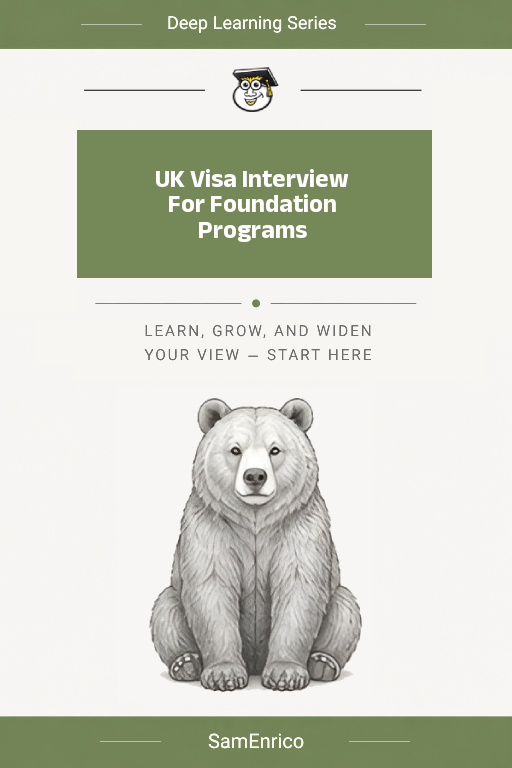
UK Visa Interview For Foundation Programs eBook
Explain pathway to degree and show how foundation
by Saenz Lelia
Explain pathway to degree and show how foundation year prepares for undergraduate success.
Formats
Free sample
Chapter 1: The Three-Year Lie...--–- When Anika Sharma landed at Heathrow with a suitcase full of dreams and a head full of misconceptions, she believed she understood what awaited her. She had researched "UK education" online, watched You Tube videos of British university life, and memorized the names of her course modules. But three weeks into her Foundation Year, she sat in a seminar room at the University of Manchester, completely lost. Her professor had just asked the class to "critique the methodology" of a research paper – a task Anika had never been taught in her Indian high school. She knew how to memorize facts and reproduce them on exams.
She did not know how to question an expert's approach. This is the hidden truth that no glossy university prospectus tells you: the UK education system is not just different in length or structure – it is fundamentally different in how it thinks, teaches, and evaluates. And if you do not understand these differences before your visa interview, you will fail to convince the Entry Clearance Officer (ECO) that you are a genuine student. Worse, you will arrive in the UK unprepared for the academic shock that awaits.The Myth That Costs Students Their Visas Every year, thousands of international students sit for their UK visa interviews carrying a dangerous assumption: that a degree is a degree, and a classroom is a classroom, no matter where you go. This assumption is wrong.
The UK does not run its universities like the United States, Canada, Australia, or most countries in Asia, Africa, or South America. Yet most students prepare for their visa interviews by memorizing generic answers about "quality education" and "global opportunities" – answers that sound rehearsed, vague, and unconvincing to an experienced ECO.Consider the data. According to UK Visas and Immigration (UKVI), the most common reason for refusal – beyond financial documentation errors – is the ECO's determination that the applicant is not a "genuine student." What does this mean in practice? It means the applicant could not articulate a clear understanding of the UK education system, could not explain how their chosen course would lead to a specific career outcome, or gave answers that could apply to any university in any country. A student who says, "I want to study in the UK because it has a good education system" has said nothing.
The ECO hears that and thinks: this student has done no research.This chapter dismantles the three most dangerous myths about UK education and replaces them with the precise knowledge you need to sound like a genuine, well-researched candidate. By the end of this chapter, you will understand the UK degree structure better than most British students. You will speak comfortably about credits, classifications, and the difference between a lecture and a seminar. And you will have a 30-second "elevator pitch" that proves to the ECO you belong in the UK.Myth #1: A UK Degree Is Just Three Years Instead of Four The most common misunderstanding is that the UK's three-year degree (in England, Wales, and Northern Ireland) is simply a compressed version of a four-year US degree. This is false.
The difference is not merely length – it is philosophy.The US model is built on liberal arts principles: you spend your first one to two years taking general education requirements in mathematics, natural sciences, humanities, and social sciences before declaring a major. A US student studying law will take classes in history, literature, and biology alongside their legal coursework. The goal is to produce a "well-rounded graduate" who can think broadly across disciplines.The UK model is built on specialization. From day one of a UK degree (after completing a Foundation Year, if required), you study your chosen subject and only your chosen subject. A UK law student takes law modules: contract law, criminal law, tort law, public law, and so on.
They do not take history, literature, or biology unless those subjects directly relate to their legal studies (e.g., legal history). The goal is to produce a "deep expert" who has mastered their discipline's content, methods, and debates by graduation.Why does this matter for your visa interview? Because the ECO will ask, either directly or indirectly, why you chose the UK over other English-speaking destinations. A weak answer sounds like: "The UK has good universities." A strong answer sounds like: "I chose the UK because I already know I want to specialize in [your subject]. The three-year model in England allows me to go deep into my field without spending a year on unrelated general education requirements.
That focus is exactly what I need to achieve my career goal of becoming a [your career]."Note for students applying to Scotland: Scottish undergraduate degrees are typically four years. The first two years are broader, allowing you to explore multiple subjects before specializing in years three and four. You can frame this as a strength: "I chose Scotland because the four-year model gives me the breadth to explore related fields before I specialize – but unlike the US, I still graduate with deep expertise in my chosen subject."Myth #2: All UK Degrees Are the Same Another dangerous assumption is that "a degree is a degree" – that all UK universities follow identical structures and standards. This is not true. The UK has a diverse higher education landscape, and understanding its variations will make you sound sophisticated in your interview.First, the nations.
England, Wales, and Northern Ireland follow the three-year model described above. Scotland follows a four-year model. Some Scottish universities also offer "accelerated" degrees, but these are rare. When you answer questions about degree length, you must know which nation your university is in. A student applying to the University of Edinburgh (Scotland) who says "I chose the UK for its three-year degrees" has just revealed they have not done their homework.Second, the types of universities.
The UK has ancient universities (Oxford, Cambridge, the University of Glasgow, the University of Aberdeen), red brick universities (Birmingham, Bristol, Leeds, Liverpool, Manchester, Sheffield, Newcastle), plate glass universities (York, East Anglia, Essex, Kent, Warwick), and post-1992 universities (formerly polytechnics). Each group has different strengths, teaching styles, and research profiles. You do not need to memorize these categories, but you should know which category your university falls into and what that means for your learning experience. For example, a student applying to a post-1992 university might say: "I chose the University of [name] because it has strong industry links and a teaching-focused approach, which suits my practical career goals in [industry]."Third, the degree classifications. The UK awards degrees with honours classifications that do not exist in most other countries.
These are: First-Class Honours (1st) – 70% and above; Upper Second-Class Honours (2:1) – 60% to 69%; Lower Second-Class Honours (2:2) – 50% to 59%; Third-Class Honours (3rd) – 40% to 49%. A "pass" without honours is possible but rare.These classifications matter enormously for your future employment and postgraduate study. A 2:1 is the standard requirement for most graduate schemes and master's programs. A First is required for top academic positions and competitive graduate schemes. A 2:2 will close many doors.
The ECO will not test you on these numbers, but your ability to discuss degree classifications shows you have researched beyond the glossy…
This is the end of the free sample. Get the eBook to keep going. Buy now
About this book
Details
- Author
- Saenz Lelia
- Publisher
- SamEnrico
- Language
- English
- Genre
- Non-Fiction, Student's Shortcut
- Released
- 2026-05-30
- Pages (approx.)
- 152
- Available as
- eBook, Audiobook

Read better in the ZLOADR app
Your eBooks on your phone or tablet. Sign in with your SamEnrico account and start reading.
More by Saenz Lelia
 Laci Peterson Vigil MemoriesSaenz Lelia$11.99
 Bud Walton Co founderSaenz Lelia$11.99
 Managing Interruptions in Open Plan Schools WorkbookSaenz Lelia$11.99
 French Revolution Complete GuideSaenz Lelia$11.99
 The Pique TechniqueSaenz Lelia$11.99
 Assertive vs Aggressive Examples WorkbookSaenz Lelia$11.99
 The Freelance Vacation BlackoutSaenz Lelia$11.99
 Scripting SuccessSaenz Lelia$11.99
 Costochondritis Chest Pain StretchesSaenz Lelia$11.99
 The Last Telegram: A Love Letter Across the Berlin WallSaenz Lelia$11.99
 Iron Dawn: The Forgotten Robots of Ancient GreeceSaenz Lelia$11.99
 The Phantom of the Pentagon: The Spy Who VanishedSaenz Lelia$11.99
You may also like
 LSE Online Program LengthAgee Letisha$11.99
 Harvard Extension School for Working AdultsRoush Yer$11.99
 LSE Online Reading ListAshford Ludivina$11.99
 LSE Online Language RequirementsWhitten Daphine$11.99
 LSE Online Class SizeHughey Garret$11.99
 LSE Online Alumni MentorshipWild Lyla$11.99
 London School of Economics Alumni NetworkDutton Chantal$11.99
 Harvard Extension School Student SupportCantrell Christene$11.99
 Harvard Extension School Library AccessSantana Adah$11.99
 Harvard Extension School Degree CompletionBray Wyatt$11.99
 Harvard Extension School Course AuditingAbbott Craig$11.99
 Harvard Extension School Extension DiplomaNew Joane$11.99