
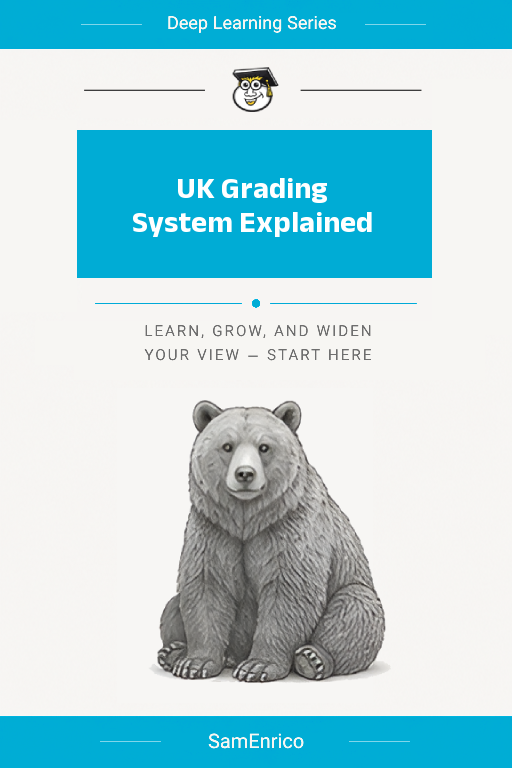
UK Grading System Explained eBook
Understand first-class upper second and degree cla
Understand first-class upper second and degree classifications for UK degrees.
Formats
Free sample
Chapter 1: The 70% Lie--–- The email arrived at 11:47 PM on a Tuesday. Amelia, a straight-A student from Singapore who had never received a grade below 85% in her life, opened her first UK university essay feedback. The score at the bottom: 62%. She stared at the screen for ten minutes. Then she cried.
Then she emailed her personal tutor: “I think there has been a mistake. I have never failed before.”Her tutor wrote back the next morning: “You didn’t fail. 62% is an Upper Second. That’s a very good mark.”Amelia did not believe her. How could 62% be “very good” when 62% was a D- in her Singaporean junior college?
How could 70% be a “First-Class Honours” when 70% had always been a C? And why had no one explained this to her before she arrived, before she paid her international tuition fees, before she spent three months believing she was failing?This chapter exists because Amelia’s story is not unusual. It is the story of thousands of international students and even domestic freshers who arrive at UK universities with a fundamental misunderstanding of what their grades actually mean. The UK grading system is not broken. But the way it is communicated to new students is.
This chapter will fix that.The Shock of the First Mark Let us begin with a simple statement that will change how you read every grade you receive for the rest of your degree: In the UK, 70% is excellent. 40% is a pass. And 90% is almost impossible.If you come from an educational system where 90% is expected, where 80% is a warning sign, and where 70% means you are failing, the UK system will feel like a foreign language masquerading as numbers. But it is not a matter of tougher marking or lower standards. It is a completely different philosophy of assessment.To understand why, you must first understand the single most important question your UK markers are asking when they read your work.
They are not asking “Did this student accumulate enough points?” They are asking “Does this work demonstrate independent critical judgment?”This distinction is everything.The Philosophy Behind the Numbers In many educational systems around the world, grading is additive. You start at zero and earn points for each correct answer, each completed task, each attendance record, each small piece of homework. A student who does everything perfectly can reach 95%, 98%, or even 100%. This is a system that rewards effort, compliance, and completeness.The UK system is not additive. It is qualitative.You start at a baseline of “pass” (40%) and your work is evaluated on its quality, originality, and critical depth.
The question is not “How many things did you get right?” but “How well did you think?” A student who attends every lecture, completes every reading, and writes a perfectly competent but entirely descriptive essay will receive a 2:2 or a low 2:1 at best. A student who misses three lectures but writes an essay that identifies a gap in the existing literature, challenges a core assumption, or synthesizes two conflicting theories into something new can receive a First.This feels unfair to students from additive systems. And in a way, it is. But it is not arbitrary. The UK system is designed to identify and reward independent thinking because that is what UK universities value most.
They do not want students who can repeat what they have been told. They want students who can tell them something they did not know.The Grade Translation Table You Actually Need Let us put numbers to this philosophy. Below is the most accurate translation of UK percentage grades into other common systems. Keep this table nearby for your entire first year. You will need it.UK Percentage UK Classification US Letter Grade US GPAChinese Percentage (Typical)Indian Percentage (Typical)European ECTS80-100%First (High)A+4.095-100%85-100%A (Outstanding)70-79%First (Standard)A/A-3.7-4.085-94%75-84%A (Excellent)65-69%Upper Second (High)B+3.3-3.775-84%65-74%B (Very Good)60-64%Upper Second (Standard)B3.0-3.370-74%60-64%B (Good)50-59%Lower Second B-/C+2.0-3.060-69%50-59%C (Satisfactory)40-49%Third / Pass D1.0-2.050-59%40-49%D (Sufficient)Below 40%Fail F0.0Below 50%Below 40%F (Fail)Important caveats before you print this table and frame it:First, these translations are approximate.
A UK 70 is not exactly a US A in every context, but for the purposes of graduate school applications and employer CVs, this is the standard conversion.Second, Chinese and Indian percentage systems vary dramatically by board, university, and even department. A 75% from Delhi University is not the same as a 75% from a newer private university. When in doubt, check the specific conversion used by your target institution.Third, and most critically: Do not try to convert your UK grades back to your home system in your head while you are studying. That way lies madness. A UK 68% is an excellent grade.
If you spend your entire degree thinking “68% is only a B- back home,” you will be miserable and you will be wrong. The table above is for external applications only. For your internal peace of mind, learn to read UK grades as UK grades.The Four Anchors: What Each Band Actually Means Now that you have the translation table, let us go deeper. What does it actually mean to write at a First-Class level versus a 2:1 level? What is the difference on the page?First-Class Honours (70-100%): The Original Thinker A First-Class essay does not just answer the question.
It challenges the premise of the question. It identifies something the question assumes that might not be true. It applies a theory to a new context. It synthesizes two authors who are usually kept separate. It notices a gap in the literature and attempts to fill it.Here is an example.
A 2:1 essay asked “Was the Industrial Revolution beneficial for British workers?” would answer: “Yes, in some ways (higher wages for some) but no, in other ways (poor working conditions).” That is competent. That is critical. That is a 2:1.A First-Class essay would ask: “What do we mean by ‘beneficial’? Beneficial in economic terms, health terms, or intergenerational terms? And which workers?
Skilled textile workers in Manchester experienced the Industrial Revolution differently from agricultural laborers in Norfolk.” The First-Class essay then answers a more specific and more interesting question than the one originally asked.This is the essence of First-Class work: you do not just play the game. You change the game.Upper Second (2:1, 60-69%): The Critical Reproducer A 2:1 essay is the gold standard for most purposes. It is competent, well-structured, and genuinely critical. It compares authors, identifies weaknesses in arguments, and reaches a reasoned conclusion. But it does not fundamentally transform the debate.
It works within the existing framework.The 2:1 essay answers the question that was asked. It does not ask a new question. It does not identify a gap that no one has noticed. It does not apply a theory in a completely novel way. It is excellent within the boundaries of the assignment, but it does not push beyond those boundaries.Approximately 46% of UK graduates receive a 2:1.
It is the most common classification for a reason: it represents solid, reliable, critical work. If you graduate with a…
This is the end of the free sample. Get the eBook to keep going. Buy now
About this book
Details
- Author
- Valenzuela Livia
- Publisher
- SamEnrico
- Language
- English
- Genre
- Non-Fiction, Student's Shortcut
- Released
- 2026-06-01
- Pages (approx.)
- 134
- Available as
- eBook, Audiobook

Read better in the ZLOADR app
Your eBooks on your phone or tablet. Sign in with your SamEnrico account and start reading.
More by Valenzuela Livia
 The Nun Who Built a UniversityValenzuela Livia$11.99
 Sephora Beauty Insider TrapValenzuela Livia$11.99
 AA Birthday Chips GuideValenzuela Livia$11.99
 The Uncomfortable Beginner GuideValenzuela Livia$11.99
 Gut Health for HistamineValenzuela Livia$11.99
 The Thrift Store WardrobeValenzuela Livia$11.99
 Assertiveness Flash CardsValenzuela Livia$11.99
 Strength Training Volume GuideValenzuela Livia$11.99
 The Siege of Constantinople: Byzantine Walls That Defied the AgesValenzuela Livia$11.99
 Shadows of the Midnight Ride: The Forgotten Black Patriots of LexingtonValenzuela Livia$11.99
 The Ballad of the Singing Cowboy: Gene Autry’s Golden ReignValenzuela Livia$11.99
 Ultimate Handbook Guide to Miami : (United States) Travel GuideValenzuela Livia$11.99
You may also like
 Hong Kong Handover 1997Dunn Johnnie$11.99
 Zumba For Postnatal Recovery CourseNeal Christian$11.99
 Zumba for BeginnersLadner Nikia$11.99
 YouTube Comment Mining GuideHumes Pandora$12.99
 Worry Box MeditationCarlin Rudy$11.99
 Workplace Stress MeditationNguyen Lynn$11.99
 Workplace Stress and Sleep RepairHawley Ivory$11.99
 Workplace Perfectionism CureDelaney Jeffry$11.99
 Workplace Injustice Anger GuideWallen Isabelle$11.99
 Work Addiction and Burnout LinkGreenwood Ester$11.99
 Women in Yoga and WellnessBeattie Galina$11.99
 Women in Stand Up ComedyChun Evangeline$11.99