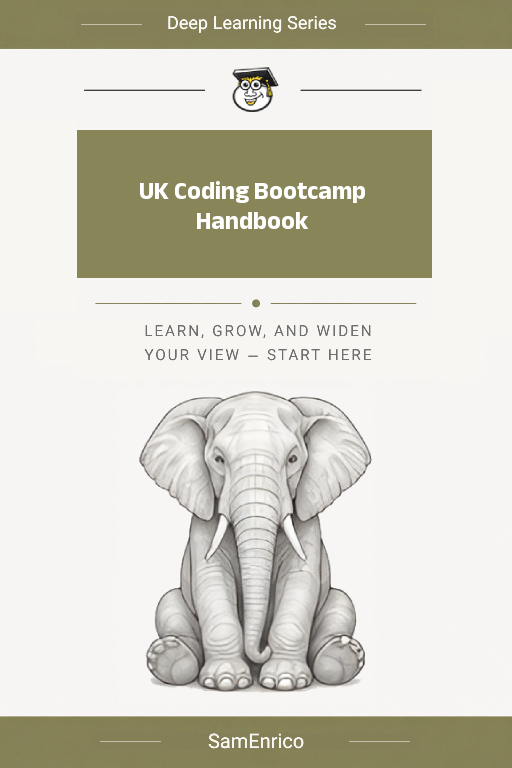
UK Coding Bootcamp Handbook eBook
Compare British bootcamps and university degrees i
by Wasson Trinh
Compare British bootcamps and university degrees including apprenticeship options and graduate salary outcomes.
Formats
Free sample
Chapter 1: The £136,000 Question--–- On a rainy Tuesday morning in Manchester, a 29-year-old retail manager named Priya did something that would change her life. She didn't write a line of code. She didn't enrol in a bootcamp. She didn't apply to university. Instead, she opened a spreadsheet and calculated the true cost of doing nothing.The number stopped her cold.Over the next thirty years, by staying in her £24,000 retail job with its 2% annual raises, she would earn approximately £1.2 million before tax.
If she could transition into tech and reach the industry median salary of £55,000 by age 35 (with 5% annual raises thereafter), her lifetime earnings would jump to £1.9 million. That £700,000 gap – the difference between staying and switching – was not a statistic. It was a mortgage. It was fifteen years of retirement. It was the financial floor beneath her daughter's future.Priya didn't know it yet, but she was asking the single most important question this book will answer: Which educational path gives me the fastest, cheapest, most reliable route from where I am now to a six-figure lifetime earnings trajectory?The answer, as she would discover over the following six months, was not what her careers adviser had told her at sixteen.
It was not what her parents believed about university degrees. And it was certainly not what the bootcamp advertisements plastered across her Instagram feed were promising.This chapter is called The £136,000 Question because that is the minimum financial mistake you will make if you choose the wrong educational path for your specific circumstances. Not the bad path – the wrong path for you. A university degree can be the best investment of your life or the worst, depending on your age, your postcode, your learning style, and your target employers. The same is true for bootcamps and apprenticeships.
The difference between the right choice and the wrong choice for a 19-year-old maths prodigy from Surrey and a 34-year-old warehouse supervisor from Leeds is not measured in hundreds of pounds. It is measured in house deposits, early retirements, and the difference between loving your work and resenting it.This book exists because the UK tech education landscape has become deliberately, profitably confusing.Universities spend millions on marketing campaigns showing happy graduates holding scrolls, but they rarely mention that 28% of computer science graduates are still unemployed six months after finishing. Bootcamps flood social media with testimonials of career-switchers who tripled their salaries, but they bury the small print showing that 27% of their graduates are still job hunting after three months. Apprenticeships – arguably the most financially rational path for most people – are so poorly advertised that the majority of prospective students don't even know they exist.You are reading this book because you suspect, correctly, that someone is not telling you the whole truth.The Three Doors: Understanding the Trilemma Every person who wants to become a software developer in the UK faces the same three doors. Behind each door is a different combination of three variables: Speed (how quickly you can start earning a developer's salary), Depth (how much theoretical computer science you will learn, which affects your long-term career ceiling), and Cost (both the upfront fees and the opportunity cost of time spent not earning).Let me name the doors clearly before we walk through them.Door One: The University Degree (BSc Computer Science).
This path maximises Depth. You will spend three to four years learning algorithms, discrete mathematics, computational theory, and formal methods. You will pay £9,250 per year in tuition fees, plus maintenance loans, plus the staggering opportunity cost of three years of foregone wages. You will graduate – if all goes well – with a deep theoretical understanding and, in most cases, very little practical experience deploying real software. Your first job search may take four to six months.
Your long-term ceiling is the highest of the three paths, but only if you graduate from a top-tier university and actively build a portfolio alongside your degree. For everyone else, the earnings converge with the other paths by age twenty-six.Door Two: The Coding Bootcamp (12–16 weeks). This path maximises Speed. You will spend three to four months in an intensive programme, typically costing £8,000 to £12,000, learning exactly the practical skills employers want right now: React, Python, APIs, cloud deployment. You will build a portfolio of real applications.
You will graduate with very little theoretical depth – you will struggle to explain Big O notation or implement a red-black tree – but you will be able to ship production-ready code. Seventy-three per cent of bootcamp graduates have a job offer within ninety days. Your starting salary will typically be £38,000 (or £42,000 in London). Your long-term ceiling is slightly lower than the university path for the top 5% of roles (CTO, principal architect at FANG companies), but for the vast majority of UK tech jobs, you will reach the same mid-level and senior salaries as your degree-holding colleagues by age twenty-six.Door Three: The Degree Apprenticeship (Level 4 or Level 6). This path minimises Cost.
You will spend four years working four days a week and studying one day. Your employer pays your tuition fees. You earn a salary from day one – typically £20,000 to £26,500, rising to £50,000 by the time you complete the programme. You graduate with a full BSc degree, four years of work experience, and zero debt. The catch is regional availability (strong in Scotland, Manchester, Bristol; weak elsewhere), brutal competition (assessment centres, aptitude tests), and a four-year commitment that feels interminable when you are twenty years old and watching your bootcamp friends land jobs in three months.The Trilemma is simple and unforgiving: You cannot maximise Speed, Depth, and low Cost simultaneously.
Every path sacrifices at least one variable. The university degree sacrifices Speed and low Cost. The bootcamp sacrifices Depth. The apprenticeship sacrifices Speed (four years is longer than three months) and, for some, the depth of theoretical instruction found at elite universities.Your job, as the reader and investor in your own future, is to decide which sacrifice you can afford to make and which you cannot.Why 76% of UK Engineering Firms Are Desperate (And Why That Matters to You)Let me give you a piece of data that should make you feel optimistic, even if you currently know nothing about coding.According to the 2024 Tech Nation Report and corroborated by the Office for National Statistics, 76% of UK engineering firms – including software development companies, fintech scaleups, and digital agencies – report difficulty hiring the talent they need. This is not a niche problem.
It is a systemic shortage that spans every region of the country, from the fintech corridors of London to the gaming studios of Leamington Spa to the fintech hubs of Edinburgh and Manchester.The shortage exists for three reasons.First, the UK does not produce enough computer science graduates. Universities have expanded their Comp Sci programmes significantly over the past decade, but demand has grown faster. The number of software developer job postings increased by 134% between 2015 and 2023, while the number of Comp Sci graduates increased by only 52%. Simple maths: more jobs, fewer graduates.Second, the graduates universities do produce are often not job-ready. A typical computer science degree from a mid-ranked university teaches theory almost exclusively.
Students graduate having written maybe a thousand lines of code in a controlled academic environment. They have never used Git…
This is the end of the free sample. Get the eBook to keep going. Buy now
About this book
Details
- Author
- Wasson Trinh
- Publisher
- SamEnrico
- Language
- English
- Genre
- Non-Fiction, Student's Shortcut, UK Education
- Released
- 2026-06-01
- Pages (approx.)
- 150
- Available as
- eBook, Audiobook

Read better in the ZLOADR app
Your eBooks on your phone or tablet. Sign in with your SamEnrico account and start reading.
More by Wasson Trinh
 Self Doubt Networking GuideWasson Trinh$11.99
 Distraction Rehearsal Training GuideWasson Trinh$11.99
 Second Generation Cuisine FusionWasson Trinh$11.99
 Keto Brain Function GuideWasson Trinh$11.99
 Bessie Smith EmpressWasson Trinh$11.99
 Email Marketing Impact On ChurnWasson Trinh$11.99
 Sleep Memory For ADHDWasson Trinh$11.99
 Tax Efficient Withdrawal OrderWasson Trinh$11.99
 The Vanishing of Flight 19: The Bermuda Triangle’s Final WitnessWasson Trinh$11.99
 The Silk Road Pioneers: Venice's Merchant Princes and the Birth of Global TradeWasson Trinh$11.99
 Understanding Fragile X-associated Tremor/ataxia Syndrome (Fxtas)Wasson Trinh$11.99
 How to Produce Skateboard TrucksWasson Trinh$11.99