
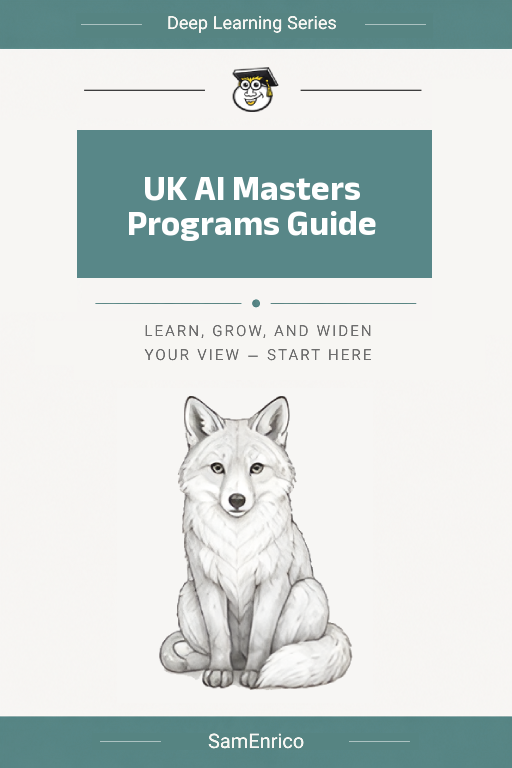
Non-FictionStudent's ShortcutUK
UK AI Masters Programs Guide eBook
Study artificial intelligence at Oxford, Cambridge
Study artificial intelligence at Oxford, Cambridge, Imperial College, and University of Edinburgh.
Formats
Free sample
Chapter 1: The Great Gamble--–- In the autumn of 2024, a twenty-two-year-old computer science graduate from Mumbai named Priya received two offers: a two-year Master’s program in Artificial Intelligence at Carnegie Mellon University in Pittsburgh, and a one-year MSc in Machine Learning at Imperial College London. The Carnegie Mellon offer came with a US tuition bill of nearly $80,000 per year, two years of lost income, and a three-year OPT work authorization that required winning a lottery for an H1-B visa. The Imperial offer required £46,000 in tuition, nine months of living expenses in London, and a guaranteed two-year Graduate Route visa with no sponsorship required. Priya chose Imperial. Eighteen months later, she was a machine learning engineer at a London-based autonomous vehicle startup, earning £72,000, holding indefinite leave to remain on a five-year track, and wondering why so many of her peers still believed that the only path to AI prestige ran through Silicon Valley.This book exists because Priya’s story is not an outlier.
It is the predictable outcome of a structural shift in global AI education that most prospective students have not yet internalized. The United Kingdom has quietly built the most efficient, most accessible, and most strategically valuable ecosystem for artificial intelligence master’s education in the English-speaking world. That claim sounds provocative. It is also supported by data, by placement records, and by the simple arithmetic of time, money, and immigration policy.The purpose of this chapter is to make the case for why a UK AI Masters—specifically at Oxford, Cambridge, Imperial College London, or the University of Edinburgh—should be your default option unless you have a compelling, individualized reason to look elsewhere. We will examine the global AI talent race, the cost-duration-visa equation, the tuition trends that signal shifting demand, and the concentrated excellence that makes these four institutions a category of their own.
By the end of this chapter, you will have a one-page decision framework to determine whether the UK gamble is right for you—and if so, which of the four universities might align with your personal optimization problem.The Global AI Talent Race: Supply, Demand, and the Signaling Problem Artificial intelligence is not a normal job market. It is a market defined by a structural imbalance that shows no sign of correcting within the next decade. In 2024, global demand for machine learning engineers exceeded supply by a ratio of approximately three to one, according to data from the World Economic Forum and Linked In’s Emerging Jobs Report. That gap is projected to widen as non-tech industries—finance, healthcare, logistics, agriculture, energy—accelerate their AI adoption. The result is a global scramble for talent in which geography matters less than speed, signal strength, and work authorization.For an international student, a master’s degree serves three economic functions.
First, it provides human capital: the technical skills required to perform at an industry or research level. Second, it provides a credentialing signal: a way to convince employers that you possess those skills without the employer having to test every candidate exhaustively. Third, and most critically for international students, it provides a work authorization bridge: a legal pathway to convert educational status into employment status in a desirable labor market.The United States has traditionally dominated on all three dimensions. American universities—Stanford, MIT, Carnegie Mellon, Berkeley—produce the most cited AI research, attract the most prominent faculty, and feed directly into Silicon Valley’s high-salary, high-prestice ecosystem. But the US system has three structural weaknesses that have become more acute since 2020.
First, duration: most competitive AI master’s programs require two years, which means two years of tuition and two years of foregone income. Second, cost: total expenditure for a two-year US program, including living expenses, routinely exceeds 100,000,andoftenapproaches100,000, and often approaches 100,000,andoftenapproaches150,000 at private universities. Third, and most significantly, post-graduation work authorization is fragile. The Optional Practical Training (OPT) program allows 36 months of work for STEM graduates, but the transition to an H1-B work visa is a lottery with odds that have fallen below thirty percent in recent years. You can do everything right—ace your courses, publish at Neur IPS, secure a job offer from Google—and still be forced to leave the country because the visa lottery did not favor you.Canada offers a more stable alternative: the Post-Graduation Work Permit (PGWP) provides up to three years of open work authorization, and the pathway to permanent residence is clearer.
But Canadian AI master’s programs are fewer in number, lower in global brand recognition, and concentrated in a small set of universities (University of Toronto, University of British Columbia, Mc Gill, and the newly emerging Vector Institute affiliates). Salaries are also lower: a machine learning engineer in Toronto earns roughly sixty to seventy percent of the salary of a counterpart in San Francisco or London.The United Kingdom has engineered a different trade-off. The UK does not compete with the US on raw research expenditure or sheer number of AI faculty. But it competes ferociously on efficiency, access, and certainty. A UK AI master’s takes one year—not two.
Total cost, including living expenses, ranges from £53,600 at the University of Edinburgh to £68,000 at Imperial College London. In US dollar terms at late-2025 exchange rates, that is roughly 68,000to68,000 to 68,000to86,000. That is significantly less than the US baseline and comparable to or cheaper than Canadian programs when adjusted for duration. And the post-study work visa—the Graduate Route—provides two guaranteed years of work authorization with no sponsorship required, no lottery, and no job offer needed at the time of application. You graduate.
You stay. You work.The Cost-Duration-Visa Equation: A Quantitative Comparison Let us make this comparison concrete. The table below summarizes the key variables for a typical international student considering AI master’s programs in the US, Canada, and the UK. All figures are in US dollars at 2025 exchange rates for consistency, with original currencies noted.Dimension United States (Top 10 Program)Canada (Top 3 Program)United Kingdom (Oxford, Cambridge, Imperial, Edinburgh)Program duration2 years2 years1 year Total tuition90,000–90,000–90,000–150,000CAD 60,000–80,000 (44,000–44,000–44,000–58,000)£38,600–£46,000 (49,000–49,000–49,000–58,000)Living expenses (2 years US/Canada, 1 year UK)30,000–30,000–30,000–50,000CAD 20,000–30,000 (15,000–15,000–15,000–22,000)£15,000–£22,000 (19,000–19,000–19,000–28,000)Total cost120,000–120,000–120,000–200,00059,000–59,000–59,000–80,00068,000–68,000–68,000–86,000Post-graduation work authorization36 months OPT + H1-B lottery (~30% odds)36 months PGWP + clear PR pathway24 months Graduate Route (guaranteed, no sponsorship)Median AI starting salary (local currency)130,000–130,000–130,000–180,000CAD 90,000–120,000 (65,000–65,000–65,000–87,000)£55,000–£75,000 (70,000–70,000–70,000–95,000)Payback period (if staying in country)1.5–2.5 years2–3 years2–3 years The critical insight from this table is not that the UK is the cheapest option—it is not, when compared to Canada. The insight is that the UK compresses the same credential and a superior work authorization guarantee into one third of the time of a US program and half the time of a Canadian program.
Time is the variable that students systematically undervalue. An extra year in school is not just an extra year of tuition and living expenses. It is an extra year of foregone salary, an extra year of delayed career progression, and an extra year of uncertainty about visa status. The UK’s one-year model is brutal—the pace is relentless, and the margin for error is thin—but it is economically rational for anyone whose discount rate is above zero.The Graduate Route visa deserves particular attention because…
This is the end of the free sample. Get the eBook to keep going. Buy now
About this book
Details
- Author
- Geoffrey Salazar
- Publisher
- SamEnrico
- Language
- English
- Genre
- Non-Fiction, Student's Shortcut, UK
- Released
- 2026-05-30
- Pages (approx.)
- 148
- Available as
- eBook, Audiobook

Read better in the ZLOADR app
Your eBooks on your phone or tablet. Sign in with your SamEnrico account and start reading.
More by Geoffrey Salazar
 The Self Hypnosis Hope GuideGeoffrey Salazar$11.99
 Ray Charles GeniusGeoffrey Salazar$11.99
 Immigrant Car Wash MagnateGeoffrey Salazar$11.99
 Sudden Resignation Succession Emergency HandbookGeoffrey Salazar$11.99
 Teen Sports Self Esteem GuideGeoffrey Salazar$11.99
 Partner Support for Sexual AddictionGeoffrey Salazar$11.99
 PSA Screening GuideGeoffrey Salazar$11.99
 Spouse Grief AffirmationsGeoffrey Salazar$11.99
 The Spy of Delphi: Oracle’s Shadow WarGeoffrey Salazar$11.99
 The Celestial Architects of Meroë: Unlocking the Secrets of the Kushite SkyGeoffrey Salazar$11.99
 How to Start a Hobby in Collecting Fountain pensGeoffrey Salazar$11.99
 Growing Centranthus (Valerian)Geoffrey Salazar$11.99
You may also like
 Hong Kong Handover 1997Dunn Johnnie$11.99
 Zumba For Postnatal Recovery CourseNeal Christian$11.99
 Zumba for BeginnersLadner Nikia$11.99
 YouTube Comment Mining GuideHumes Pandora$12.99
 Worry Box MeditationCarlin Rudy$11.99
 Workplace Stress MeditationNguyen Lynn$11.99
 Workplace Stress and Sleep RepairHawley Ivory$11.99
 Workplace Perfectionism CureDelaney Jeffry$11.99
 Workplace Injustice Anger GuideWallen Isabelle$11.99
 Work Addiction and Burnout LinkGreenwood Ester$11.99
 Women in Yoga and WellnessBeattie Galina$11.99
 Women in Stand Up ComedyChun Evangeline$11.99