
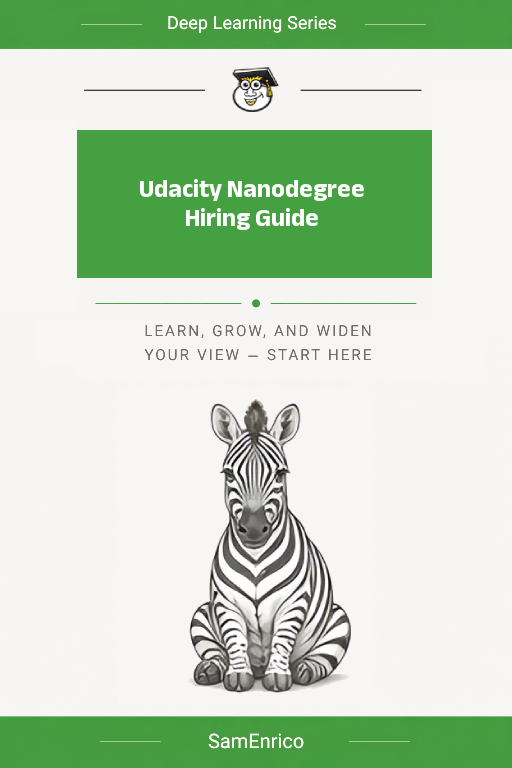
Udacity Nanodegree Hiring Guide eBook
Complete project based nanodegree in AI, data scie
by Scales Skye
Complete project based nanodegree in AI, data science, or cloud to build portfolio employers trust.
Formats
Free sample
Chapter 1: The Performance Principle--The resume that got you to pick up this book is essentially a work of fiction. Not because you lied—though many do—but because the very format of a resume is structurally incapable of telling the truth about your ability to do technical work. A resume is a list of claims. A portfolio is a collection of proofs. And in the fields of artificial intelligence, data science, and cloud computing, proofs matter infinitely more than claims.This chapter reveals the single most important concept you will learn from this book: The Performance Principle.
It is simple enough to state in one sentence but profound enough to reorganize your entire approach to job seeking. Here it is: Employers do not hire potential. They hire demonstrated performance.Everything in this book flows from that principle. The Nanodegree model exists because someone finally asked: what if we built an educational credential around performance instead of potential? The project-based portfolio exists because someone finally asked: what if we assessed candidates by watching them work instead of reading about what they studied?
The shift toward skills-based hiring exists because employers finally asked: what if we stopped filtering on proxies that don't work and started evaluating evidence that does?This chapter will dismantle the potential-based hiring model that has dominated employment for a century. You will learn why traditional credentials fail, how Udacity pioneered a better alternative, and what "Trust Signals" are—the invisible architecture that allows your project portfolio to bypass traditional HR filters. By the end of this chapter, you will understand why your Nanodegree is not a compromise but an upgrade, and you will have the language to explain this to any skeptical recruiter.The Lie at the Heart of the Resume Let us begin with a simple experiment you can conduct yourself. Open any job description for a data science or cloud engineering role. Read the requirements section.
Now ask yourself: how many of these requirements can a candidate actually prove on a resume?The answer is close to zero.A resume can claim "Python proficiency" but cannot demonstrate it. A resume can claim "three years of experience with cloud infrastructure" but cannot show you the infrastructure. A resume can claim "built machine learning models in production" but cannot link to a single working model. Everything on a resume is unverifiable until a human being invests hours in interviews, technical assessments, and reference checks.This is not a minor flaw. It is a fundamental design defect.
The resume was invented for an industrial economy where most jobs were about compliance, attendance, and following procedures. In that world, a resume made sense. You could list the machines you operated, the shifts you worked, the years of seniority you accumulated. The work was visible and verifiable through simple observation.Knowledge work is different. A data scientist's output is not visible on an assembly line.
A cloud architect's competence cannot be measured by attendance. The work happens in code repositories, in deployed models, in infrastructure configurations, in collaborative problem-solving that leaves digital traces but does not fit neatly into a one-page document.The resume persists because we have not yet built a better alternative. Or rather, we have built better alternatives, but hiring systems have been slow to adopt them. Your Nanodegree portfolio is one of those better alternatives. This book will teach you to use it as the powerful Trust Signal it was designed to be.The Two Layers of the Paper Ceiling The traditional hiring system excludes capable people through two distinct barriers.
Understanding which barrier applies to you is the first step toward overcoming it.Layer One: No Degree at All The most visible barrier blocks candidates who never completed a bachelor's degree. According to data from the United States Census Bureau, approximately sixty-two percent of Americans over twenty-five do not hold a bachelor's degree. Yet in technology job postings, the bachelor's degree requirement appears in the vast majority of listings—even for roles where research has repeatedly shown that degrees do not predict job performance.This barrier operates automatically and invisibly. Most large employers use Applicant Tracking Systems (ATS) that can be configured to reject any application lacking a four-year degree. The rejection happens before a human sees the application.
The candidate never knows why they were filtered out. They simply receive the form letter: "After careful review, we have decided to move forward with other candidates."No careful review occurred. No human evaluated their portfolio. Their project links were never clicked. Their Git Hub repositories were never opened.
Their deployed models were never tested. The ATS made a binary decision based on a checkbox, and the candidate lost before they ever had a chance to prove themselves.Layer Two: Unrelated Degree The second barrier is less visible but equally pernicious. It blocks candidates who have bachelor's degrees—just not in computer science, data science, or related fields. An English major who learned Python. A history major who mastered cloud infrastructure.
A philosophy major who built AI models. These candidates technically satisfy the degree requirement, but their resumes are often deprioritized in favor of computer science graduates.This barrier creates the illusion of fairness. "We only hire degreed candidates," the hiring manager might say, ignoring that the degree they value has nothing to do with the job's requirements. Research from the Burning Glass Institute and Harvard Business School found that degree requirements in technology roles increased by over sixty percent in the past decade, even as the actual skills required for those roles shifted dramatically. Employers inflated credential requirements not because the work got harder, but because they had no better way to filter applicants.Why Resumes Fail at Predicting Technical Performance Let us get specific about why resumes are such poor predictors of success in AI, data science, and cloud roles.
This matters because understanding the failure modes helps you understand what employers actually need to see.Problem One: Static Snapshot A resume captures what someone did, often years ago. In fields like AI and cloud computing, where tools and best practices evolve monthly, a degree earned five years ago may be less relevant than a project completed last week. Yet resumes implicitly privilege older, more static credentials. A 2018 computer science degree looks better on paper than a 2024 Nanodegree, even if the Nanodegree covers tools that did not exist in 2018.Problem Two: No Verification Everything on a resume is self-reported. Studies suggest that a significant percentage of resumes contain inaccuracies, ranging from exaggerated responsibilities to entirely fabricated degrees.
Even honest resumes suffer from this problem: the employer has no way to distinguish the candidate who truly mastered Python from the candidate who took one online course and forgot everything. Both write "Python proficiency" on their resumes.Problem Three: The Honesty Penalty The resume format penalizes honest candidates who accurately describe their limited experience while rewarding dishonest candidates who exaggerate. This is not speculation. Research on resume fraud consistently finds that embellishment is common and often successful. The candidate who writes "Led a team of four in deploying a production ML model" gets more interviews than the candidate who writes "Contributed to a team project in my Nanodegree,"…
This is the end of the free sample. Get the eBook to keep going. Buy now
About this book
Details
- Author
- Scales Skye
- Publisher
- SamEnrico
- Language
- English
- Genre
- Non-Fiction, Student's Shortcut
- Released
- 2026-06-01
- Pages (approx.)
- 136
- Available as
- eBook, Audiobook

Read better in the ZLOADR app
Your eBooks on your phone or tablet. Sign in with your SamEnrico account and start reading.
More by Scales Skye
 Road Rage Insurance ImpactScales Skye$11.99
 Allergies Ayurveda GuideScales Skye$11.99
 The No Email Morning RuleScales Skye$11.99
 Immigrant Health Care Entrepreneur GuideScales Skye$11.99Immigrant Health Care Entrepreneur GuideScales Skye$11.99
 1031 Exchange Multiple Properties GuideScales Skye$11.99
 Language Working MemoryScales Skye$11.99
 Wheel Dream Jungian ViewScales Skye$11.99
 NVC For Couples ConflictScales Skye$11.99
 Vaclav Havel PowerScales Skye$11.99
 Byzantium Unveiled: The Golden Legacy of the Eastern RomansScales Skye$11.99
 The Cult of the Infinite Loop: How a Tech Guru’s Vision Became a Digital ReligionScales Skye$11.99
You may also like
 Hong Kong Handover 1997Dunn Johnnie$11.99
 Zumba For Postnatal Recovery CourseNeal Christian$11.99
 Zumba for BeginnersLadner Nikia$11.99
 YouTube Comment Mining GuideHumes Pandora$12.99
 Worry Box MeditationCarlin Rudy$11.99
 Workplace Stress MeditationNguyen Lynn$11.99
 Workplace Stress and Sleep RepairHawley Ivory$11.99
 Workplace Perfectionism CureDelaney Jeffry$11.99
 Workplace Injustice Anger GuideWallen Isabelle$11.99
 Work Addiction and Burnout LinkGreenwood Ester$11.99
 Women in Yoga and WellnessBeattie Galina$11.99
 Women in Stand Up ComedyChun Evangeline$11.99