
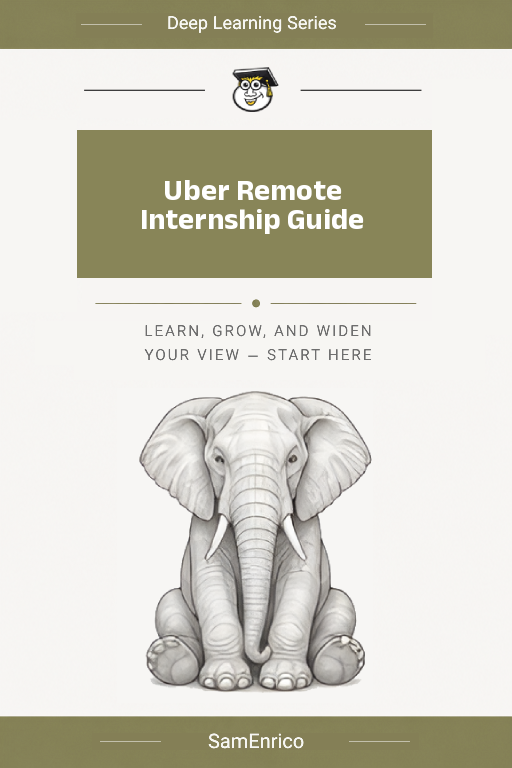
Uber Remote Internship Guide eBook
Apply for virtual internships at Uber in operation
by Fain Lyndsey
Apply for virtual internships at Uber in operations, data science, or engineering departments.
Formats
Free sample
Chapter 1: The Invisible Edge...--For three consecutive years, Alex had done everything right. He had the grades—a respectable 8.2 CGPA from a tier-two engineering college in Pune. He had the projects—a weather app, a basic chatbot, a dashboard that visualized COVID-19 data. He had applied to over forty internships across what his career services office called “dream companies.” And he had received exactly zero offers.The rejection that stung most came from Uber. Not because the email was harsh—it was polite, formulaic, and probably automated.
“Thank you for your interest… high volume of qualified candidates… we encourage you to apply again…” Alex had read those words so many times across different company letterheads that they blurred into a single, numbing chorus of no. What stung was the timing. He received the rejection at 2:17 AM on a Tuesday, after staying up late to polish his portfolio. He had convinced himself that this time would be different. This time, he had included a link to his Git Hub.
This time, he had customized his cover letter.It was not different.Three thousand miles away, a very different story was unfolding. Priya, a third-year student at a university Alex had never heard of, was finishing her second week as a remote Community Operations intern at Uber. She had no family connections in tech. She had never been to San Francisco. She had never even met her manager in person—they had connected through a single Zoom interview that lasted forty-seven minutes.
But on that Tuesday morning, while Alex was waking up to another rejection, Priya was presenting a data analysis that would save her team six hours of manual work per week. Her manager had already started the paperwork for a return offer.What did Priya know that Alex didn’t?That question became an obsession. Over the next eighteen months, Alex reverse-engineered the entire system. He interviewed forty-three successful Uber remote interns across Operations, Data Science, and Engineering. He analyzed hundreds of job postings, rejection emails, acceptance letters, and interview transcripts.
He mapped the hidden pathways that no career services office teaches—the specific SQL queries that impress hiring managers, the exact email templates that get responses from recruiters, the subtle behavioral signals that separate a “maybe” from a “strong hire” in a virtual interview.This book is what he learned.And the first lesson—the one that changes everything—is this: The students who land Uber’s most competitive virtual internships are not necessarily the smartest, the most credentialed, or the hardest working. They are the ones who understand a single, fundamental truth that the other 99.7% of applicants miss entirely.They understand the difference between being qualified and being visible.The Great Misunderstanding Here is a fact that will either terrify you or liberate you, depending on how you choose to see it: Uber receives over 2.5 million internship applications every year for approximately 1,200 positions. That is a 0.048% acceptance rate, which means you are statistically more likely to be accepted to Harvard Business School (11%) or to be struck by lightning in your lifetime (0.06%) than to receive an Uber internship offer.Unless you stop applying like everyone else.The vast majority of applicants—smart, capable, hardworking students from excellent universities—make the same fatal error. They believe that the application process is a meritocracy in the purest sense: that if they work hard enough, build enough projects, and earn good enough grades, the system will eventually reward them. They spend hundreds of hours perfecting their resumes, solving Leet Code problems, and adding fluff to their Linked In profiles.
Then they submit their applications through the same portal, using the same keywords, in the same format, alongside the other 2.5 million people.And then they wonder why nothing happens.Priya, the intern from the unknown university, did not have better grades than Alex. She did not have more impressive projects. What she had was something far more valuable: a map of the hidden terrain. She knew that Uber’s recruiting system is not designed to find the best candidates. It is designed to filter out the largest number of candidates in the shortest amount of time.
The two goals are not the same. In fact, they are often opposites.How Uber Actually Hires (Not What They Tell You)Before we go any further, we need to understand the machine you are trying to enter. Uber’s internship recruiting process is not personal. It is not fair. And it is not designed to discover hidden talent.
It is a high-volume filtration system built by engineers for efficiency, not justice.Let me walk you through exactly what happens from the moment you click “Submit Application.”Step One: The ATS Gatekeeper Your application lands in an Applicant Tracking System (ATS)—a piece of software that functions like a very aggressive, very literal-minded immigration officer. The ATS has no ability to appreciate creativity, to recognize potential, or to forgive formatting errors. It scans your resume for specific keywords that match the job description. If your resume contains those keywords, it passes to the next stage. If it doesn’t, it is automatically rejected, often within seconds, and no human being ever sees it.Most candidates never get past this step.
Their resumes are not “bad.” They are simply invisible.Step Two: The Recruiter Glance If you survive the ATS, your resume lands in front of a human recruiter. Here is what you need to know about this person: they have approximately six to eight seconds to evaluate your entire application before moving to the next one. They are not reading your resume. They are scanning for three things: relevant experience, clear metrics, and a logical career trajectory. If they cannot find all three in under ten seconds, they move on.Step Three: The Technical Screen If the recruiter likes what they see, you will receive a link to a Hacker Rank or Codility assessment.
This is not a test of your intelligence. It is a test of your ability to perform under timed pressure while solving problems that bear only a passing resemblance to actual Uber engineering work. Many excellent engineers fail this stage not because they lack skill, but because they have never practiced this specific format.Step Four: The Virtual Onsite If you pass the technical screen, you will be scheduled for a series of three to five Zoom interviews back-to-back. This is where most candidates who have made it this far finally stumble. The reason is rarely technical.
By this stage, everyone in the pool can write decent code and analyze data. The differentiator is behavioral. Can you communicate your thinking clearly while whiteboarding on a shared screen? Can you handle a curveball question without freezing? Can you project confidence and likeability through a camera that captures only your face?Step Five: The Hiring Committee Here is the step that almost no one talks about.
After your interviews, you do not receive an immediate decision. Instead, your interviewer writes up detailed feedback, and your entire application package—resume, assessment scores, interview notes—goes before a Hiring Committee. This group of senior managers and engineers meets weekly to review every candidate who made it to the onsite…
This is the end of the free sample. Get the eBook to keep going. Buy now
About this book
Details
- Author
- Fain Lyndsey
- Publisher
- SamEnrico
- Language
- English
- Genre
- Non-Fiction, Student's Shortcut, Ride-sharing
- Released
- 2026-06-01
- Pages (approx.)
- 136
- Available as
- eBook, Audiobook

Read better in the ZLOADR app
Your eBooks on your phone or tablet. Sign in with your SamEnrico account and start reading.
More by Fain Lyndsey
 Eye Contact PersuasionFain Lyndsey$11.99
 Picking Strangers Out of LineupsFain Lyndsey$11.99
 The Sports Event TraffickerFain Lyndsey$11.99
 Cybersecurity Valuation ManualFain Lyndsey$11.99
 Binge Eating and Orthorexia RecoveryFain Lyndsey$11.99
 Ayurvedic Kidney HealthFain Lyndsey$11.99
 Spending Visualization GuideFain Lyndsey$11.99
 SAD Diagnostic GuideFain Lyndsey$11.99
 The Silk Road Blackmail: How a Family Syndicate Ruined Lives (1950s)Fain Lyndsey$11.99
 The Great Airline Heist: How a Single Strike Grounded the SkiesFain Lyndsey$11.99
 How to Start a Aluminium Semi-manufactures Production Business (Beginners Guide)Fain Lyndsey$11.99
 How to Produce TetherballFain Lyndsey$11.99