
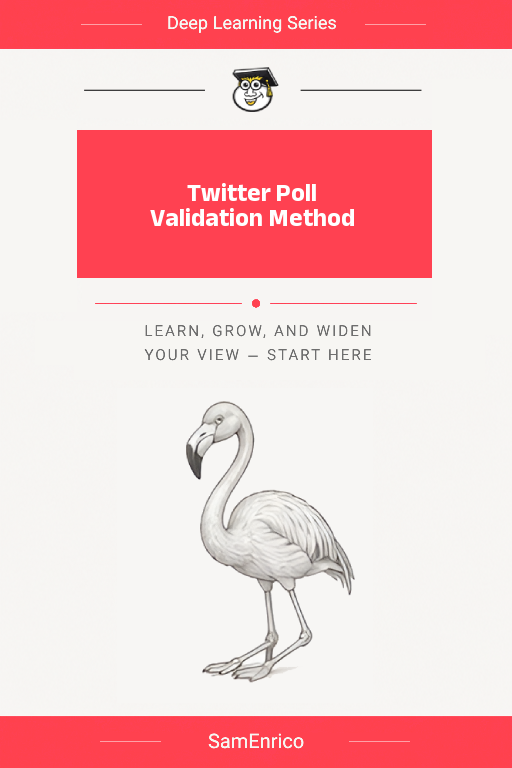
Non-FictionStartup GuideTwitterPoll Testing
Twitter Poll Validation Method eBook
Run free Twitter polls to gauge interest in your i
by Bellamy Mui
Run free Twitter polls to gauge interest in your idea and collect qualitative feedback from followers.
Formats
Free sample
Chapter 1: The $100,000 Lie...--Entrepreneurship has a dirty secret that nobody tells you in the MBA program, the accelerator pitch session, or the congratulatory handshake after you announce your "big idea." The secret is this: most of what you have been taught about building a business is not just incomplete—it is actively dangerous. The cult of "build it and they will come" has bankrupted more founders than bad markets, incompetent co-founders, and recessions combined. And the cruelest irony is that the victims of this cult wear their scars like medals. "I worked 80-hour weeks for eighteen months," they say, pride dripping from the confession. "I mortgaged my house.
I never gave up." But giving up was never the problem. The problem was building first and asking questions never.This chapter will cost you something. It will cost you the comfortable belief that hard work guarantees success. It will cost you the excuse that "I just need more time" or "I just need more features." And if you are currently six months into building something that nobody has asked for, this chapter might cost you your illusion. But what you gain in return is infinitely more valuable: a permission slip to stop building before you break, and a $0 tool that would have saved you from ever starting down the wrong path in the first place.Let me tell you about Sarah.
Not her real name, but her story is real, and it is happening to someone reading this book right now.The Fifteen-Month Funeral Sarah was a product manager at a mid-sized tech company. She had spent seven years watching other people's ideas come to life, and she was tired of being a midwife to other people's visions. She wanted her own thing. So she quit her job—a stable, six-figure job with health insurance and a 401(k) match—to build a Saa S tool for freelance graphic designers. The idea was simple: a project management dashboard that integrated with Adobe Creative Cloud, automatically tracking billable hours based on when a designer had a file open.She spent three months on customer discovery.
She interviewed seventeen freelance designers. Every single one said the same thing: "That sounds amazing. I would absolutely use that." Energized by the validation, Sarah hired two developers from Upwork. She spent 40,000ontheinitialbuild.Fourmonthslater,shehadaminimumviableproduct—uglybutfunctional.Shespentanother40,000 on the initial build. Four months later, she had a minimum viable product—ugly but functional.
She spent another 40,000ontheinitialbuild.Fourmonthslater,shehadaminimumviableproduct—uglybutfunctional.Shespentanother15,000 on a landing page, a logo, and some Twitter ads. She launched on Product Hunt with a "growth hacker" she paid $5,000 to run the campaign. The result? Thirty-seven signups in the first week. Zero paying customers.
Eleven uninstalls after the free trial. And one reply on her launch tweet that she screenshotted and kept as a kind of haunted talisman: "This solves a problem I don't have."Sarah spent eleven months and over $100,000 to learn what a free Twitter poll could have told her in twenty-four hours: that freelance designers do not actually struggle with time tracking. They struggle with getting clients to pay on time. They struggle with scope creep. They struggle with finding new clients.
But time tracking? That is a minor annoyance, not a burning pain. And people do not pay money for minor annoyances. They tolerate minor annoyances. They complain about them over coffee.
They do not pull out their credit cards.The seventeen designers who said "that sounds amazing" were not lying. They were being polite. They were being optimistic. They were imagining their ideal selves—the organized, time-tracking, perfectly efficient freelancer they wanted to be—not their actual, messy, "I'll just estimate my hours at the end of the month" selves. This is not malice.
This is human nature. And it is the single most dangerous force in early-stage entrepreneurship.The Micro-Validation Loop: A $0 Alternative What if Sarah had spent twenty-four hours and zero dollars before writing a single line of code? What if she had run a Twitter poll instead of a customer discovery interview? The answer is not theoretical. It is the central mechanism of this entire book, and it is called the Micro-Validation Loop.The loop has four stages.
First, Hypothesize. Write down a specific, falsifiable assumption about your target customer's behavior. Not "freelancers need better tools"—that is a vibe, not a hypothesis. A real hypothesis sounds like this: "Freelance graphic designers lose at least three billable hours per week to manual time tracking, and they would pay $20 per month for a tool that automates this." See the difference? The second version can be proven wrong.
The first version is a horoscope—vague enough to fit any outcome.Second, Poll. Launch a Twitter poll that tests your hypothesis without biasing the answers. This takes five minutes and costs nothing. The poll is not the end of your research; it is the beginning. But it is a beginning that costs nothing and delivers data within twenty-four hours—data that would take weeks and thousands of dollars to gather through traditional means.Third, Analyze.
Spend one hour looking at the results. But here is where most people go wrong. They look only at the percentages. "Seventy percent said yes!" they cheer, and they run off to start building. This is like buying a house based on the color of the front door.
The percentages matter, but the replies matter more. The qualitative feedback—the comments, the quote tweets, the DMs from people who care enough to type words—that is where the actual market lives. A poll with 200 votes and twenty passionate, detailed replies is infinitely more valuable than a poll with 2,000 votes and two-word responses.Fourth, Pivot or Proceed. If the data clearly shows that your hypothesis was wrong, do not "tweak." Do not "refine." Do not tell yourself that you just need to ask differently. If the pain is not acute, if the solution does not resonate, if the target customer does not exist on Twitter where you can reach them—pivot.
Change the problem, change the audience, or change the solution. If the data shows strong, consistent signals of acute pain and willingness to pay, then proceed—but proceed to the next poll, not to the code editor. Validation is a ladder, not a light switch. Each poll should narrow your uncertainty, not eliminate the need for further testing.Why Twitter Polls Beat Focus Groups and Surveys You might be thinking: "I already do customer research. I send surveys.
I run focus groups. Why is Twitter special?" This is a fair question, and the answer reveals something uncomfortable about traditional research methods.Focus groups are theatrical performances. Put seven strangers in a room with free pizza and a moderator who smiles at every answer, and you will get the politest, most socially acceptable version of the truth. Nobody wants to be the person who says "that idea is stupid" while the moderator nods encouragingly and the other six participants stare. Focus groups are excellent for generating ideas.
They are terrible for killing bad ones. And killing bad ideas early is the entire point of validation.Surveys are better than focus groups, but only slightly. The problem with…
This is the end of the free sample. Get the eBook to keep going. Buy now
About this book
Details
- Author
- Bellamy Mui
- Publisher
- SamEnrico
- Language
- English
- Genre
- Non-Fiction, Startup Guide, Twitter, Poll Testing
- Released
- 2026-05-30
- Pages (approx.)
- 138
- Available as
- eBook, Audiobook

Read better in the ZLOADR app
Your eBooks on your phone or tablet. Sign in with your SamEnrico account and start reading.
More by Bellamy Mui
 The Sleep Apnea in ChildrenBellamy Mui$11.99
 Israeli High Tech EmigrationBellamy Mui$11.99
 Workplace Stress and Physical Health GuideBellamy Mui$11.99
 Sustainable Weight Loss JournalBellamy Mui$11.99
 Collaborative Leadership For Creativity ManualBellamy Mui$11.99
 Luminous Deception: The Secret Life of Tyrian PurpleBellamy Mui$11.99
 Echoes of the Forgotten: The Unseen Architects of the Berlin WallBellamy Mui$11.99
 Mammoth Asse BreedingBellamy Mui$11.99
 Understanding Chromosome 3, Trisomy 3pBellamy Mui$17.99
 Business Email List BuildingBellamy Mui$12.99
 How to Become a Buzzsaw-operator HelperBellamy Mui$11.99
You may also like
 Hong Kong Handover 1997Dunn Johnnie$11.99
 Zumba For Postnatal Recovery CourseNeal Christian$11.99
 Zumba for BeginnersLadner Nikia$11.99
 YouTube Comment Mining GuideHumes Pandora$12.99
 Worry Box MeditationCarlin Rudy$11.99
 Workplace Stress MeditationNguyen Lynn$11.99
 Workplace Stress and Sleep RepairHawley Ivory$11.99
 Workplace Perfectionism CureDelaney Jeffry$11.99
 Workplace Injustice Anger GuideWallen Isabelle$11.99
 Work Addiction and Burnout LinkGreenwood Ester$11.99
 Women in Yoga and WellnessBeattie Galina$11.99
 Women in Stand Up ComedyChun Evangeline$11.99