
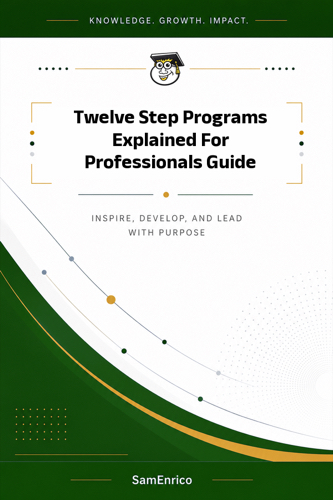
Twelve Step Programs Explained For Professionals Guide eBook
Educates therapists and counselors on twelve-step
Educates therapists and counselors on twelve-step philosophy and referral.
Formats
Free sample
Chapter 1: Beyond the Big Book...–- Most clinicians believe they understand Alcoholics Anonymous. They are wrong. Not about the details—about the fundamental nature of what they are dismissing. The version of Twelve Step history taught in graduate programs, repeated in supervision, and reinforced by popular culture is not merely oversimplified. It is, in key respects, factually incorrect.
And this misunderstanding has real consequences. When a therapist confuses the text with the fellowship, or the fellowship with the program, they do not just make an academic error. They close a door that might have led a client to recovery. This chapter provides the professional context almost never taught: a clinically relevant history of the Twelve Step movement, a clear distinction between the Big Book, the fellowship, and the program, and an alignment of Step work with the modern ASAM disease model of addiction. By the end, the clinician will understand why "powerlessness" is not submission but diagnosis, and why the Twelve Steps are best understood as what cognitive behavioral therapy looked like before CBT was invented.The Origin Story You Thought You Knew Every field has its origin myths.
In addiction treatment, the story goes like this: two hopeless drunks, Bill Wilson and Dr. Bob Smith, met in Akron, Ohio, in 1935, had a spiritual awakening, and founded Alcoholics Anonymous. A decade later, they wrote the Big Book, and the Twelve Step movement spread across the world. This story is not false, but it is dangerously incomplete. The missing details matter for clinicians because they reveal that the Twelve Steps were never intended as a religious program, were never static, and were deliberately designed to be compatible with medical and psychological treatment.The actual history begins with the Oxford Group, a Christian evangelical movement founded by Frank Buchman in the 1920s.
The Oxford Group emphasized four absolute standards: honesty, purity, unselfishness, and love. They practiced five key rituals: confession of sins, restitution for wrongs, surrender to God, guidance through prayer and meditation, and "sharing" (evangelism). Bill Wilson attended Oxford Group meetings in the early 1930s and found them helpful for his drinking. He borrowed heavily from their practices. The moral inventory, the amends, the surrender, the confession—all came from the Oxford Group.But here is what most histories leave out.
When Wilson and Smith began helping other alcoholics, they systematically stripped the Oxford Group of its coercive, religious, and hierarchical elements. The Oxford Group demanded belief in Jesus Christ as savior. AA did not. The Oxford Group required members to publicly confess sins to strangers. AA advised confession to one trusted person (a sponsor or clergy).
The Oxford Group had a single, authoritarian leader (Buchman). AA had no leaders, only trusted servants. The Oxford Group demanded absolute obedience to its standards. AA offered suggestions, not commands. Wilson and Smith were not religious fundamentalists translating dogma into addiction language.
They were pragmatists who had watched religious coercion fail to keep alcoholics sober. They deliberately, consciously, and carefully removed every element that would make the program inaccessible to atheists, agnostics, and members of non-Christian religions.This is not revisionist history. Wilson wrote extensively about this process. In the 1955 book Alcoholics Anonymous Comes of Age, he explained: "We had to be careful never to preach or be dogmatic. We could not require anyone to follow any particular religious path.
The moment we did, we would lose the very people who most needed help." The Twelve Steps were never meant to be a bible. They were meant to be a manual for a specific kind of cognitive and behavioral change, written in the language of 1930s Protestant spirituality because that was the language Wilson had available to him.The Three Things Every Clinician Must Distinguish Most professionals use the phrase "Twelve Step program" to refer to three entirely different things simultaneously: the Big Book (a text), the fellowship (AA/NA as a social structure), and the program (the Twelve Steps themselves). This conflation creates endless confusion. Let us separate them clearly.The Text: The Big Book as Historical Document The book Alcoholics Anonymous, first published in 1939, is a collection of personal stories, heuristic wisdom, and a prose description of the Twelve Steps. It is not a scientific textbook.
It was written by two non-clinicians in the 1930s. It contains language that is dated, sometimes problematic, and occasionally contradictory. The famous line "rarely have we seen a person fail who has thoroughly followed our path" is aspirational, not data. The chapter "To Wives" is, by modern standards, patronizing and sexist. The book makes no distinction between addiction and co-occurring personality disorders.
It uses "alcoholic" as both a diagnostic category and a social identity without clarifying the difference.None of this makes the Big Book useless. It contains profound insights about craving, obsession, denial, and the social nature of recovery. The description of the "insanity of the first drink" (the phenomenon of craving that overrides intention) is neurologically prescient. The discussion of resentment as the "number one offender" anticipates modern research on emotional dysregulation and relapse. But the clinician must read the Big Book as a historical artifact, not a clinical manual.
You do not need your client to believe the Big Book is infallible. You do not need to defend every sentence. You need to know where specific passages can be usefully cited as heuristics for clients who find them meaningful.The Fellowship: AA and NA as Social Structures When clinicians say "I don't like AA," they are almost always responding to the fellowship—the actual meetings, the people, the coffee, the cigarette smoke (less common now), the slogans, the prayers, the old-timers, the newcomers who cry, the members who share too graphically, the occasional predatory "13th stepper," and the rare cult-like group that forms around a charismatic but unwell individual. These are legitimate concerns. The fellowship is imperfect because it is composed of imperfect people.
Meetings vary enormously. Some are warm, well-run, and trauma-informed. Others are chaotic, hostile, or dominated by a single domineering personality. Some are explicitly religious; most are not. Some welcome medication; a few do not.The fellowship is also, for millions of people, the only place they have ever experienced unconditional acceptance, honest feedback, and accountability without punishment.
The fellowship provides what no therapist can provide: 24/7 availability, peer modeling, service opportunities, and a social network that replaces the using network. A therapist sees a client for one hour per week. A sponsor can take a call at 2:00 AM. That is not a failure of therapy. It is a difference in function.
The clinician who dismisses the fellowship because of its flaws is like a surgeon who refuses to use a scalpel because knives can cut. The tool has risks. The tool also saves lives.The Program: The Twelve Steps as Cognitive-Behavioral Protocol The Twelve Steps, separated from the Big Book's prose and the fellowship's culture, are a sequence of cognitive and behavioral interventions. Step 1: accurate self-diagnosis and acceptance of biological limits. Step 2: induction of hope via externalization of agency.
Step 3: decision to cease maladaptive control efforts. Step 4: systematic inventory of thoughts, emotions, and behaviors that precede addictive episodes. Step 5: verbal disclosure to reduce shame. Steps 6 and…
This is the end of the free sample. Get the eBook to keep going. Buy now
About this book
Details
- Author
- Rickard Dayna
- Publisher
- SamEnrico
- Language
- English
- Genre
- Non-Fiction, Self-Help, Professional Education
- Released
- 2026-06-08
- Pages (approx.)
- 156
- Available as
- eBook, Audiobook

Read better in the ZLOADR app
Your eBooks on your phone or tablet. Sign in with your SamEnrico account and start reading.
More by Rickard Dayna
 Forgiveness for Family EstrangementRickard Dayna$11.99
 Craps Addiction RecoveryRickard Dayna$11.99
 Corporate PR to Nonprofit AdvocacyRickard Dayna$11.99
 Conference Networking TipsRickard Dayna$11.99
 Pet Euthanasia Grief GuideRickard Dayna$11.99
 Combat Soldier Stress GuideRickard Dayna$11.99
 Calming Anger Before It EscalatesRickard Dayna$11.99
 The Last Empress: Wu Zetian's Shadow EmpireRickard Dayna$11.99
 Backstage at the Palace: The Untold Story of the 1964 'Funny Girl' FeudRickard Dayna$11.99
 How to Produce Service EquipmentRickard Dayna$11.99
 Cash Flow for Accounting FirmsRickard Dayna$12.99
 Mailchimp Social Proof in EmailsRickard Dayna$12.99