
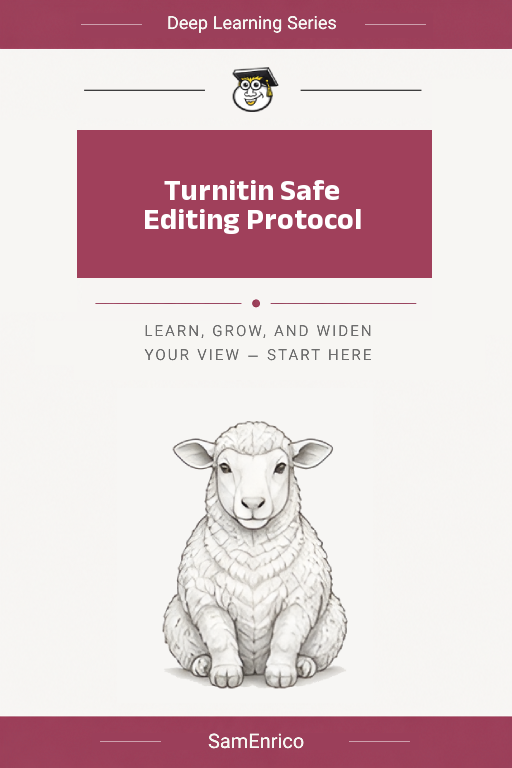
Non-FictionSide Hustle ArchitectEditing ServiceEthics Guide
Turnitin Safe Editing Protocol eBook
Proofread without triggering plagiarism flags or a
Proofread without triggering plagiarism flags or academic integrity violations. Covers tracked changes, comment insertion, and avoiding content rewriting that crosses into ghostwriting.
Formats
Free sample
Chapter 1: The Similarity Illusion--–- Maria stared at the number on her screen: forty-seven percent. Her final research paper, written entirely in her dorm room over three caffeine-fueled weeks, had just been processed through Turnitin. The similarity score was forty-seven percent. Her stomach dropped. She had not copied a single sentence.
She had cited every source meticulously. She had run her draft through two different grammar checkers and asked her roommate to read it for accidental plagiarism. Nothing. And yet, here was a bright orange flag telling her professor—and soon her academic integrity board—that nearly half her paper matched existing sources.Maria did what most students do. She panicked.
She opened the similarity report and saw highlights scattered across every page. Her introduction matched a Wikipedia article she had never visited. Her methodology section matched a student paper from a university in Australia she had never heard of. Her conclusion matched three different sources simultaneously. She felt like she was being accused of a crime she did not commit, and she had no idea how to defend herself.This book is for Maria.
And for you.If you have ever submitted a paper to Turnitin and felt confused, betrayed, or terrified by the number that appeared, you have experienced what this chapter calls the Similarity Illusion. The illusion is this: that a high similarity score means you have done something wrong, and that a low similarity score means you are safe. Both beliefs are false. Both beliefs have ruined academic careers. And both beliefs persist because almost no one actually understands how Turnitin works under the hood.This chapter dismantles the Similarity Illusion.
By the time you finish reading, you will understand what Turnitin actually does (and does not do), how to read a similarity report like a forensic analyst rather than a frightened student, and why a fifteen percent match can be perfectly fine while a one percent match can be a career-ending red flag. More importantly, you will learn the single most important ethical boundary that governs everything else in this book: the difference between editing your own work and disguising someone else’s.The Great Misunderstanding: Turnitin Is Not a Plagiarism Detector Let us start with a statement that sounds like heresy: Turnitin does not detect plagiarism. It cannot. Plagiarism is an intellectual and ethical violation—a deliberate act of presenting someone else’s work as your own. Turnitin is a piece of software.
It has no morals, no intent, no judgment. All it does is compare strings of text.Think of Turnitin as a very fast, very thorough librarian with perfect memory. You hand it a document. It scans every string of consecutive words and checks whether that exact string has appeared anywhere else in its database. That database includes three main sources: (1) publicly available internet pages, (2) academic journals and books, and (3) every other student paper that has ever been submitted to Turnitin by any participating institution worldwide.That last source is crucial and often misunderstood.
When you submit a paper to Turnitin, your paper becomes part of the database. This is why students sometimes see matches to “another student’s paper” from a different university. That match is not evidence that either student copied the other. It is evidence that both students used a common phrase, a standard citation format, or a widely available template. The algorithm does not know which paper came first.
It only knows they match.The word “plagiarism” never appears in Turnitin’s similarity report. The report shows matches. That is all. Whether those matches constitute plagiarism is a human judgment made by your instructor. A match to a properly cited quote is not plagiarism.
A match to a bibliography is not plagiarism. A match to a common phrase like “the purpose of this study” is not plagiarism. But Turnitin highlights all of them the same way—in bright, alarming colors that make everything look like an accusation.This is the first crack in the Similarity Illusion. The software does not know what plagiarism is. It only knows what text matching is.
Your job—and the job of this book—is to learn the difference.The Anatomy of a Similarity Report: A Field Guide Before you can interpret your similarity score, you need to understand what you are looking at. The Turnitin similarity report is divided into several sections, each of which tells a different story. This section walks through each component as if you were looking at the report on your own screen.The Overall Similarity Score. This is the large number at the top of the report, usually color-coded: blue (0 percent), green (1-24 percent), yellow (25-49 percent), orange (50-74 percent), or red (75-100 percent). Most students fixate on this number.
Most instructors have learned to ignore it until they look deeper. The overall score is a blunt instrument. It adds together every matched string of text, counts the total number of matched words, and divides by the total number of words in your paper. A paper with one long block quote of one hundred words might show the same overall score as a paper with fifty scattered two-word matches. The overall number tells you nothing about the nature of the matches.The Match Highlights.
Below the overall score, Turnitin displays your paper with color-coded highlights. Each color corresponds to a different source from the database. Hover over a highlight, and Turnitin shows you the source. Click the source, and Turnitin opens a side-by-side comparison. This is where the real investigation happens.
A highlight that matches a source you have never seen and that uses identical technical jargon is a red flag. A highlight that matches your own correctly cited bibliography is not.The Source List. On the right side of the report, Turnitin lists every source that produced a match, ranked by how many words matched. The top source is usually the one with the most overlapping text. This list is where students often discover the bizarre coincidences that cause false panic: a match to a student paper from 2017 about an entirely different topic, matched only on the phrase “in conclusion.”The Excluded Text Section.
This is the most underutilized feature in the entire report. Turnitin automatically excludes three categories of text from the similarity calculation, meaning these matches do not count toward your overall score. The first excluded category is the bibliography or reference list. The second is properly formatted quotations (text inside quotation marks). The third is matches under a certain length—typically five to seven consecutive words, depending on your institution’s settings.
You can also manually exclude additional sources or small matches if your instructor has given you permission to resubmit.Many students do not know that bibliographies are excluded by default. They see a high similarity score and panic, not realizing that the score would drop by twenty or thirty points if they simply looked at the excluded text section. The algorithm is already doing them a favor. They just do not know it.The Invisible Thresholds: Why Fifteen Percent Can Be Safe and One Percent Can Be Deadly Here is where the Similarity Illusion does its most dangerous work. Most students believe that…
This is the end of the free sample. Get the eBook to keep going. Buy now
About this book
Details
- Author
- Drummond Kaylene
- Publisher
- SamEnrico
- Language
- English
- Genre
- Non-Fiction, Side Hustle Architect, Editing Service, Ethics Guide
- Released
- 2026-05-30
- Pages (approx.)
- 146
- Available as
- eBook, Audiobook

Read better in the ZLOADR app
Your eBooks on your phone or tablet. Sign in with your SamEnrico account and start reading.
More by Drummond Kaylene
 Dog Sleeping MeditationDrummond Kaylene$11.99
 Phobia Triggers GuideDrummond Kaylene$11.99
 Benzo Taper Headache ManagementDrummond Kaylene$11.99
 Boomy Video Soundtrack GuideDrummond Kaylene$11.99
 Building a Sober Social Life ManualDrummond Kaylene$11.99
 The Fire This Time: The Lost Voices of the 1921 Tulsa Race Massacre in Harlem’s EchoesDrummond Kaylene$11.99
 Understanding Infant Epilepsy With Migrant Focal CrisisDrummond Kaylene$17.99
 Travel Tourism Spending OutlookDrummond Kaylene$12.99
 A Beginners Guide to Bokator (Volume 1)Drummond Kaylene$11.99
 Application Penetration TesterDrummond Kaylene$11.99Application Penetration TesterDrummond Kaylene$11.99
You may also like
 Hong Kong Handover 1997Dunn Johnnie$11.99
 Zumba For Postnatal Recovery CourseNeal Christian$11.99
 Zumba for BeginnersLadner Nikia$11.99
 YouTube Comment Mining GuideHumes Pandora$12.99
 Worry Box MeditationCarlin Rudy$11.99
 Workplace Stress MeditationNguyen Lynn$11.99
 Workplace Stress and Sleep RepairHawley Ivory$11.99
 Workplace Perfectionism CureDelaney Jeffry$11.99
 Workplace Injustice Anger GuideWallen Isabelle$11.99
 Work Addiction and Burnout LinkGreenwood Ester$11.99
 Women in Yoga and WellnessBeattie Galina$11.99
 Women in Stand Up ComedyChun Evangeline$11.99