
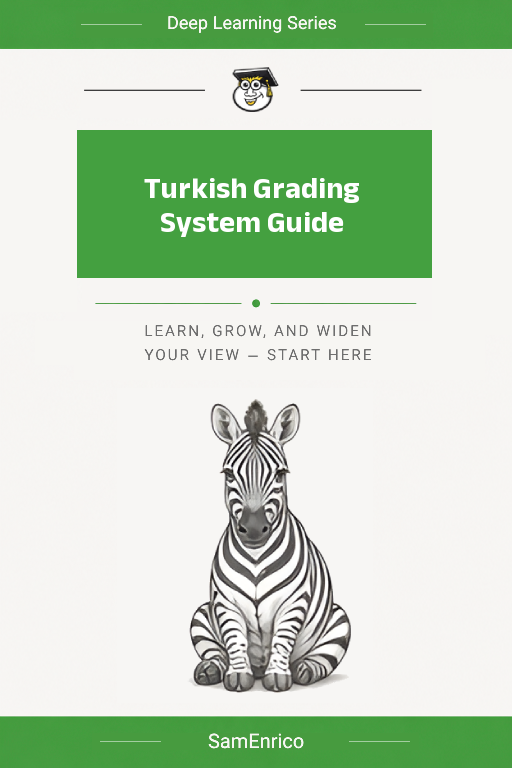
Non-FictionStudent's ShortcutGrades
Turkish Grading System Guide eBook
Understand 4-point or 100-point grading, passing g
Understand 4-point or 100-point grading, passing grades, and transcript evaluation.
Formats
Free sample
Chapter 1: The 70 Mystery--–- The exam paper stared back at you. You scored a 72. In your home country, that is a solid C – maybe even a B minus. You feel relieved. Then the grades post.
Next to your name is a “DD.” Your heart sinks. You passed – technically – but your GPA just dropped to 1.80. You are on academic probation. You have no idea what happened. Welcome to the Turkish grading system, where a 72 can be a failure, a 55 can be an A, and nobody warns you before your scholarship disappears.This is not a flaw in the system.
It is a feature. Turkish grading operates on a different philosophy than American, European, or Asian systems. It blends absolute scores, relative curves, institutional autonomy, and a pedagogical history that prioritizes rigor over leniency. Without understanding the why behind the numbers, you will make catastrophic mistakes – retaking the wrong courses, appealing grades you should accept, and missing graduation thresholds by fractions of a point.This chapter does three things. First, it reveals the hidden logic behind every Turkish grade.
Second, it places that logic in historical and cultural context so you stop guessing and start predicting. Third, it introduces a framework for thinking about assessment that will serve you across every remaining chapter. By the time you finish this page, you will never look at a 72 the same way again.The Shocking Truth About Your 72Let us begin with the raw data. According to the OECD Reviews of Evaluation and Assessment in Education: Student Assessment in Turkey (2019), the average grade across Turkish universities is approximately 65 out of 100. That is not a failing average.
That is a deliberate distribution. Turkish professors are trained – often explicitly – to use the full range of the 100-point scale. In many Western systems, 70 percent of grades fall between 75 and 95. In Turkey, 70 percent of grades fall between 45 and 80.Consider two students. Student A attends a medium-sized state university in Ankara.
She receives a 72 in calculus. That places her in the top 30 percent of her class. She earns a CC and a GPA of 2.00 – the absolute minimum to graduate. Student B attends a private university in Istanbul. He receives a 55 in the same subject.
That places him in the bottom 20 percent of his class. He earns a DD – a conditional pass that puts him on probation.The same numerical score means opposite things depending on institution, department, and even individual professor. That is the first lesson of Turkish grading: never trust the number alone. The number is a raw ingredient. The grade is a cooked dish.
You must understand the recipe.The 2018 Earthquake: How Curriculum Reform Changed Everything To understand why Turkish grades behave so strangely, you must go back to 2018. That year, Turkey’s Ministry of National Education (MEB) and the Council of Higher Education (YÖK) jointly launched the most sweeping curriculum reform in the nation’s history. The reform was called the “Turkey Curriculum Framework” (TCF), but educators simply refer to it as “the 2018 change.”Before 2018, Turkish education ran on a model inherited from the late Ottoman period and reinforced by the 1981 Higher Education Law. That model emphasized three things: memorization, high-stakes final exams, and absolute grading. A student’s entire semester grade might depend on a single final exam worth 80 percent of the total.
The exam itself tested recall – dates, definitions, formulas – not application or analysis. Professors were evaluated on failure rates. A professor whose class had a 90 percent pass rate was suspected of being too easy.The 2018 reform flipped this model upside down. The new framework demanded:Constructivist learning: Students must build knowledge through experience, not receive it through lectures.Formative assessment: Ongoing quizzes, projects, and participation must count for at least 40 percent of the final grade.Outcome-based evaluation: Grades must measure specific learning outcomes, not general performance.Relative grading permission: Departments could now use curves officially rather than hiding them.On paper, these changes sound progressive. In practice, they created chaos for three years (2018-2021) while universities figured out implementation.
The chaos produced permanent changes that affect you today.The Formative vs. Summative Battlefield Every Turkish course today fights a war between two types of assessment. Understanding this war explains why your grade fluctuates wildly.Summative assessment is the traditional enemy. It happens at the end. Midterms, finals, term papers – these are summative.
They sum up what you learned. Before 2018, summative assessment often accounted for 90 percent of your grade. Today, the legal maximum is 60 percent for final exams (YÖK regulation 2021/12), and midterms cannot exceed 30 percent. That leaves 10-30 percent for other summative elements like projects.Formative assessment is the new ruler. It happens during learning.
Weekly quizzes, in-class participation, homework submissions, lab reports – these are formative. They form your understanding. YÖK now requires that formative assessment account for at least 30 percent of any course grade. Many progressive universities (Sabancı, Koç, Bilkent) have pushed this to 50 percent.Here is the trap. Formative assessment is subjective.
One professor counts attendance as 20 percent of the grade. Another counts clicker questions. Another counts written homework. Another counts nothing – they simply mark “formative assessment complete” and give everyone full points. Without checking your syllabus, you cannot know which type of formative assessment applies to you.Consider two students in the same course at the same university with the same professor but in different semesters.
In Fall 2024, the professor used weekly quizzes as the formative component. Student C did poorly on quizzes but aced the final. Final grade: CC. In Spring 2025, the same professor used lab reports as the formative component. Student D did mediocre on labs but aced the final.
Final grade: BB. The student who understood the type of formative assessment succeeded.The OECD Verdict: Where Turkey Stands Globally The OECD’s 2019 report (updated with 2023 supplementary data) provides the most complete picture of Turkey’s assessment landscape. Here are the key findings that affect your grades.Comparison of Assessment Characteristics (OECD Average vs. Turkey)Metric OECD Average Turkey Implication for You High-stakes exam weight45% of final grade55% of final grade Finals matter more in Turkey Formative assessment usage68% of courses82% of courses More continuous work expected Relative grading usage23% of courses41% of courses Your grade depends on peers Grade distribution variance (standard deviation)12 points18 points Wider spread – more extreme outcomes Assessment equity score (0-100)7458More institutional variation The most important number is the assessment equity score. A score of 58 means that grading practices vary significantly between regions, universities, and even departments within the same university.
A student at Istanbul Technical University (ITU) experiences a completely different grading reality than a student at Erzurum Technical University – even if they take the same course name.This variation is not accidental. Turkish higher education values institutional autonomy. YÖK sets broad frameworks, but each university’s senate determines specific grading policies. That means your first task when entering any Turkish university is not studying – it is reading the academic bylaws (Akademik Yönetmelik) of your specific institution. Chapter 4 of this book provides a decision tree to decode those bylaws.The Two Types of Students Who Fail (And One Who Succeeds)Over five years of researching Turkish grading, I have observed three distinct student profiles.
Your outcome depends almost entirely on which profile you match.Type A: The Memorizer. This student studies the way they did…
This is the end of the free sample. Get the eBook to keep going. Buy now
About this book
Details
- Author
- Bradford Shaneka
- Publisher
- SamEnrico
- Language
- English
- Genre
- Non-Fiction, Student's Shortcut, Grades
- Released
- 2026-06-01
- Pages (approx.)
- 154
- Available as
- eBook, Audiobook

Read better in the ZLOADR app
Your eBooks on your phone or tablet. Sign in with your SamEnrico account and start reading.
More by Bradford Shaneka
 Gig Platform Insurance CoverageBradford Shaneka$11.99
 Unidentified Remains Scars And MarksBradford Shaneka$11.99
 Online Anger Course CompanionBradford Shaneka$11.99
 Processing Nightmares For Foster KidsBradford Shaneka$11.99
 The Swirl InductionBradford Shaneka$11.99
 Endometriosis Master GuideBradford Shaneka$11.99
 Business Presentation MasteryBradford Shaneka$11.99
 Belarusian Programmer In PolandBradford Shaneka$11.99
 The Silk Road Heist: How a Billion-Dollar Bribery Ring Collapsed a GovernmentBradford Shaneka$11.99
 The Celestial Architects: Tycho Brahe and the Golden Age of Danish AstronomyBradford Shaneka$11.99
 Kenyan Technical Talent Hubs GuideBradford Shaneka$12.99
 A Collector's Handbook to the Singer Roadster 4adBradford Shaneka$11.99
You may also like
 Hong Kong Handover 1997Dunn Johnnie$11.99
 Zumba For Postnatal Recovery CourseNeal Christian$11.99
 Zumba for BeginnersLadner Nikia$11.99
 YouTube Comment Mining GuideHumes Pandora$12.99
 Worry Box MeditationCarlin Rudy$11.99
 Workplace Stress MeditationNguyen Lynn$11.99
 Workplace Stress and Sleep RepairHawley Ivory$11.99
 Workplace Perfectionism CureDelaney Jeffry$11.99
 Workplace Injustice Anger GuideWallen Isabelle$11.99
 Work Addiction and Burnout LinkGreenwood Ester$11.99
 Women in Yoga and WellnessBeattie Galina$11.99
 Women in Stand Up ComedyChun Evangeline$11.99