
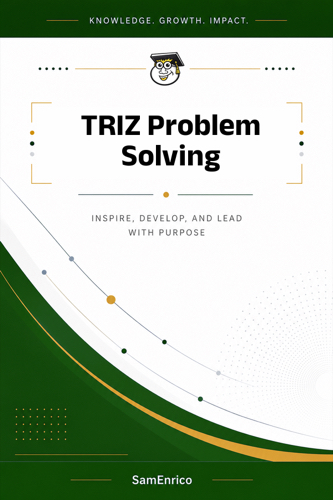
TRIZ Problem Solving eBook
Use engineering creativity method for systematic i
Use engineering creativity method for systematic innovation.
Formats
Free sample
Chapter 1: The Invention Lie--–- On a Tuesday morning in 1974, a Soviet patent examiner named Genrich Altshuller did something that should have been impossible. He looked at a pile of 200,000 patents and found a pattern where generations of engineers had seen only random noise. While his colleagues saw isolated moments of individual genius, Altshuller saw a hidden structure—a secret grammar buried inside every breakthrough invention. That discovery would eventually become TRIZ, the systematic innovation method that has since been used by Samsung, Rolls-Royce, Airbus, and thousands of other organizations to solve problems that traditional brainstorming could not touch.But here is the uncomfortable truth that Altshuller uncovered: most of what we believe about creativity is wrong.The Myth of the Genius Moment Walk into any corporate innovation workshop, and you will see the same ritual. A facilitator stands at the front of the room, writes a problem on a whiteboard, and says, "Let's brainstorm some ideas.
No bad ideas. Go wild." For the next hour, people shout out half-formed thoughts while someone writes them on sticky notes. At the end, they vote on the "best" ideas, and everyone feels creative. Then nothing happens. The solutions are obvious, impractical, or already tried.
The problem remains unsolved.This scene plays out thousands of times every day across the world. And it fails almost every time.The reason is not that people are unintelligent or unmotivated. The reason is that complex engineering problems do not yield to random association. When you are trying to design a wing that is both light and strong, or a battery that charges quickly and holds its charge for days, or a manufacturing process that is both fast and precise, your brain does not have the necessary information to generate a breakthrough solution through spontaneous generation. The solution space is simply too vast.Consider the numbers.
A typical engineering system might have dozens of components, each with multiple parameters that can be adjusted. The number of possible configurations easily reaches into the millions or billions. Trial and error—including the structured trial and error we call brainstorming—cannot search that space efficiently. You would need centuries of random attempts to stumble upon the solutions that TRIZ can deliver in hours.The 200,000-Patent Revelation Altshuller did something radical. Instead of asking, "How can I make people more creative?" he asked a different question: "What do successful inventors actually do?" He analyzed hundreds of thousands of patents, not to study the inventions themselves, but to study the thinking patterns behind them.
He wanted to know if breakthrough solutions followed predictable logic.The answer was yes.Altshuller discovered that regardless of industry, time period, or nationality, the most inventive patents shared common structures. The same patterns of problem-solving appeared again and again. A solution for a chemical reactor used the same inventive principle as a solution for a mechanical clutch. A breakthrough in semiconductor manufacturing mirrored a breakthrough in agricultural equipment. The specific materials and technologies changed, but the underlying logic remained constant.This was a revolutionary insight.
It meant that creativity was not a mystical gift bestowed upon a lucky few. It was a skill that could be taught, learned, and systematically applied. Just as there are repeatable patterns in music composition, chess strategy, and software architecture, there are repeatable patterns in invention.Altshuller extracted these patterns into what he initially called the Theory of Inventive Problem Solving—a name later shortened to the Russian acronym TRIZ. The theory grew over decades, expanding from a simple list of patterns to a complete methodology that includes functional analysis, contradiction resolution, predictive evolution trends, and a step-by-step algorithm for solving the hardest problems.The Five Levels of Inventiveness Not all problems are created equal. One of the most useful frameworks Altshuller developed is the Five Levels of Inventiveness.
Understanding these levels is essential because the level of your problem determines which TRIZ tools you should use. Using a sledgehammer to crack a nut is inefficient, but using a nutcracker to demolish a wall is impossible.Level 1: Apparent Solution At Level 1, the solution is obvious to anyone with basic technical knowledge in the field. You are not inventing something new; you are applying a standard solution to a standard problem. Making a bolt thicker to handle more load. Adding a second support bracket to reduce vibration.
Increasing the temperature to speed up a chemical reaction.Approximately 32% of patents fall into Level 1. These are not bad ideas, but they are not breakthroughs. They are routine engineering. If your problem is Level 1, you do not need TRIZ. You need a good reference manual and basic competence.Level 2: Minor Improvement At Level 2, the solution requires resolving a contradiction using known methods from within the same industry.
The problem is not obvious, but the solution exists somewhere in your technical domain. You need to adapt an existing solution to your specific situation.For example, imagine you are designing a fan and you need it to move more air, but a larger fan blade will not fit in the available space. A Level 2 solution might be to use multiple smaller blades arranged differently, or to change the blade angle. Both solutions exist elsewhere in the fan industry. Your job is to find and adapt them.Approximately 45% of patents are Level 2.
Most professional engineers operate at this level. The work is valuable, but it is not transformative.Level 3: Major Invention At Level 3, the solution requires resolving a contradiction using methods from a different industry. This is where TRIZ begins to shine. The answer exists somewhere in the world, but not in your field. You must cross-pollinate.Consider the problem of cleaning a microscope lens without touching it.
The lens is delicate and easily scratched. Within the optics industry, no good solution existed. But the solution came from the audio industry: a piezoelectric crystal that vibrates at ultrasonic frequencies, shaking dust off the lens without contact.Level 3 solutions are true inventions. They represent about 18% of patents. These are the breakthroughs that give companies competitive advantages.Level 4: New Concept At Level 4, the solution requires discovering a new way to use existing physics or chemistry.
You are not inventing new science, but you are applying science in a way that has never been done before.The laser is a Level 4 invention. The physics of stimulated emission existed before the laser was built, but no one had turned that physics into a practical device. The transistor is another Level 4 invention. The semiconductor physics was understood, but the specific configuration of materials and contacts that made amplification possible was novel.Level 4 represents about 4% of patents. These are rare, and they require deep technical knowledge combined with extraordinary problem-solving skill.Level 5: Discovery At Level 5, the solution requires discovering new physics or chemistry.
This is the realm of fundamental science. The discovery of X-rays. The discovery of superconductivity. The discovery of the photoelectric effect.Less than 1% of patents reach Level 5. TRIZ does not claim to help with Level 5 problems.
If you are trying to discover a new law of physics, you need a research laboratory, not a problem-solving methodology.Here is the critical insight for this chapter: TRIZ is designed to help engineers solve Level 3…
This is the end of the free sample. Get the eBook to keep going. Buy now
About this book
Details
- Author
- Mcdade Refugio
- Publisher
- SamEnrico
- Language
- English
- Genre
- Non-Fiction, Self-Help, Engineering
- Released
- 2026-06-10
- Pages (approx.)
- 143
- Available as
- eBook, Audiobook

Read better in the ZLOADR app
Your eBooks on your phone or tablet. Sign in with your SamEnrico account and start reading.
More by Mcdade Refugio
 MBSR Beginners Eight Week CourseMcdade Refugio$11.99
 Survey Confidence Interval GenerationMcdade Refugio$11.99
 No Equipment HIIT WorkoutsMcdade Refugio$11.99
 OCD And Hair Pulling TrichotillomaniaMcdade Refugio$11.99
 Echoes from the Abyss: The Voyager Golden Record's Cosmic ConversationMcdade Refugio$11.99
 The Plague Hunters of Timbuktu: Africa's Forgotten Battle Against DiseaseMcdade Refugio$11.99
 Understanding Canine DistemperMcdade Refugio$17.99
 Slovak Master Degree GuideMcdade Refugio$12.99
 Coursework as Publication SubstituteMcdade Refugio$12.99
 Forensic AccountingMcdade Refugio$11.99
 How to Become a Mixing-machine FeederMcdade Refugio$11.99
You may also like
 Relationship Building for EngineersGetz Cordie$11.99
 Dreaming for Engineering DesignKline Sharee$11.99
 Constraints for EngineersSlaughter Birgit$11.99
 Emotional Intelligence For EngineersWorth Zina$11.99
 Personal Branding for EngineersKimmel Cletus$11.99
 Failure Fear in EngineeringSpalding Richard$11.99
 NVC for EngineersCrump Krysta$11.99
 Workaholism in EngineeringHughes Derrick$11.99
 Fear of Failure for EngineersSchott Charline$11.99
 Engineering Student StressBurris Trinh$11.99
 Engineer Imposter SyndromeMoreau Melodee$11.99
 Workplace Esteem for EngineersPotts Colette$11.99