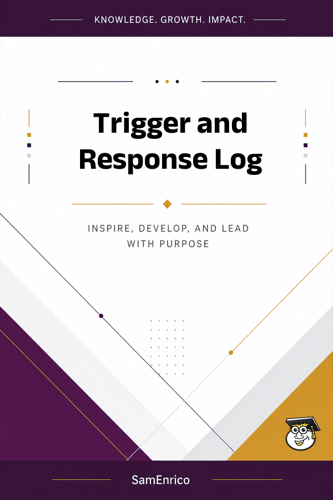
Trigger and Response Log eBook
Document cause, reaction, and helpful coping for e
by Moses Katia
Document cause, reaction, and helpful coping for each episode.
Formats
Free sample
Chapter 1: The 30-Second Rule--The sigh came from across the kitchen table.It was not a loud sigh. It was not a dramatic sigh. It was the kind of sigh that could mean anything—exhaustion, a long day, a mild annoyance with the dog. But in the three seconds that followed that sigh, you felt something shift. A tightness in your chest.
A thought that arrived without invitation: They're sick of me. Then a word, spoken before you could stop it. Something sharp. Something you regretted immediately.The sigh was not the problem. The three seconds after the sigh were not the problem either.
The problem was everything that happened in the thirty seconds before the sigh—and that you never saw it coming.This is the most important thing you will learn in this entire book: Your trigger is not what you think it is. Most people, when asked what set them off, will point to the obvious event. The sigh. The critical email. The partner who left dishes in the sink.
The teenager who rolled their eyes. But the obvious event is almost never the real trigger. The real trigger is hiding in the thirty seconds before the obvious event—a window so narrow and so crowded with微小 signals that you have learned to look right through it.This chapter will teach you to see that window. And once you see it, you will never be able to unsee it.The Geography of a Trigger Let us begin with a definition so precise that it will change how you listen to your own life. A trigger is any stimulus—internal or external—that activates a stored emotional memory (a schema) and initiates a cascade of physiological, cognitive, and behavioral responses.
That definition contains three parts, each of which we will unpack.First, a trigger is a stimulus. Something happens. Someone speaks. A memory surfaces. Your stomach growls.
These are events in the world or in your body. Second, that stimulus activates a stored emotional memory. Your brain does not respond to the present moment as it actually is. It responds to the present moment as it resembles the past. Third, that activation initiates a cascade—a sequence of events that unfolds automatically, without your permission, often before you are even aware anything has happened.Most people spend their lives reacting to the second or third stage of this cascade.
They notice the anger. They notice the urge to yell or withdraw. They notice the spiral of anxious thoughts. But they never notice the trigger itself, because the trigger is already gone by the time they look for it. This is like trying to find the starting line of a race after the runners have already finished.
You see the exhaustion. You see the sweat. But you have no idea where they began.The good news is that the starting line is always the same distance behind the finish. It is exactly thirty seconds back.The 30-Second Window Let me explain where this number comes from. Neuroscientific research on emotional reactivity has consistently found that the gap between a trigger event and a conscious emotional response is approximately twenty to forty seconds.
During that window, your amygdala (the brain's threat-detection center) has already sounded the alarm. Cortisol and adrenaline have begun to flood your system. Your heart rate has increased. Your breathing has shallowed. But your prefrontal cortex—the part of your brain responsible for reasoning, planning, and self-control—is still catching up.This means that for roughly thirty seconds, you are running on autopilot.
You are not choosing your response. Your nervous system is choosing it for you, based on patterns it learned long ago. By the time you feel angry or scared or ashamed, the trigger has already come and gone. You are responding to a memory of the trigger, not the trigger itself.Here is the liberating truth: you cannot prevent the thirty-second window from opening. But you can learn to see it opening.
And seeing it is the first step toward doing something different inside it.The thirty-second window is where your freedom lives. Viktor Frankl, the psychiatrist and Holocaust survivor, wrote that between stimulus and response there is a space, and in that space lies our power to choose our response. That space is not an abstraction. It is the thirty seconds between the sigh and the sharp word. It is the thirty seconds between the critical email and the frantic reply.
It is the thirty seconds between the memory surfacing and the spiral beginning.Most people have no space at all. They react so quickly that stimulus and response feel like a single event. The goal of this book—and this chapter in particular—is to stretch that space. Not to eliminate triggers. Not to become immune to them.
But to stretch the thirty seconds into something you can see, name, and eventually navigate.External Triggers: The World Outside Triggers come from two directions: outside you and inside you. Let us begin with what is outside.External triggers are stimuli in your environment that your nervous system has learned to treat as threats. They are not threats in reality. A sigh is not a threat. A closed door is not a threat.
A particular tone of voice is not a threat. But your nervous system does not operate on reality. It operates on resemblance. If a sigh once preceded criticism, rejection, or danger, your nervous system will now treat all sighs as if they precede criticism, rejection, or danger. This is called generalization, and it is the engine of most chronic reactivity.Common external triggers include:People.
Specific individuals—a parent, a partner, a boss, a particular coworker—can become walking triggers. Often this is because your history with that person has established predictable patterns of conflict or disappointment. But sometimes the person themselves is not the trigger. It is what they represent. A boss who reminds you of a critical parent.
A partner whose withdrawal reminds you of childhood abandonment. You are not reacting to the person in front of you. You are reacting to a ghost standing behind them.Places. Environments carry emotional memories. The kitchen where you fought with your spouse.
The office where you were humiliated. The house where you grew up. Walking into these places can trigger a full physiological response before you have even said hello to anyone. Your body remembers what your mind has tried to forget.Times of day. Many people have predictable trigger windows.
The hours before dinner, when exhaustion and hunger collide. Late at night, when the distractions fall away and the anxious thoughts rush in. Sunday evenings, when the dread of Monday morning begins to build. These are not random. They are rhythms your nervous system has learned.Sounds.
A door slamming. A particular ringtone. A tone of voice that echoes someone from your past. The sound of someone sighing across a kitchen table. These auditory triggers are among the fastest, because the auditory cortex processes sound more quickly than the visual cortex processes sight.
You can hear a trigger before you see one.Situations. Performance reviews. Family gatherings. First dates. Medical appointments.
These are not inherently threatening, but if your history includes painful experiences in similar situations, your nervous system will treat…
This is the end of the free sample. Get the eBook to keep going. Buy now
About this book
Details
- Author
- Moses Katia
- Publisher
- SamEnrico
- Language
- English
- Genre
- Non-Fiction, Self-Help, Symptom Tracking
- Released
- 2026-06-08
- Pages (approx.)
- 138
- Available as
- eBook, Audiobook

Read better in the ZLOADR app
Your eBooks on your phone or tablet. Sign in with your SamEnrico account and start reading.
More by Moses Katia
 Divorce and Estate PlanningMoses Katia$11.99
 Team Creativity for DevelopersMoses Katia$11.99
 Road Rage Smartphone DistractionMoses Katia$11.99
 Nonprofit Layoff GuideMoses Katia$11.99
 Attic Dust Motes MeditationMoses Katia$11.99
 Breast Health For Blind WomenMoses Katia$11.99
 Persuasion for Data ScientistsMoses Katia$11.99
 The Blood of Marathon: Athens' Last Stand Against the Persian HordeMoses Katia$11.99
 The Great Louvre Heist: Napoleon's Lost MasterpiecesMoses Katia$11.99
 How to Produce a Cooling SystemMoses Katia$11.99
 How to Produce Paintball EquipmentMoses Katia$11.99
 Fair Trade Export Certification GuideMoses Katia$12.99