
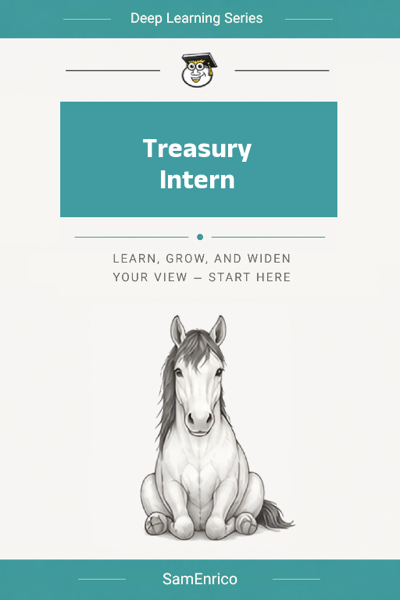
Treasury Intern
A Coursebook on Treasury Intern
A Coursebook on Treasury Intern
Formats
About this book
Free sample
Chapter 1: The Money Nerve--– Every organization, from a multinational bank to a municipal utility, has a nerve center where money flows in, money flows out, and someone has to make sure the math never breaks. That nerve center is treasury. It is not accounting, which looks backward at what has already happened. It is not corporate finance, which looks forward at long-term investments. Treasury lives in the eternal present – and the near future – managing the cash, the risk, and the funding that keeps the entire organization alive.
If you want to understand where the money actually is, where it is going, and whether there will be enough of it to pay the bills tomorrow, you need to understand treasury.This chapter defines treasury and positions it within the broader financial ecosystem of any organization. You will learn what treasury does, why it exists, and how it differs from the finance functions you may already know. You will learn the three-office structure that separates dealing, risk management, and settlement – a separation that is not accidental but deliberately designed to prevent disaster. You will meet the key players: the Chief Dealer, the Treasury Analyst, the members of the Asset Liability Committee. And you will learn, at a high level, how banks make money and how treasury manages the balance sheet to optimize that profit while controlling risk.
By the end of this chapter, you will see treasury not as a back-office support function but as the strategic heart of every well-run organization.What Treasury Is – And What It Is Not Let us start with clarity. Treasury is the function responsible for managing an organization's financial risk and funding. That sentence contains two critical words: risk and funding. Treasury does not record transactions – that is accounting. Treasury does not evaluate whether to build a new factory or acquire a competitor – that is corporate finance.
Treasury ensures that when the company needs to make a payment, the money is there. When the company has excess cash, that cash is invested safely. When the company faces currency fluctuations or interest rate changes, those risks are…
This is the end of the free sample. Get the eBook to keep going. Buy now
Contents
- Chapter 1
- Chapter 2
- Chapter 3
- Chapter 4
- Chapter 5
- Chapter 6
- Chapter 7
- Chapter 8
- Chapter 9
- Chapter 10
- Chapter 11
- Chapter 12
Details
- Author
- Riddick Brittni
- Publisher
- SamEnrico
- Language
- English
- Genre
- Non-Fiction, Informative, Educational
- Released
- 2026-05-04
- Pages (approx.)
- 117
- Available as
- eBook, Audiobook

Read better in the ZLOADR app
Your eBooks on your phone or tablet. Sign in with your SamEnrico account and start reading.
More by Riddick Brittni
 Scaling Investor RelationsRiddick Brittni$11.99
 Intergenerational Anger Transmission GuideRiddick Brittni$11.99
 Injustice Anger Trigger GuideRiddick Brittni$11.99
 Financial Stress and Car RepossessionRiddick Brittni$11.99
 The Trial of the Century: The Inside Story of the O.J. Simpson CaseRiddick Brittni$11.99
 The Midnight Swap: The Untold Story of Baseball's Secret 1919 BlockbusterRiddick Brittni$11.99
 Understanding Hyperglycinemia, Isolated Nonketotic Type 1Riddick Brittni$17.99
 How to Start a Paste Made of Asbestos Business (Beginners Guide)Riddick Brittni$11.99
 No Degree SEO Career GuideRiddick Brittni$12.99
 Telehealth Documentation OutlookRiddick Brittni$12.99