
Non-FictionSelf-HelpPublic Transit
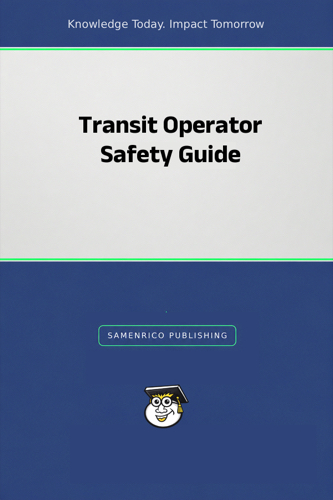
Transit Operator Safety Guide eBook
Handle track incidents and passenger conflicts on
by Farr Michal
Handle track incidents and passenger conflicts on rail systems.
Formats
Free sample
Chapter 1: The Zero-Foot Gap--–- The first thing they don’t tell you in training is that you will feel the train breathe. Not metaphorically. The steel exoskeleton expands in summer heat, contracts in winter cold, and between those metal ribs, you sit in a swivel chair bolted to a floor plate that has killed men. Your left hand rests on a throttle that can move five hundred tons from zero to sixty in under forty seconds. Your right hand hovers over a brake valve that can stop that same mass so abruptly that standing passengers become projectiles.
Between your hands, your chest, your racing heart, and the outside world, there is nothing but glass and a door that locks from the inside—or sometimes, terrifyingly, from the outside. This is the cab. This is the zero-foot gap. And this is where the threat environment begins.The rail operator occupies a paradox no other transportation professional faces. A bus driver has a steering wheel, a shoulder lane, and a rear door that opens to the street.
A pilot has a locked cockpit, a co-pilot, and thirty thousand feet of buffer air. A truck driver has a sleeper cab, a CB radio, and the ability to pull over at any rest stop. You have a chair, a window, and four hundred people behind you who cannot exit until you open the doors. When the threat comes—and it will come—your reactionary gap is not six feet. It is not four feet.
It is zero inches from the moment you sit down and seal the door.This chapter defines the rail threat environment with surgical precision. You will learn the two categories of incidents that will define your career. You will learn the three types of passenger conflict that have sent operators to hospitals and early retirements. And you will learn why the reactionary gap—that invisible bubble of safety you carry in everyday life—evaporates the moment you take control of a train. By the end of this chapter, you will see your cab differently.
Not as a workplace. As a battlefield with rules you can master.The Two Worlds of Rail Incidents Every incident you will ever face falls into one of two categories. They require different mindsets, different training, and different reflexes. Confusing one for the other has killed operators.Operational Incidents: When the Infrastructure Attacks Operational incidents are threats that emerge from the track, the train, or the electrical system. They do not have emotions.
They do not negotiate. They follow the laws of physics, not psychology. These include track obstructions (stalled cars, fallen trees, debris), signal failures (red lights that lie, green lights that shouldn't exist), fires (electrical, brake-related, or passenger-caused), and the silent killer—third-rail debris that can turn a routine stop into a cremation.Operational incidents demand checklist responses. You do not de-escalate a fire. You do not negotiate with a failed signal.
You execute pre-learned drills with the mechanical precision of an air traffic controller. The operator who hesitates during an operational incident—who stops to think about feelings or fairness—loses seconds that cost lives. Chapter 3 will drill you on the Three C's (Control, Communicate, Contain with the tunnel fire exception). Chapter 5 will teach you when to evacuate and when to keep passengers locked inside a burning train. But first, you must learn to identify an operational threat within two seconds of seeing it.Social Incidents: When the Passenger Becomes the Hazard Social incidents are threats that emerge from human behavior.
Unlike a red signal, a passenger can change their mind. Unlike a fire, an angry customer can be redirected with words—if you use the right words at the right time. These include fare disputes (the single largest trigger, accounting for sixty-seven percent of reported assaults on rail operators per Federal Transit Administration data from 2018 to 2023), conflicts between passengers that spill toward the cab, intoxication, mental health crises, and the uniquely dangerous "platform-passing" aggression where a conflict begins on the platform and intensifies when the doors close, trapping combatants and operator together.Social incidents demand psychological responses. You do not fight a passenger if you can talk to them. You do not call police if a calm word will suffice.
But the window for de-escalation is narrow—measured in seconds, not minutes—and once a passenger's limbic system hijacks their prefrontal cortex, words become weapons or shields depending entirely on your delivery. Chapter 7 will teach you the pre-assault indicators that predict violence before the passenger knows they will swing. Chapter 8 will give you the CAIRO method (Calm, Assertive, Inform, Reflect/Redirect, Opening) as a five-step script for saving situations that feel unsalvageable. Chapter 10 will tailor those scripts for the high-risk demographics—intoxicated, mentally ill, and youth swarms—that require different approaches.The critical skill this chapter teaches is instantaneous categorization. When you see a threat approaching your cab—whether it emerges from the tracks ahead or from the rear carriage where shouting has turned to shoving—you have approximately two seconds to answer one question: Is this operational or social?
Answer wrong, and you will apply a checklist to a human who needs empathy, or you will attempt empathy on a fire that needs evacuation. Both errors kill.The Three Faces of Rail Conflict Within the social incident category, conflict takes three distinct forms. Each requires a different defensive posture, a different communication strategy, and a different exit plan.Passenger vs. Operator: The Direct Threat This is the scenario that wakes operators at 3:00 AM. A passenger directs their anger specifically at you.
The fare dispute escalates from "I'm not paying" to "You're going to pay" in four syllables. The intoxicated man who boarded at the last stop decides that your face is the reason his life went wrong. The teenager who was denied entry for lack of fare presses his palm against the cab window and smiles.In passenger-versus-operator conflict, you are the target. This simplifies your decision tree: protect yourself first, then passengers, then evidence. The Operator's Trinity, introduced in this book's opening, applies most urgently here.
You do not open the cab door to reason with someone who has already decided to hurt you. You do not make announcements that reveal your location or emotional state. You use the barrier—glass, metal, or the door itself—as your first line of defense, and you use CAIRO only if the passenger is at a distance where your words can reach them before their hands can reach you.Passenger vs. Passenger: The Spillover Threat This is the scenario that operators misjudge most often. Two passengers argue over a seat, an accidental elbow, or a perceived insult.
The argument escalates. Shouting becomes shoving. Shoving becomes swinging. And somewhere in that escalation, one of the combatants looks for a witness, an authority figure, or a target to redirect their rage. You are standing behind glass, wearing a uniform, holding a radio.
You are all three.Spillover conflict is dangerous not because of its intensity but because of its unpredictability. The operator who intervenes too early becomes the new target. The operator who intervenes too late watches a passenger get seriously injured. The solution is…
This is the end of the free sample. Get the eBook to keep going. Buy now
About this book
Details
- Author
- Farr Michal
- Publisher
- SamEnrico
- Language
- English
- Genre
- Non-Fiction, Self-Help, Public Transit
- Released
- 2026-06-06
- Pages (approx.)
- 146
- Available as
- eBook, Audiobook

Read better in the ZLOADR app
Your eBooks on your phone or tablet. Sign in with your SamEnrico account and start reading.
More by Farr Michal
 Medellin Cartel Extortion NetworkFarr Michal$11.99
 The Household Toxin Detox GuideFarr Michal$11.99
 Creative Pivot Planning GuideFarr Michal$11.99
 Social Entrepreneur Remote Team GuideFarr Michal$11.99
 Red Tails Over Berlin: The Forgotten Victory of the Tuskegee AirmenFarr Michal$11.99
 The Last Spartan’s Stand: Thermopylae’s Forgotten DefenderFarr Michal$11.99
 Understanding Familial Wilms Tumor 2Farr Michal$17.99
 How to Become a Casing-running-machine TenderFarr Michal$11.99
 Strategy Meeting Shortcuts for Time Crunched LeadersFarr Michal$12.99
 EU VAT on Digital ServicesFarr Michal$12.99
 Reservations and Communications SpecialistFarr Michal$11.99
You may also like
 Hong Kong Handover 1997Dunn Johnnie$11.99
 Zumba For Postnatal Recovery CourseNeal Christian$11.99
 Zumba for BeginnersLadner Nikia$11.99
 YouTube Comment Mining GuideHumes Pandora$12.99
 Worry Box MeditationCarlin Rudy$11.99
 Workplace Stress MeditationNguyen Lynn$11.99
 Workplace Stress and Sleep RepairHawley Ivory$11.99
 Workplace Perfectionism CureDelaney Jeffry$11.99
 Workplace Injustice Anger GuideWallen Isabelle$11.99
 Work Addiction and Burnout LinkGreenwood Ester$11.99
 Women in Yoga and WellnessBeattie Galina$11.99
 Women in Stand Up ComedyChun Evangeline$11.99