
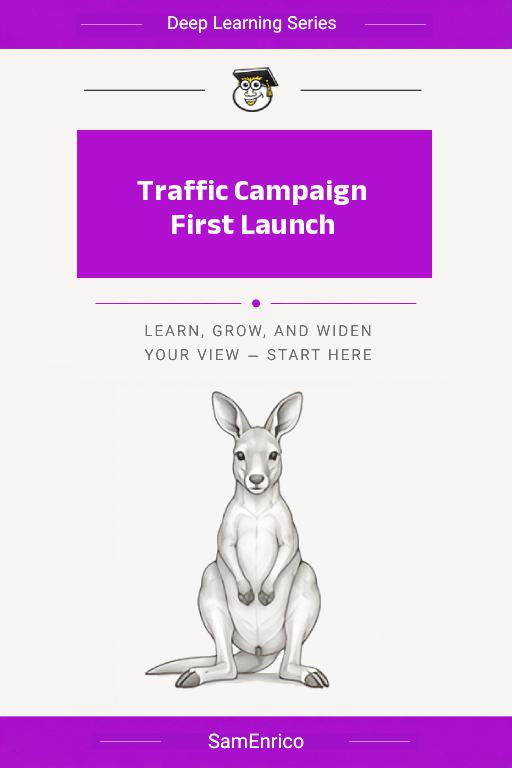
Traffic Campaign First Launch eBook
Drive first clicks to your website or landing page
by Solano Irwin
Drive first clicks to your website or landing page. Optimize for link clicks or landing page views.
Formats
Free sample
Chapter 1: The Zero-Trust Funeral--The click died three years ago. Most marketers just haven’t held the funeral yet.You remember what it used to feel like. A clever headline, a flashing button, a half‑truth about “one weird trick”—and the clicks poured in like water through a broken dam. Curiosity was currency. Attention was cheap.
And the only thing a consumer had to lose was ten seconds of their afternoon.That world is gone.Today, the average person is exposed to over ten thousand commercial messages every single day. Banner ads, sponsored posts, pre‑roll videos, native articles, pop‑ups, push notifications, email offers, text messages, and the quiet desperation of “link in bio.” The human brain, magnificent as it is, has adapted to this assault by building a wall. Not a wall of indifference—a wall of active distrust.We are living in what I call the Zero‑Trust Economy.In the Zero‑Trust Economy, the default setting of every potential customer is not “maybe” or “tell me more.” The default setting is “prove it.” Prove you are not a scam. Prove you are not wasting my time. Prove you see me as a human being, not a conversion rate.
Prove that your link leads somewhere worth my finite, irreplaceable attention.If you cannot meet that burden of proof before the click, you will never get the click. It does not matter how good your offer is. It does not matter how beautiful your landing page will be. It does not matter how many features your product has. The click is the toll booth, and the toll is trust.
No trust, no passage.This chapter is not a pep talk. It is a reckoning. We are going to bury the old model of “curiosity clicks” and build something that works in the world as it actually is, not as we wish it were. By the end of this chapter, you will understand exactly why your last campaign failed—and you will have the first real tool to fix it.The Funeral of the Curiosity Click Let me tell you a quick story.A few years ago, a well‑funded startup launched a new productivity app. They had a gorgeous website, a clever name, and a six‑figure ad budget.
Their headline read: “You’re working too hard. Here’s the secret to getting it all done in four hours.”Classic curiosity gap. It worked beautifully—for about three days.They got tens of thousands of clicks. Their cost per click was enviably low. Their executives high‑fived each other.
And then they looked at the landing page data. Ninety‑two percent of those curious visitors bounced within eight seconds. They had spent $47,000 on clicks that bought them nothing but a high bounce rate and a lesson in how the web had changed.What happened?The headline promised a secret. The landing page asked for an email address, a credit card, and a fifteen‑minute demo booking. The gap between what was promised and what was required was so vast that visitors felt manipulated.
They did not feel curious anymore. They felt tricked. And when people feel tricked, they do not convert. They leave, and they do not come back.This is the funeral of the curiosity click. Curiosity is no longer enough.
In fact, pure curiosity has become a liability because it sets an expectation that you almost certainly cannot meet in the first three seconds of the landing page experience.The modern click is something else entirely. The modern click is a vote of confidence.Think about the last time you clicked on an ad or an email link. Really think about it. You did not click because you were vaguely curious. You clicked because you had already decided, in the split second before your finger moved, that the thing on the other side of that link was likely to be worth your time.
You made a judgment about the source. You scanned the headline for credibility signals. You subconsciously asked yourself: “Do I trust this person, brand, or platform enough to risk five seconds of my life?”That is the vote.And if you cannot earn that vote, you cannot earn the click.The Three Burials: What Drove the Dagger In The death of the curiosity click did not happen overnight. Three specific forces buried it, and understanding them is the first step toward building a campaign that works in the Zero‑Trust Economy.Burial #1: The Clickbait Hangover For the better part of a decade, clickbait was the dominant strategy. “You won’t believe what happened next.” “This one trick changed everything.” “Doctors hate this simple solution.” These headlines worked because they exploited a neurological loophole: the brain’s aversion to incomplete information.
We hate not knowing how the story ends.But the loophole closed. After being burned hundreds of times by headlines that led to listicles, thinly veiled sales pages, or outright garbage, the collective consumer brain rewired itself. Today, a curiosity‑gap headline triggers not intrigue but suspicion. The immediate reaction is not “I wonder what happens next” but “What are they trying to sell me?”This is not cynicism. This is learned survival.
The clickbait industry trained consumers to distrust curiosity. And now we all pay the price.Burial #2: Ad Fatigue at Scale The average person now encounters between four thousand and ten thousand ads every single day. That number is not a typo. From the moment you wake up and check your phone to the moment you scroll through a food delivery app before bed, you are swimming in a river of commercial messaging.The human brain has a finite capacity for attention. When that capacity is exceeded, the brain does not get bigger.
It gets more selective. It builds shortcuts. And the most powerful shortcut it has built is this: ignore everything that looks like an ad.Even ads that do not look like ads—native content, influencer posts, “sponsored” articles—are now recognized for what they are within milliseconds. The brain’s ad‑detection circuitry has become astonishingly efficient. Your beautiful, expensive, carefully targeted ad is not being rejected.
It is not even being seen. It is being filtered out before it reaches conscious awareness.Burial #3: The Brand Loyalty Collapse Here is a hard truth that marketing executives do not want to hear: brand loyalty is largely a myth of the past. Consumers do not love your brand. They do not dream about your brand. They do not wake up hoping to buy from your brand.What consumers have is habit and convenience.
And both of those evaporate the moment a better, easier, or cheaper option appears.In the Zero‑Trust Economy, a “trusted brand” is not one that has earned loyalty. It is one that has not yet disappointed the customer. The bar is that low. And that low bar means that even established brands cannot rely on past reputation to drive first clicks. Every campaign, every email, every ad is judged on its own merits in a matter of milliseconds.If the incumbent brands are struggling, what chance does a new launch have?
The answer is simple: the same chance as everyone else. Because in the Zero‑Trust Economy, the past does not matter.…
This is the end of the free sample. Get the eBook to keep going. Buy now
About this book
Details
- Author
- Solano Irwin
- Publisher
- SamEnrico
- Language
- English
- Genre
- Non-Fiction, First 30 Days, Traffic
- Released
- 2026-06-01
- Pages (approx.)
- 123
- Available as
- eBook, Audiobook

Read better in the ZLOADR app
Your eBooks on your phone or tablet. Sign in with your SamEnrico account and start reading.
More by Solano Irwin
 Thunderstorm Phobia HelpSolano Irwin$11.99
 Self Compassion Affirmations CourseSolano Irwin$11.99
 Egypt Consumer AnalysisSolano Irwin$11.99
 The Persuasive Complaint HandlingSolano Irwin$11.99
 Minor Children Guardianship GuideSolano Irwin$11.99
 The Battle of Salamis: Thebes vs. Athens—Naval Genius That Saved a CivilizationSolano Irwin$11.99
 Jamie Dimon GuideSolano Irwin$12.99
 Understanding OxalosisSolano Irwin$17.99
 How to Start a Packaged Tour Sales Business (Beginners Guide)Solano Irwin$11.99
 Atomic Force Microscope TechnicianSolano Irwin$11.99