
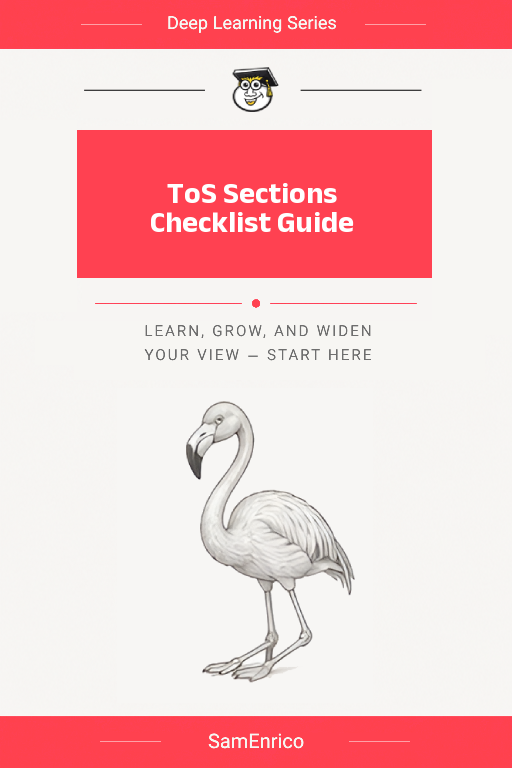
Non-FictionFirst 30 DaysChecklists
ToS Sections Checklist Guide eBook
Verify you have all 12 essential sections: accepta
by Amato Lupe
Verify you have all 12 essential sections: acceptance, user accounts, payments, termination, and dispute resolution.
Formats
Free sample
Chapter 1: The Click That Counts...--Most founders discover the hard way that a beautifully written Terms of Service is worthless if no one can prove the user ever agreed to it. I have sat across from dozens of startup founders who were absolutely certain their To S was bulletproof, only to watch them squirm when a lawyer asked the simplest question in contract law: "Where is the record of acceptance?"The silence that follows is deafening.You can have the most meticulously crafted clauses on intellectual property, liability caps, and dispute resolution. You can hire the most expensive legal team to draft your terms. But if you cannot produce a clear, timestamped, and unambiguous record of each user saying "I agree" before they ever touched your service, then in the eyes of the court, your To S might as well be written on invisible ink.This chapter is not about what goes into your To S. It is about the single most fundamental question that determines whether your To S will ever be enforced: How do you prove the user agreed?I have analyzed thousands of To S enforcement cases, reviewed the agreements of the fastest-growing Saa S companies, and distilled the acceptance mechanisms that actually hold up in court.
What follows is the blueprint for creating a legally binding acceptance process that does not crumble under scrutiny.The Sobering Reality: Why Most To S Agreements Fail Before we dive into solutions, let us understand the scope of the problem. Across the United States and major international jurisdictions, courts dismiss or refuse to enforce To S agreements in an estimated 40 to 60 percent of cases where the only evidence of acceptance is passive. That is not a typo. Nearly half of all To S disputes are lost before they even reach the merits of the case, simply because the company cannot prove the user agreed.Consider the following real-world outcomes:In Specht v. Netscape Communications Corp.
(2002), a federal court refused to enforce Netscape's To S because users merely had to click "Download" — a button that did not explicitly say "I agree to the terms." The court ruled that a hyperlink to the terms hidden on a different webpage did not constitute meaningful assent.In Sgouros v. Trans Union Corp. (2019), the court rejected browsewrap terms posted at the bottom of a webpage because there was no evidence the user ever saw them. The judge wrote, "A reasonable user would not know that continuing to use the site constituted agreement to legal terms buried in a footer."These cases share a common thread: the companies assumed that because they had terms, those terms were enforceable. They were wrong.The lesson is brutal but simple.
Assent is not implied. Assent must be demonstrated.Two Worlds, One Verdict: Clickwrap vs. Browsewrap The legal world divides acceptance mechanisms into two starkly different categories. Understanding the distinction between them is the difference between sleeping soundly and losing your company in a class action.Clickwrap: The Gold Standard Clickwrap refers to any mechanism that requires the user to take an unambiguous affirmative action before using the service. The classic example is a checkbox next to the statement "I have read and agree to the Terms of Service" followed by a button labeled "Create Account" or "Continue."Why do courts love clickwrap?
Because it creates a digital paper trail. Every click is timestamped, IP-logged, and associated with a specific user session. When a court asks, "Did this user agree?" you can produce a screenshot of the exact interface they saw, the exact time they clicked, and the exact version of the To S they agreed to.Leading Saa S companies like Stripe, Shopify, and Dropbox all use clickwrap. Notice that when you sign up for any of these services, you cannot proceed without checking a box or clicking a button that explicitly references the terms. That is not accidental.
That is defensive design.There are three variations of clickwrap, each with different levels of legal strength:The Checkbox Method (Strongest): A pre-checked box is weak because courts have ruled that users may not notice it. An unchecked box that requires the user to click it is strongest. The user must take deliberate action.The Button Method (Also Strong): A button that says "I Agree to the Terms" or "Create Account (Agree to Terms)" is generally enforceable even without a checkbox, provided the button text explicitly references the terms.The Scrollwrap Method (Moderate): The user must scroll to the bottom of the To S before the "I Agree" button becomes enabled. This proves they at least had the opportunity to view the terms. Some courts love this; others see it as unnecessary theater.Browsewrap: The Lawsuit Magnet Browsewrap, by contrast, is the assumption that merely using a website constitutes agreement to its terms.
The terms are typically posted via a hyperlink in the footer, and there is no explicit "I agree" step. The company argues, "By continuing to use our site, you agree to our terms."Courts have rejected browsewrap in case after case. The reasoning is intuitive: a reasonable person does not expect that clicking a link or scrolling a page binds them to a legally enforceable contract. Browsewrap survives only in the narrowest circumstances — typically when the user is a repeat business customer who has been explicitly notified of the terms multiple times.I advise my clients to treat browsewrap as legally worthless for consumer-facing services. If you are relying on browsewrap, you are effectively uninsured.The Hybrid Trap: Registration Without Agreement Some services make users register for an account but place the To S link on a separate page without requiring explicit agreement.
This is neither clickwrap nor browsewrap — it is worse. The user has taken action (registering) but that action was not explicitly tied to the terms. Courts have consistently ruled that registration alone does not imply To S acceptance unless the registration button explicitly references the terms.If your signup button says only "Sign Up" and the To S link is somewhere else on the page, you have a problem.The Right to Read vs. The Right to Update Acceptance is not a one-time event. The relationship between a company and its users evolves.
Features change. Laws change. Business models change. Your To S must change with them. But you cannot simply rewrite the terms one day and assume users agree the next.This introduces two competing rights that every To S must balance: the Right to Read and the Right to Update.The Right to Read Users have the right to read the terms that govern them before they agree.
This seems obvious, but you would be surprised how many companies hide their To S behind a login wall or only show it after the user has already paid.The Right to Read requires that the To S be presented at the point of acceptance. If you are using clickwrap, the To S must be accessible via a hyperlink directly next to the checkbox or button. The user should not have to hunt for it.Some best practices for the Right to Read include:Place a hyperlink to the full To S immediately adjacent to the acceptance…
This is the end of the free sample. Get the eBook to keep going. Buy now
About this book
Details
- Author
- Amato Lupe
- Publisher
- SamEnrico
- Language
- English
- Genre
- Non-Fiction, First 30 Days, Checklists
- Released
- 2026-06-01
- Pages (approx.)
- 142
- Available as
- eBook, Audiobook

Read better in the ZLOADR app
Your eBooks on your phone or tablet. Sign in with your SamEnrico account and start reading.
More by Amato Lupe
 The Volunteer Who VanishedAmato Lupe$11.99
 Loneliness Animal Shelter GuideAmato Lupe$11.99
 Mediation Techniques GuideAmato Lupe$11.99
 Recurring Dreams in Children GuideAmato Lupe$11.99
 Senior Creative ExpressionAmato Lupe$11.99
 HR Tech Growth Capital GuideAmato Lupe$11.99
 Recovery from Leadership BurnoutAmato Lupe$11.99
 Driving Anxiety TranceAmato Lupe$11.99
 Inside The Diamond ClubAmato Lupe$11.99
 Silent Witness: The Trial of Jean-Gaspard Deburau and the Birth of Modern MimeAmato Lupe$11.99
 The Frozen Silk Road: How a Forgotten Explorer Mapped Antarctica's Hidden SecretsAmato Lupe$11.99
 The Container King: How One Man Built a Global Empire on Steel BoxesAmato Lupe$11.99
You may also like
 Hong Kong Handover 1997Dunn Johnnie$11.99
 Zumba For Postnatal Recovery CourseNeal Christian$11.99
 Zumba for BeginnersLadner Nikia$11.99
 YouTube Comment Mining GuideHumes Pandora$12.99
 Worry Box MeditationCarlin Rudy$11.99
 Workplace Stress MeditationNguyen Lynn$11.99
 Workplace Stress and Sleep RepairHawley Ivory$11.99
 Workplace Perfectionism CureDelaney Jeffry$11.99
 Workplace Injustice Anger GuideWallen Isabelle$11.99
 Work Addiction and Burnout LinkGreenwood Ester$11.99
 Women in Yoga and WellnessBeattie Galina$11.99
 Women in Stand Up ComedyChun Evangeline$11.99