
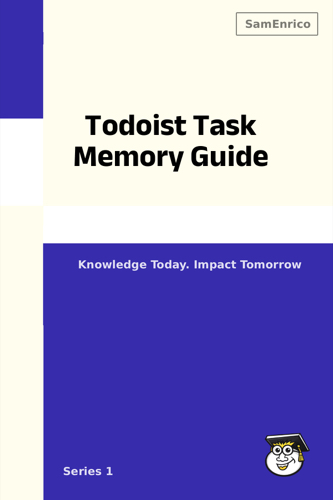
Non-FictionSelf-HelpProject Management
Todoist Task Memory Guide eBook
Manage projects and recurring tasks with this prac
Manage projects and recurring tasks with this practical digital reminder tool.
Formats
Free sample
Chapter 1: The $10,000 Leaky Roof--–- Imagine for a moment that your home has a slow, persistent leak in the roof. It is not dramatic—no waterfalls, no collapsed ceilings. Just a single drop of water every few minutes, landing in the same spot on your hardwood floor. At first, you ignore it. You place a small bucket underneath and go on with your life.
But weeks become months. The bucket fills and overflows. The wood begins to warp. Mold grows in the walls. One morning, you wake up to find that the entire structural integrity of your home has been compromised—not by a single catastrophe, but by thousands of tiny, ignored drops.That leaky roof is your brain trying to store to-do lists.
And the warped floor is your fractured attention.This book is about patching that roof. It is about taking the constant drip of obligations, reminders, ideas, and “don’t forgets” that cycle endlessly through your mind and moving them into a trusted external system called Todoist. The goal is not to become more productive in the frantic, hustle-culture sense of the word. The goal is to free your mind—to reclaim the cognitive real estate that has been silently stolen from you by the myth that memory is a reliable storage device.This chapter will make a provocative argument that challenges everything you have been taught about “trying harder to remember.” Your brain was never designed to function as a to-do list. It is a thinking organ, not a storage drive.
Every task you hold in your head is a tax on your creativity, your patience, and your presence. By the end of this chapter, you will understand exactly why your current system is failing—and you will take the first concrete step toward building a new one.The Zeigarnik Effect: Why Unfinished Tasks Haunt You In 1927, a young Lithuanian psychologist named Bluma Zeigarnini observed something peculiar about waiters in a busy Vienna café. She noticed that waiters could remember complex, multi-item orders with astonishing accuracy—but only until the bill was paid. Once the transaction was complete, the orders vanished from their memory as if they had never existed.Zeigarnik returned to her laboratory at the University of Berlin and designed a series of experiments that would become foundational to modern psychology. She gave participants a series of simple tasks—building clay figures, solving puzzles, arithmetic problems.
For half the tasks, she allowed participants to complete them uninterrupted. For the other half, she interrupted them mid-stream, claiming technical difficulties or time constraints.Later, when asked to recall the tasks they had worked on, participants were nearly twice as likely to remember the interrupted, unfinished tasks as the completed ones. The human brain, Zeigarnik concluded, has a built-in tension system: unfinished tasks remain active in a privileged memory loop, demanding attention until they are closed.This is the Zeigarnik Effect, and it is running constantly in the background of your life right now.Every email you told yourself you would reply to later, every chore you postponed until the weekend, every project you started but never finished, every vague goal you have been “meaning to get to”—all of them are open loops cycling through your subconscious, consuming cognitive bandwidth like a dozen browser tabs playing autoplay videos.Here is what most people get wrong about the Zeigarnik Effect. They assume that the solution is to finish more tasks. Finish the email.
Finish the chore. Finish the project. And certainly, completion is part of the answer. But you cannot finish everything. There are simply not enough hours in your Four Thousand Weeks (a concept we will revisit in Chapter 12) to close every open loop.The real solution is not finishing.
It is offloading.When you move an unfinished task from your brain into a trusted external system—a piece of paper, a notes app, or in our case, Todoist—the Zeigarnik Effect does not disappear. But it dramatically reduces its intensity. Your brain needs to know that the task will be handled. It does not need to handle it right now. By recording the task externally, you give your brain permission to release its grip.
The loop remains open in the world, but it closes in your mind.This is the first and most important shift of this entire book: Your brain is for having ideas, not holding them.Attention Residue: The Hidden Cost of Switching The Zeigarnik Effect explains why unfinished tasks linger. But there is an even more insidious cognitive tax that most people do not even know exists. It is called Attention Residue, and it was identified and named by Cal Newport in his book Deep Work.Here is how attention residue works. When you switch from Task A to Task B—perhaps you are writing a report and you pause to answer a text message—your attention does not fully transfer. A portion of your focus remains stuck on Task A, like a drop of water clinging to a spoon.
The more frequently you switch, the more residue accumulates, until your cognitive engine is running on sludge.Newport cites research showing that after even a brief distraction—a two-second glance at a notification—it takes an average of twenty-three minutes to return to the same depth of focus. Twenty-three minutes. That means a single interruption at 9:02 AM can cost you focus until 9:25 AM. If you check your phone four times in the morning, you have effectively lost two hours of deep concentration before lunch.Now consider how this interacts with the Zeigarnik Effect. Every unfinished task in your head is a potential interruption.
You do not need a phone notification to be distracted. You can be sitting perfectly still, staring at your computer screen, while your mind cycles through the grocery list, the project deadline, the email you forgot to send, and the call you need to make. These are internal interruptions, and they are just as damaging as external ones.The combination of open loops (Zeigarnik) and attention residue (Newport) creates a perfect storm of cognitive inefficiency. Your brain is simultaneously trying to remember unfinished tasks while also being unable to focus deeply on the task in front of you. This is why you can spend eight hours at your desk and feel like you accomplished nothing.
You were busy—frantically, exhaustingly busy—but your attention was splintered across a dozen half-present priorities.The only remedy is a trusted external system that holds your tasks so completely that your brain stops trying to remember them. When you know with absolute certainty that nothing will be lost, forgotten, or dropped, you can afford to give your full attention to the single task in front of you. This is the state that David Allen calls Mind Like Water—the mind of a martial artist who is completely present, completely responsive, and completely unburdened by the past or future.The Myth of “I’ll Just Remember”We need to name and dismantle a dangerous assumption that most of us carry without examination: the belief that our memory is sufficient for the demands of modern life.This belief is not entirely unreasonable. For 99 percent of human evolutionary history, the demands on memory…
This is the end of the free sample. Get the eBook to keep going. Buy now
About this book
Details
- Author
- Alonso Ethelene
- Publisher
- SamEnrico
- Language
- English
- Genre
- Non-Fiction, Self-Help, Project Management
- Released
- 2026-06-06
- Pages (approx.)
- 155
- Available as
- eBook, Audiobook

Read better in the ZLOADR app
Your eBooks on your phone or tablet. Sign in with your SamEnrico account and start reading.
More by Alonso Ethelene
 Pomodoro For Job SearchAlonso Ethelene$11.99
 The Governor's Education WarAlonso Ethelene$11.99
 Validating Mental Health StrugglesAlonso Ethelene$11.99
 Sleep Apnea Success StoriesAlonso Ethelene$11.99
 Pet Bedtime Meditation GuideAlonso Ethelene$11.99
 Desulfovibrio InterpretationAlonso Ethelene$11.99
 TM for Chronic Illness AcceptanceAlonso Ethelene$11.99
 Del Toro LabyrinthAlonso Ethelene$11.99
 The Last Whisper of the Dead Sea ScrollsAlonso Ethelene$11.99
 Divine Winds: The Mongols' Failed Conquest of JapanAlonso Ethelene$11.99
 The Great Thaw: How a Melting Glacier Rewrote HistoryAlonso Ethelene$11.99
 Growing FatsiaAlonso Ethelene$11.99
You may also like
 Hong Kong Handover 1997Dunn Johnnie$11.99
 Zumba For Postnatal Recovery CourseNeal Christian$11.99
 Zumba for BeginnersLadner Nikia$11.99
 YouTube Comment Mining GuideHumes Pandora$12.99
 Worry Box MeditationCarlin Rudy$11.99
 Workplace Stress MeditationNguyen Lynn$11.99
 Workplace Stress and Sleep RepairHawley Ivory$11.99
 Workplace Perfectionism CureDelaney Jeffry$11.99
 Workplace Injustice Anger GuideWallen Isabelle$11.99
 Work Addiction and Burnout LinkGreenwood Ester$11.99
 Women in Yoga and WellnessBeattie Galina$11.99
 Women in Stand Up ComedyChun Evangeline$11.99