
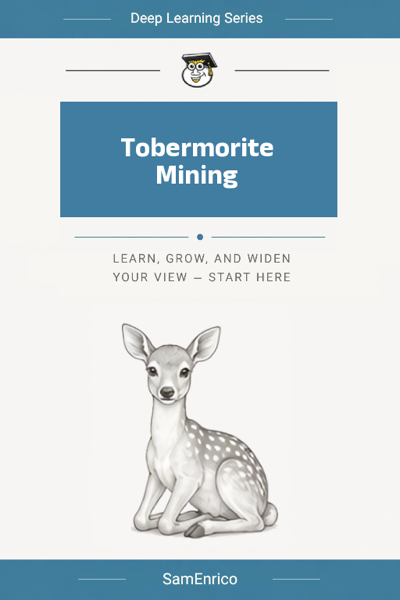
Non-FictionInformativeEducational
Tobermorite Mining
A Coursebook on Tobermorite Mining
A Coursebook on Tobermorite Mining
Formats
About this book
Free sample
Chapter 1: The White Stone--– The white stone sat in a wooden box in the basement of the Natural History Museum in London for ninety-seven years. It was not large—roughly the size of a man’s fist—and it was not beautiful, at least not in any obvious way. Where diamonds explode with light and gold gleams with self-evident value, this specimen was a dull, fibrous mass the color of old bone. It had been collected in 1880 by a Scottish mineralogist named Henry Heddle, who had pried it from a basalt cliff on the Isle of Mull after nearly slipping to his death on rain-slicked rock. Heddle labeled it “unknown zeolitic mineral, locality: Tobermory Bay,” packed it in straw, and shipped it south.
Then he forgot about it.For nearly a century, the white stone was ignored. Curators walked past its drawer. Mineralogy students used it as a reference for “unidentified—possibly a thomsonite variant.” A visiting German researcher in 1923 tested a small chip, found nothing remarkable, and moved on. The stone accumulated dust and the quiet dignity of the permanently overlooked.Then, in 1977, a young American chemist named Stephen Merlino opened the drawer.Merlino was not looking for anything in particular. He was at the museum to study zeolites—porous minerals used in water softeners and cat litter.
But the white stone caught his eye because of something odd. The label said it came from a basalt cavity, which meant it had formed at low temperature and low pressure. Yet its crystal structure, as far as Merlino could tell from a quick optical inspection, was unusually ordered—more ordered than it had any right to be. He scraped off a few milligrams, powdered the sample, and ran an X-ray diffraction analysis.The pattern that came back made no sense.The basal spacing—the distance between repeating layers in the crystal—was 11.3 angstroms. That was unexpected.
Most hydrated calcium silicates had spacings of either 14 angstroms (fully hydrated) or 9 angstroms (dehydrated). An 11-angstrom phase was a ghost, something that existed in between stable states, like water that refused to…
This is the end of the free sample. Get the eBook to keep going. Buy now
Contents
- Chapter 1
- Chapter 2
- Chapter 3
- Chapter 4
- Chapter 5
- Chapter 6
- Chapter 7
- Chapter 8
- Chapter 9
- Chapter 10
- Chapter 11
- Chapter 12
Details
- Author
- Dorn Leonarda
- Publisher
- SamEnrico
- Language
- English
- Genre
- Non-Fiction, Informative, Educational
- Released
- 2026-05-08
- Pages (approx.)
- 157
- Available as
- eBook, Audiobook

Read better in the ZLOADR app
Your eBooks on your phone or tablet. Sign in with your SamEnrico account and start reading.
More by Dorn Leonarda
 Section 301 Tariff MitigationDorn Leonarda$11.99
 Smoking Cessation For Heavy UsersDorn Leonarda$11.99
 IBS and SIBO ConnectionDorn Leonarda$11.99
 Compulsive Spending for VeteransDorn Leonarda$11.99
 Hammurabi’s Code: The Birth of Western JusticeDorn Leonarda$11.99
 How to Produce Antennas For CommunicationsDorn Leonarda$11.99
 Partner Skills Inclusion HandbookDorn Leonarda$12.99
 How to Start a Alloy Bearing Steel Business (Beginners Guide)Dorn Leonarda$11.99
You may also like
 Hong Kong Handover 1997Dunn Johnnie$11.99
 Zumba For Postnatal Recovery CourseNeal Christian$11.99
 Zumba for BeginnersLadner Nikia$11.99
 YouTube Comment Mining GuideHumes Pandora$12.99
 Worry Box MeditationCarlin Rudy$11.99
 Workplace Stress MeditationNguyen Lynn$11.99
 Workplace Stress and Sleep RepairHawley Ivory$11.99
 Workplace Perfectionism CureDelaney Jeffry$11.99
 Workplace Injustice Anger GuideWallen Isabelle$11.99
 Work Addiction and Burnout LinkGreenwood Ester$11.99
 Women in Yoga and WellnessBeattie Galina$11.99
 Women in Stand Up ComedyChun Evangeline$11.99