
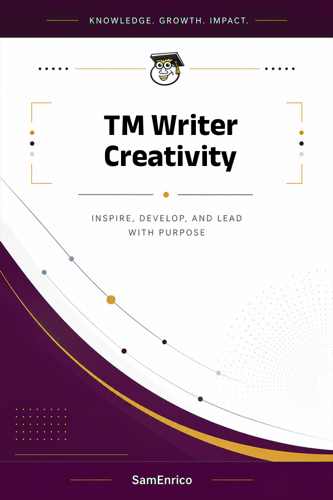
TM Writer Creativity eBook
Settle the inner critic and access deeper creative
Settle the inner critic and access deeper creative currents.
Formats
Free sample
Chapter 1: The Gatekeeper’s Lie...--–- You are sitting at your desk. The cursor blinks. The page is white. And already, before you have written a single word, a voice speaks inside your head.It says: “This won’t be good enough.”Or perhaps it says: “You should be working on something else.” Or: “Who do you think you are?” Or the most devastating version of all—silence. Not even a voice.
Just a heavy, suffocating certainty that nothing you write today will matter.That voice has a name. In this book, we call it the Gatekeeper.Not the inner critic. Not the saboteur. Not the gremlin. Those words are worn smooth from overuse.
“Gatekeeper” is more precise because it tells you exactly what this voice does: it stands at the door between you and the page, and it decides who gets in. It checks your credentials. It demands to see your portfolio. It asks, “Are you really allowed to be here?”And most of the time, you believe it.You believe the Gatekeeper because the Gatekeeper speaks in your own voice. It uses your vocabulary.
It knows your history—every failed project, every embarrassed silence, every time someone read your work and said nothing. The Gatekeeper did not come from nowhere. It was built, brick by brick, from every grade you ever received, every sideways glance from a teacher, every rejection letter, every well-meaning relative who asked, “And what do you do for real money?”The Gatekeeper is not your enemy. This is the most important thing you will read in this entire chapter, so read it twice: The Gatekeeper is not your enemy.It is your protector. A bad one.
A misguided one. A exhausted one. But a protector nonetheless.The Gatekeeper believes, with absolute sincerity, that it is saving you from embarrassment, from wasted time, from the humiliation of being seen trying and failing. Every time it tells you to revise that sentence one more time, it thinks it is polishing a shield. Every time it convinces you to wait until tomorrow, it thinks it is saving you from the shame of producing something ugly today.
Every time it offers a “helpful” suggestion while you are still writing the first paragraph, it thinks it is your co-pilot.It is not your co-pilot. It is the backseat driver who keeps grabbing the steering wheel.This chapter introduces the foundational split that will govern everything else in this book: the difference between the Conscious Writer (the Gatekeeper) and the Unconscious Writer (the Genius). You have both. You need both. But you have been letting the wrong one drive during the wrong part of the journey.The Two Writers Inside You Every human being who has ever written anything of value has possessed two distinct mental capacities for language.
The first is linear, logical, grammatical, and social. It knows what a noun is. It can spot a comma splice from across the room. It worries about word count, deadlines, and what your mother will think when she reads that sex scene. This is the Conscious Writer—the Gatekeeper.The second is associative, image-based, boundaryless, and wild.
It does not know what a noun is and does not care. It makes connections that logic would never allow—a telephone pole becomes a dead tree becomes a grandfather’s cane becomes the sound of rain on a tin roof, and suddenly you have a poem. This is the Unconscious Writer—the Genius.Dorothea Brande, in her 1934 masterpiece Becoming a Writer, called these two forces the “Conscious Self” and the “Unconscious Self.” She wrote: “The conscious mind is the critic, the editor, the censor. The unconscious is the dreamer, the maker, the source. The first writes nothing of value without the second.
The second produces nothing usable without the first. But they must never be allowed in the room at the same time.”Most writers fail because they let the Gatekeeper drive during the generative phase. They sit down to write, and before the Genius can open its mouth, the Gatekeeper says: “Let me just check that last sentence. That verb is weak. Actually, rewind.
The whole premise is flawed. Let’s start over. No, let’s not start at all. Let’s read one more article about writing first. Let’s reorganize the bookshelf.
Let’s sharpen all the pencils.”This is not a failure of willpower. It is a failure of role assignment.Imagine hiring a chef to cook a meal, then standing behind her at the stove, grabbing her wrist every time she reaches for salt, saying, “Are you sure? That seems like too much. Last time you used too much. Remember that terrible soup?” The chef would quit.
Or she would cry. Or she would scream. That is exactly what your Genius does every time you let the Gatekeeper edit while you write. The Genius does not quit entirely—it cannot—but it goes quiet. It retreats into a back room of your mind and waits for the shouting to stop.The good news is that the Gatekeeper is not trying to be cruel.
It is trying to be helpful. It just does not understand its job.The Protector Who Became a Prison Guard Let us trace the Gatekeeper’s origin story, because understanding where it came from is the first step toward putting it in its proper place.You were not born with a Gatekeeper.Babies do not have inner critics. Toddlers do not stare at a crayon drawing of a purple dog and think, “The perspective is off, and the anatomy is unconvincing.” They scribble, they scream, they show you the page with joy, and if you say, “What a beautiful dog!” they correct you: “It’s a spaceship.” No shame. No hesitation. Pure creative flow.The Gatekeeper arrived slowly, as you learned to read the faces of adults.The first time you showed a story to a parent and they said, “That’s nice, honey,” but their eyes were on their phone, something small and cold settled into your chest.
The first time a teacher wrote “awkward phrasing” in red pen, you learned that there was a right way and a wrong way. The first time a peer laughed at a line you thought was beautiful, you learned that your taste was not universal. The first time you read a published author and realized you could never write that well, you learned comparison.Each of these moments was a brick. Over years, the bricks built a wall. And eventually, you forgot that you built the wall yourself.
You began to believe the wall had always been there.The Gatekeeper’s core belief is this: The world is dangerous for people who create badly.Is that belief true? Partially. The world can be cruel. Readers can be dismissive. Editors can be indifferent.
Publishers can be silent. But the Gatekeeper takes this partial truth and inflates it into an absolute law: Therefore, do not create at all unless you can create perfectly.This is the Gatekeeper’s Lie. And it is a lie because perfection is not a prerequisite for creation. It is not even a real destination. Perfection…
This is the end of the free sample. Get the eBook to keep going. Buy now
About this book
Details
- Author
- Asbury Freida
- Publisher
- SamEnrico
- Language
- English
- Genre
- Non-Fiction, Self-Help, Writing
- Released
- 2026-06-08
- Pages (approx.)
- 124
- Available as
- eBook, Audiobook

Read better in the ZLOADR app
Your eBooks on your phone or tablet. Sign in with your SamEnrico account and start reading.
More by Asbury Freida
 Dealing With Spiritual DisappointmentAsbury Freida$11.99
 Night Stalker Witness TestimonyAsbury Freida$11.99
 Imposter Syndrome in TeachingAsbury Freida$11.99
 Hamstring Flexibility PlanAsbury Freida$11.99
 Einstein at the Edge of the World: Relativity, Revolution, and the Pacific Voyage of 1922Asbury Freida$11.99
 The Pillars of Power: How the Sackler Family Built an Empire on OpioidsAsbury Freida$11.99
 UN Legal Affairs CareerAsbury Freida$12.99
 Provisional Patent ConversionAsbury Freida$12.99
 Understanding Craniosynostosis Synostoses Hypertensive NephropathyAsbury Freida$17.99
 Nurse PractitionerAsbury Freida$11.99
 How to Start a Casein Production Business (Beginners Guide)Asbury Freida$11.99
You may also like
 Hong Kong Handover 1997Dunn Johnnie$11.99
 Zumba For Postnatal Recovery CourseNeal Christian$11.99
 Zumba for BeginnersLadner Nikia$11.99
 YouTube Comment Mining GuideHumes Pandora$12.99
 Worry Box MeditationCarlin Rudy$11.99
 Workplace Stress MeditationNguyen Lynn$11.99
 Workplace Stress and Sleep RepairHawley Ivory$11.99
 Workplace Perfectionism CureDelaney Jeffry$11.99
 Workplace Injustice Anger GuideWallen Isabelle$11.99
 Work Addiction and Burnout LinkGreenwood Ester$11.99
 Women in Yoga and WellnessBeattie Galina$11.99
 Women in Stand Up ComedyChun Evangeline$11.99